This past Friday, I had lunch at a naval base on the coast of Israel. The base isn't open to the public, so the Mediterranean there is as pristine, as clear, as blue and turquoise and aquamarine as the Tel Aviv waters once were.
I swam out into the water, the sandy bottom just beyond my toes for a long way out. Even in deeper water, the bottom appeared mere inches away. A heard a swoop, and saw a seagull fly off, having passed mere inches above my head. He came back once more, with a friend, encouraging me to join my own species on shore before I got pecked! The other downside was the onset of the jellyfish season. We saw a few big ones hovering menacingly just beneath the surface. The smaller ones swam out of sight, leaving tiny stings on my legs and stomach.
It was an extremely hot day, so some of the guys put up a shelter on the beach. I stayed as much as possible out of the sun by the picnic tables nearby. There were about 15 families there and lots of young children to play with. It was sheer joy to watch the fathers caring tenderly for their children, taking them into the water, helping them navigate the buffet, showering them, and even dealing with some less pleasant crisis related to, em, certain human necessities.
There was an obscene amount of food, and the mass consumption of rare meat was the one aspect of the day that fit neatly into my preconceptions. After one huge gorging of steaks and kebabs and sausages (no forks necessary!), we all went for a swim. Stuffed, I was shocked when the guys lit up the fire again an hour later and started round two. Ori came over to me, dripping steak in hand, red juice trickling down his chin, and offered me a bite... (Uncle Chris, I think you would have been in heaven!) There was dessert, too - Ori's mom had hand made ice cream and brownies and chocolate mousse. It was, simply - a food orge.
The meal, however fabulous, was hardly the highlight of the day. After everyone cleared out, we headed out to explore the ancient ruins that remain securely protected from public grasp by the elaborate security forces of the base. Adorned with headlamps, sneakers, long pants and some water, we went into the depths of the crusader fortress. The fortress, erected in 1218 by the Knights Templer, truly defies description. It is in incredibly good condition. There is an elaborate system of underground, cavernous rooms. There is a long hall, somewhat reminiscent (and I apologize for what I am about to say) of the dining hall in Harry Potter. The complex of large gray stones stretches out into the sea, with systems of arches, towers and walls that protected the city that once stood along the shore.
We walked out towards the sea, into the dining chambers where the water crashed up against the outer walls. Light poured in from the long, arched windows at the end of the rooms. From there, we walked into rooms more hidden underground. The floor of the fortress was sandy (and flea-covered, we found out later!) We stuck close together to see in the dim beam of our headlamps. We heard the distinct squealing of bats and stayed far from one of the rooms where the din of their soanr navigation was deafening. We choose an alternate passageway and tunneled on until the site of the disease-carrying fleas beneath us was too terrifying for us to want to linger any longer.
We found a shelf of rock and coral barely covered by the water and sat watching the sunset amidst barnacles, crabs and a giant jellyfish.The water splashed against us and the sun shed changing hues of orange against the stone arches and walls that have stood guard to so many sunsets...
Very few people have had the incredible privilege and adventure of exploring this place. Lacking the tourist trap feeling of an archaeological dig, I couldn't help feeling that such sites might be better left untouched. There were no glass cases filled with artifacts, no hole covered in glass to show the layers of ancient construction over thousands of years. Perhaps the knowledge gained from such archaeological projects is fascinating and important. Still, I've always felt a bit tentative about museums and they're flagrant exploitation of the simple day-to-day life of ancient cultures...
For photos:
http://www.sitesandphotos.com/catalog/actions-show/id-389281.html
Monday, June 30, 2008


Monday, June 16, 2008
Last night, in spite of being exhausted from another very short night on Saturday and a trip to Jerusalem for Hebrew classes, Ori and I went out to a concert. We walked the several kilometers to "Barbie" - venue near Yafo (the southern part of Tel Aviv). The draw was a musician named Idan Haviv, a friend of Ori's.
As we walked through the seedier neighborhoods of Tel Aviv, i didn't know what to expect from the evening, nor was I particularly mollified when we walked into the smoky club.
However!
In contrast to the dingy surroundings, the unassuming man on center stage was singing with a voice, a passion, a rare talent and a tenderness that were completely captivating. I have been to more than a few concerts - but this one was special, unforgettable even. With a backup entourage of four musicians and plus a female vocalist, plus lights, and smoke - Idan was still able to snag and maintain everyone's attention. The other musicians - also talented - faded into the background as Idan sang his own creations. Tender, smart songs that ranged from romantic, to introspective to lively and fun.
Ori and I agree - he will be a star. And when we told him so after the show, he humbly thanked us and told that he does not yet have a CD. I wished him good luck, and then assured him he wouldn't need it...
Bedouin Field Trip
Today, we went with our colloquium class to the south of Israel. We spent the day learning about the Bedouin tribes of the Negev Desert. In spite of the logistical nightmares that ensued - unordered buses, lack of directions etc..., we had an incredible experience.
Our group had seven students and we were accompanied by Erez, a young security guard who was very nice, but slept during the long drives in the van. *As we all did, I should add!* Our first stop was at the Bedouin Museum, named (inexplicably) for a forger Israeli pilot named Joe Alon.
The Bedouins are named after the Arabic word for "desert." The museum depicts their life as it was until about 50 years ago - nomadic, tribal based, tent-dwelling. The Bedouins survived off their herds of goats, and some camels - using their bounty for food, clothing and shelter. Today, as I have seen on some of my hikes, many Bedouins still live in the traditional way. Saudi Arabia is mostly Bedouin as is the Sinai Desert. Tribes wander throughout Jordan and make up a large percentage of the population in southern and northern Israel.
In the Negev Desert, with modernization and political agendas squeezing the nomads from all sides, they, too, have begun to settle in permanent communities.
We stopped next in the huge Bedouin city of Rahat. There, we went to the community center, dedicated to encouraging and helping young Bedouins to attend college.
Throughout the day, the people we met expressed the same themes over and over again. On a positive note, the Bedouin are reputed for their hospitality - tea, and copious food (pita, desserts, fruit) was served to us, as it would be to any guest. Even in the midst of the desert, a wandering stranger would receive 3 days of hospitality- no questions asked. We stopped at a roadside convenience store for drinks, and the clerk there insisted on giving our whole group free drinks. Most of us paid anyway, suggesting they give the money to charity instead. The Bedouins of southern Israel have a surprisingly high level of school attendance. They also volunteer for the Israeli army at high rates.
Still, problems are rampant - in Rahat, the major Bedouin 'metropolis' unemployment is 54%. It is worse in other cities and villages.
There are drug problems from the goods smuggled into Israel from across the Sinai in Egypt. Violence is increasing in the major cities and many Bedouins live in unrecognized communities. These residents have no access to facilities for water, electricity or decent schooling. They do have citizenship, however, and free health care.
Polygamy (although illegal in Israel) is still widely practiced and culturally accepted among the Bedouin. Having several wives means that many Bedouin nuclear families can have as many as 60 or more members!
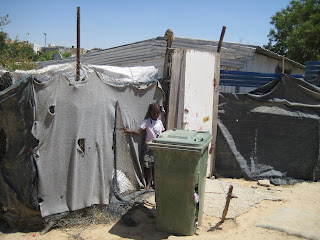
As we drove through Rahat, we also were exposed to the layers of social division and tribal differences within the Bedouin culture. The black Bedouins - orinngally from Sudan and Egypt - are the lowest class. They live in tin shanties sitting on dusty clearings. The children were barefoot, the yard of homes surrounded by barbed wire. Up on a hill, a few meters above the poor neighborhoods, were large villas. In those homes, we were told, lived smaller families of wealthy Bedouins - the lawyers, and other professional of Rahat whose homes literally overlooked the slums of the the city from above a stark, daunting fence. Our guide informed us (after apologizing if he seemed racist) that the black Bedouins tend to be lazy and don;t work, thus explaining their higher poverty rates.
I couldn't help but think back to Ladakh, in India. There, too, the encroaching globalization and modernization had changed the way of life for small villagers. While the modern era has brought cell phones and satellite dishes to remote groups of people it has also destroyed the ability of these groups to live self-sustainably. Their former way of life as nomads isn't possible in modern Israel, and thus they are forming more permanent settlements and facing new problems of modernity - homelessness, drug use, unemployment and increasing domestic violence. Of course the "old way of life" had its problems too, I am sure, and the museum made it clear that the Bedouin life had always been challenging and very divided by gender and tribe.
Our last stop was at the 'unrecognized town' where the manager of the community center lives. We drove around for another 45 minutes or so looking for the place, and finally pulled up a dusty road to the community gathering room. Our bus pulled up beside an outhouse and we were directed into a room lined with cushions and mattresses. We waited about 10 minutes for children to bring us platters piled high with fresh fruit and pastries. Only after we ate and drank did the presentation begin.
We were introduced to the village leader - a man who had served 28 years in the Israeli army and is the holds the highest rank ever achieved by a Bedouin. He told us about the problems of the village which has 11,000 residents. For years, he has been trying to get the Israeli government to recognize the town. They don't want to put in the financial commitment of suppling the settlement with water, electricity or schools. The residents have offered to give up 2/3 of their 15,000 dinams of land in exchange for recognition, but the government still declines.
The government wants them to relocate to already established towns, such as Rahat. The leader pointed out, however, that there are several reasons why the local community does not want to move. They are a different tribe than the reisdents in the cities, and the relationships between different Bedouin groups are not always good. Furthermore, they have been in this settlement for over a generation and do not wnat to leave behind their home or their more rural lifestyles. Finally, they have much less crime and drug problems than a city such as Rahat and they do not want to raise their families among the rpoblems of the urban areas.
In spite of their arguments in favor of obtaining status and their assurance that they will pay taxes, become educated, join the military and generally add to Israeli society, the government requried that they prove that there are at least 800 families
in the town. They lack this number, and are also aware that for Jewish settlements, only a few dozen families or less are necessary in order to obtain government recognition.
All in all, the day was fascinating. There is a clear dearth of nonprofit organizations working in this community and a great deal of need. The problems the Bedouins face are typical of a minority group that is being affected by modernization, overpopulation, under-education and general neglect. Of course the problems are complicated, but I think by visiting the community and learning about it, all Israelis and tourists in Israel can help get a more realistic view of the variety of existence in this country.
PICTURES:
1. Rahat - contrasting neighborhoods
2. Rahat - child in front of her home
3. Unrecognized Village


As we walked through the seedier neighborhoods of Tel Aviv, i didn't know what to expect from the evening, nor was I particularly mollified when we walked into the smoky club.
However!
In contrast to the dingy surroundings, the unassuming man on center stage was singing with a voice, a passion, a rare talent and a tenderness that were completely captivating. I have been to more than a few concerts - but this one was special, unforgettable even. With a backup entourage of four musicians and plus a female vocalist, plus lights, and smoke - Idan was still able to snag and maintain everyone's attention. The other musicians - also talented - faded into the background as Idan sang his own creations. Tender, smart songs that ranged from romantic, to introspective to lively and fun.
Ori and I agree - he will be a star. And when we told him so after the show, he humbly thanked us and told that he does not yet have a CD. I wished him good luck, and then assured him he wouldn't need it...
Bedouin Field Trip
Today, we went with our colloquium class to the south of Israel. We spent the day learning about the Bedouin tribes of the Negev Desert. In spite of the logistical nightmares that ensued - unordered buses, lack of directions etc..., we had an incredible experience.
Our group had seven students and we were accompanied by Erez, a young security guard who was very nice, but slept during the long drives in the van. *As we all did, I should add!* Our first stop was at the Bedouin Museum, named (inexplicably) for a forger Israeli pilot named Joe Alon.
The Bedouins are named after the Arabic word for "desert." The museum depicts their life as it was until about 50 years ago - nomadic, tribal based, tent-dwelling. The Bedouins survived off their herds of goats, and some camels - using their bounty for food, clothing and shelter. Today, as I have seen on some of my hikes, many Bedouins still live in the traditional way. Saudi Arabia is mostly Bedouin as is the Sinai Desert. Tribes wander throughout Jordan and make up a large percentage of the population in southern and northern Israel.
In the Negev Desert, with modernization and political agendas squeezing the nomads from all sides, they, too, have begun to settle in permanent communities.
We stopped next in the huge Bedouin city of Rahat. There, we went to the community center, dedicated to encouraging and helping young Bedouins to attend college.
Throughout the day, the people we met expressed the same themes over and over again. On a positive note, the Bedouin are reputed for their hospitality - tea, and copious food (pita, desserts, fruit) was served to us, as it would be to any guest. Even in the midst of the desert, a wandering stranger would receive 3 days of hospitality- no questions asked. We stopped at a roadside convenience store for drinks, and the clerk there insisted on giving our whole group free drinks. Most of us paid anyway, suggesting they give the money to charity instead. The Bedouins of southern Israel have a surprisingly high level of school attendance. They also volunteer for the Israeli army at high rates.
Still, problems are rampant - in Rahat, the major Bedouin 'metropolis' unemployment is 54%. It is worse in other cities and villages.
There are drug problems from the goods smuggled into Israel from across the Sinai in Egypt. Violence is increasing in the major cities and many Bedouins live in unrecognized communities. These residents have no access to facilities for water, electricity or decent schooling. They do have citizenship, however, and free health care.
Polygamy (although illegal in Israel) is still widely practiced and culturally accepted among the Bedouin. Having several wives means that many Bedouin nuclear families can have as many as 60 or more members!
As we drove through Rahat, we also were exposed to the layers of social division and tribal differences within the Bedouin culture. The black Bedouins - orinngally from Sudan and Egypt - are the lowest class. They live in tin shanties sitting on dusty clearings. The children were barefoot, the yard of homes surrounded by barbed wire. Up on a hill, a few meters above the poor neighborhoods, were large villas. In those homes, we were told, lived smaller families of wealthy Bedouins - the lawyers, and other professional of Rahat whose homes literally overlooked the slums of the the city from above a stark, daunting fence. Our guide informed us (after apologizing if he seemed racist) that the black Bedouins tend to be lazy and don;t work, thus explaining their higher poverty rates.
I couldn't help but think back to Ladakh, in India. There, too, the encroaching globalization and modernization had changed the way of life for small villagers. While the modern era has brought cell phones and satellite dishes to remote groups of people it has also destroyed the ability of these groups to live self-sustainably. Their former way of life as nomads isn't possible in modern Israel, and thus they are forming more permanent settlements and facing new problems of modernity - homelessness, drug use, unemployment and increasing domestic violence. Of course the "old way of life" had its problems too, I am sure, and the museum made it clear that the Bedouin life had always been challenging and very divided by gender and tribe.
Our last stop was at the 'unrecognized town' where the manager of the community center lives. We drove around for another 45 minutes or so looking for the place, and finally pulled up a dusty road to the community gathering room. Our bus pulled up beside an outhouse and we were directed into a room lined with cushions and mattresses. We waited about 10 minutes for children to bring us platters piled high with fresh fruit and pastries. Only after we ate and drank did the presentation begin.
We were introduced to the village leader - a man who had served 28 years in the Israeli army and is the holds the highest rank ever achieved by a Bedouin. He told us about the problems of the village which has 11,000 residents. For years, he has been trying to get the Israeli government to recognize the town. They don't want to put in the financial commitment of suppling the settlement with water, electricity or schools. The residents have offered to give up 2/3 of their 15,000 dinams of land in exchange for recognition, but the government still declines.
The government wants them to relocate to already established towns, such as Rahat. The leader pointed out, however, that there are several reasons why the local community does not want to move. They are a different tribe than the reisdents in the cities, and the relationships between different Bedouin groups are not always good. Furthermore, they have been in this settlement for over a generation and do not wnat to leave behind their home or their more rural lifestyles. Finally, they have much less crime and drug problems than a city such as Rahat and they do not want to raise their families among the rpoblems of the urban areas.
In spite of their arguments in favor of obtaining status and their assurance that they will pay taxes, become educated, join the military and generally add to Israeli society, the government requried that they prove that there are at least 800 families
in the town. They lack this number, and are also aware that for Jewish settlements, only a few dozen families or less are necessary in order to obtain government recognition.
All in all, the day was fascinating. There is a clear dearth of nonprofit organizations working in this community and a great deal of need. The problems the Bedouins face are typical of a minority group that is being affected by modernization, overpopulation, under-education and general neglect. Of course the problems are complicated, but I think by visiting the community and learning about it, all Israelis and tourists in Israel can help get a more realistic view of the variety of existence in this country.
PICTURES:
1. Rahat - contrasting neighborhoods
2. Rahat - child in front of her home
3. Unrecognized Village


Tuesday, June 10, 2008
First of all...I know it's been awhile, but no one event has seemed that interesting.Granted, the two weddings of two of my closest friends in the US were certainly UNFORGETABLE, precious occasions, but I am not sure how interesting they are to "my readership." (that's all 5 of you, mom, dad, etc...!)
The biggest news in my life happened today: I am officially a GERMAN! More importantly, I am a real, live European citizen... and it feels great. A little bit like cheating - since I've spent all of 3 weeks there and I don't speak the language- but exhilarating none the less. The windows of opportunity feel wide open to me, the glass of borders smashed; I sort of feel like my own view of myself as citizen of the
"world" is official. Of course that is a nauseatingly closed-minded and western-centric attitude...but I'll bask in this feeling for at least 24 hours nonetheless!
Other news...I move to Tel Aviv this week! Come and visit us near Shuk HaCarmel - and a few blocks from the beach! We have an extra bedroom :)
On to more interesting stories...
Israel had a 4-day weekend in honor of Shavuot (a holiday marking the giving/receiving of the Ten Commandments at Sinai) I celebrated in the wilderness - which I feel is very fitting. (And also with the customary sweet, dairy foods that are eaten on Shavuot. Ori's mom made AMAZING blintzes, and even let us take the leftovers! :)
Thursday night I went to two weddings here and then woke up a few hours later to take a bus up to the most northern part of Israel.
THE GOLAN HEIGHTS:
The Golan is in the north of Israel, to the east of the Jordan River. From its heights we could view Syria, Lebanon, and the finger of the Galilee (the region of Israel that is to the west of the Jordan River.) Beginning up North near Har Dov, with Mount Hermon in site, we spent 4 days wandering, trail blazing, fence hopping, jungle crawling, bushwacking, berry picking, river crossing, swimming and generally crisscrossing the territory as we headed mostly south towards Lake Kinneret.
I learned two Hebrew words this week, although sharing them hardly represents the amazing, breathtaking, memorable experience of the weekend. Still, it's only fair:
בֹּץ - "botz" - mud
מוֹקֵשיםׁ - "moksheem" - landmines
The weekend began with a word of advice from our incredibly knowledgeable guide. The Golan is filled with landmines (something I never knew...) that are left over from the time before 1967 when Syria controlled the territory. There are many, many barbed wire fences posted with warnings about the mines... but Sharon (the guide) also taught us how to distinguish between the metal fence posts used by the Israeli army and those used by Syria. (It's all in the shape of the tiny groves that hold the barbed wire in place.) Although the threat was scary in principle, on the trail it was not a major issue. The mine fields were clearly marked and we walked close together in a single file line. (No mom, I was not in front.) At some points the cleared path was narrow and steep, but certainly passable.
The first day was probably the most remote. The hilly landscape was scattered with beautiful but thorny flowers - purple, blue balls of spikes atop long, thick stems. There were also poppies and other various wild flowers. There were fewer hikers than on a typical weekend, so we went as one group. This meant - much to my advantage! - that the pace was not nearly as challenging as the previous hikes I have done with this group. I got, over the weekend, the worst blisters I have ever had. They plagues me throughout the trek, and , to be honest, put a damper on the entire expreience. I don't at all regret going, but I am busy wondering what exactly I should do about my hiking boots in Turkey next month.
Okay, between thorns, landmines and blisters, I know I am not painting a pretty picture. Let me explain...
First of all, just being in this much argued-over territory, and seeing its geography first hand helped to enhance my understanding of the place. It is lush and green and bursting with fertile fruit trees, agriculture and endless tiny springs. There were lots of cattle, chewing happily or grazing, feeding their young, or lying down, basking in the sunny breeze and swatting at the flies with their tails. We watched a small deer as she pranced across a sloping field and then "did her business," while hiding modestly under one of the few shade-granting trees. She skipped off happily afterwards, never seeming to take note (or care) of our presence.
More soon...
This is just the beginning!
The biggest news in my life happened today: I am officially a GERMAN! More importantly, I am a real, live European citizen... and it feels great. A little bit like cheating - since I've spent all of 3 weeks there and I don't speak the language- but exhilarating none the less. The windows of opportunity feel wide open to me, the glass of borders smashed; I sort of feel like my own view of myself as citizen of the
"world" is official. Of course that is a nauseatingly closed-minded and western-centric attitude...but I'll bask in this feeling for at least 24 hours nonetheless!
Other news...I move to Tel Aviv this week! Come and visit us near Shuk HaCarmel - and a few blocks from the beach! We have an extra bedroom :)
On to more interesting stories...
Israel had a 4-day weekend in honor of Shavuot (a holiday marking the giving/receiving of the Ten Commandments at Sinai) I celebrated in the wilderness - which I feel is very fitting. (And also with the customary sweet, dairy foods that are eaten on Shavuot. Ori's mom made AMAZING blintzes, and even let us take the leftovers! :)
Thursday night I went to two weddings here and then woke up a few hours later to take a bus up to the most northern part of Israel.
THE GOLAN HEIGHTS:
The Golan is in the north of Israel, to the east of the Jordan River. From its heights we could view Syria, Lebanon, and the finger of the Galilee (the region of Israel that is to the west of the Jordan River.) Beginning up North near Har Dov, with Mount Hermon in site, we spent 4 days wandering, trail blazing, fence hopping, jungle crawling, bushwacking, berry picking, river crossing, swimming and generally crisscrossing the territory as we headed mostly south towards Lake Kinneret.
I learned two Hebrew words this week, although sharing them hardly represents the amazing, breathtaking, memorable experience of the weekend. Still, it's only fair:
בֹּץ - "botz" - mud
מוֹקֵשיםׁ - "moksheem" - landmines
The weekend began with a word of advice from our incredibly knowledgeable guide. The Golan is filled with landmines (something I never knew...) that are left over from the time before 1967 when Syria controlled the territory. There are many, many barbed wire fences posted with warnings about the mines... but Sharon (the guide) also taught us how to distinguish between the metal fence posts used by the Israeli army and those used by Syria. (It's all in the shape of the tiny groves that hold the barbed wire in place.) Although the threat was scary in principle, on the trail it was not a major issue. The mine fields were clearly marked and we walked close together in a single file line. (No mom, I was not in front.) At some points the cleared path was narrow and steep, but certainly passable.
The first day was probably the most remote. The hilly landscape was scattered with beautiful but thorny flowers - purple, blue balls of spikes atop long, thick stems. There were also poppies and other various wild flowers. There were fewer hikers than on a typical weekend, so we went as one group. This meant - much to my advantage! - that the pace was not nearly as challenging as the previous hikes I have done with this group. I got, over the weekend, the worst blisters I have ever had. They plagues me throughout the trek, and , to be honest, put a damper on the entire expreience. I don't at all regret going, but I am busy wondering what exactly I should do about my hiking boots in Turkey next month.
Okay, between thorns, landmines and blisters, I know I am not painting a pretty picture. Let me explain...
First of all, just being in this much argued-over territory, and seeing its geography first hand helped to enhance my understanding of the place. It is lush and green and bursting with fertile fruit trees, agriculture and endless tiny springs. There were lots of cattle, chewing happily or grazing, feeding their young, or lying down, basking in the sunny breeze and swatting at the flies with their tails. We watched a small deer as she pranced across a sloping field and then "did her business," while hiding modestly under one of the few shade-granting trees. She skipped off happily afterwards, never seeming to take note (or care) of our presence.
More soon...
This is just the beginning!
Sunday, April 06, 2008
Following my wild week in the wilderness, I spent the next few days in elegant company, wearing suits and cocktail dresses in wedding halls, fancy hotels and the homes of dignataries!
What a week I had - a time when I feel once again that I am so unbelievably blessed - a time that makes me want to turn to the little guardian angel on my shoulder and hug him until he nearly bursts. Life is incredibly, and I feel almost guilty at the continuous stream of good fortune that is spilling forth into mine.
On Saturday and Sunday, I attended a conference sponsored by Tel Aviv University on Faith and International Development. There were about 100-150 attendees from non profit organizations in Israel and abroad. It was an amazing opportunity and experience to be able to talk with the heads of so many organizations that I admire. IT gave me enormous hope and excitement that so many faith based organization are working to improve the lives of people far beyond their immediate community circles. In a year, when (god willing!) I have my degree, it seems there will be many amazing options for me...
At the conclusion of that conference, I has the bus drop my off at the President's House in Jerusalem for Conference Two! This conference, of the Jewish Funders Network was aboslutely impressive, even from the vantage point of a mere volunteer. In one room were gathered a powerhouse of Jewish philanthropists seeking ideas and opportunities to set the direction of the Jewush people on the coming years. The creators of Birthright, of Table to Table, and many other international organizations were together, networking, creating ideas, sharing best practices, admitting and examining failures. President Perez spoke in a near-perfect English, without notes, and was inspiring and wise. I hesitate to say more out of respect for the attendees, but it was increible, interesting, exciting.... They conference truly impressed me as more than a shmoozing of celebrity and a sharing of fancy clothes and delicious food. That was all there, but the purpose behind the conference held a premium and the attendees fought for standing room in the many workshops and lectures that were offered. Everyone wore their nametags and chatted diligently with people who had stickers marking common interests. (For example, a blue sticker might indicate an interest in health care and a purple in Zionism...)
Along with a woman I study with, I handed out translation headphones and helped direct people around the hotel. After two days, some of the attendees even knew who we were and why we were there!
------------
Thursday we had a guest lecturer come and speak about the relationship between altruistic behavior and genetics. It was fascinating and a bit refreshing to be debating about science, about nature vs. nurture instead of about our more typical arguments related to the nonprofit world.
----------------
THE ISRAELI WEDDING
Following class, I made my way through the Thursday evening weekend rush at the Central Jerusalem Station and hopped a bus to Tel Aviv. From Ori's house, we drove north to Kadima (near my former digs in Hod HaSharon!) and went to my first Israeli wedding!
Orthodox or Secular, Jewish or Muslim, weddings in Israel are known to be must-see events. AS in any culture, I suppose, they are filled with traditions and customs typical only to the local population. Many of them seem "oh so Jewish" and shed light on the underlying values of the society. Others are just humurmous, unusual or exciting for the foreign spectator.
Thursday was the wedding of longtime friend of Ori's so I knew some of the guests there from his hometome crew of friends.
AS we entered the enormous and lavishly decorated complex, we parked in a lot filled with hundreds of cars (Think of a mall parking lot!)
Custom 1: The wedding present
In Israel, there are no gift registries, no engagement presents, no hours of hemming and hawing over gift options. You give money, and to do otherwise can be seen as bad taste. You give according to the estimated price of your attendance at the event, plus more if you are close. At the entrance to the party, there was a table of envelopes. Each guest seals their check in an envelope, scribbles a quick message on the outside and shoves it into one of the safes stationed nearby. Then, the frenzy begins.
Custom 2: The cocktail frenzy
The cocktail hour was lavish. There were HUNDREDS of people, (really HUNDREDS!) and we bagan drinking and eating furiously before the end of the shmoozing period. It was outdoors, and the catering hall had beautiful flowers and (I think) a fountain in the middle.) In spite of his longtime acquaintance with the groom, Ori knew a very small percentage of the guests.
Custom 3: The Ceremony
An announcement was made over a loudspeaker that the ceremony was about to begin. The food stations closed down and even the bartenders got a break. The DJ pumped up the music and we all gathered around the huppah that (I am sorry) really reminded me of the set of a music video. The event was, by no exaggeration, a production. There were sexy violinists dressed in tight, chinzy dressed who accompanied the blasting, eleectronic music. The huppas was two long sheets of white cloth lit by an ensemble of lighting that must have been conjured up by a lighting designer and engineer.
We gathered nearby the "stage" but did not sit. The crowd's roar lowered slightly to a din and a few people turned their heads to watch the bride waltz down the aisle. A beautiful woman, who works at a gym, the dress was oh-so-Israeli too. Its design was clearly intended to accentuate the hips, just like every pair of jeans I've tried to buy in this country!
The chasedic Rabbi looked anachronistic on stage with his black suit and tall black hat. He mumbled some prayers to a smattering of Amens, but as the ceremony continues, most of the audience (i mean guests) were busy chatting, smoking cigarettes or gazing watching the scene with an air of nonchalence. Two good friends of the groom were chosen to set off fire crackers on Confetti after the groom broke the glass, and with that, the party began. the music pumped up and we all filtered inside accompanied by techno, jazzy violinisits and a light show that led us to the dance floor.
THE PARTY:
We were seated at an enormous table beside the dance floor. (Of note - I was truly impressed that we all had placecards! It must be an incredible task to try and write hundreds of place cards and table arrangements for this size of an event!) The flowers, lighting and centerpieces were spectacular. There were salads, wine and bread on the table, and throughout the night food arrived and was cleared mostly without time to eat it (or even notice its presence on our table.) We danced, drank, chatted a bit and generally enjoyed the party. By about 1am, it was clearing out, and we headed home tired. It was certainly impressive and a good time, but different from the sort of wedding I imagine for myself, and certainly a far cry from what I expect these next few weeks at the weddings of two of my closest friends.
On Wednesday, we are going to another wedding here in Israel. My research will be more conclusive with a bigger sample size!
What a week I had - a time when I feel once again that I am so unbelievably blessed - a time that makes me want to turn to the little guardian angel on my shoulder and hug him until he nearly bursts. Life is incredibly, and I feel almost guilty at the continuous stream of good fortune that is spilling forth into mine.
On Saturday and Sunday, I attended a conference sponsored by Tel Aviv University on Faith and International Development. There were about 100-150 attendees from non profit organizations in Israel and abroad. It was an amazing opportunity and experience to be able to talk with the heads of so many organizations that I admire. IT gave me enormous hope and excitement that so many faith based organization are working to improve the lives of people far beyond their immediate community circles. In a year, when (god willing!) I have my degree, it seems there will be many amazing options for me...
At the conclusion of that conference, I has the bus drop my off at the President's House in Jerusalem for Conference Two! This conference, of the Jewish Funders Network was aboslutely impressive, even from the vantage point of a mere volunteer. In one room were gathered a powerhouse of Jewish philanthropists seeking ideas and opportunities to set the direction of the Jewush people on the coming years. The creators of Birthright, of Table to Table, and many other international organizations were together, networking, creating ideas, sharing best practices, admitting and examining failures. President Perez spoke in a near-perfect English, without notes, and was inspiring and wise. I hesitate to say more out of respect for the attendees, but it was increible, interesting, exciting.... They conference truly impressed me as more than a shmoozing of celebrity and a sharing of fancy clothes and delicious food. That was all there, but the purpose behind the conference held a premium and the attendees fought for standing room in the many workshops and lectures that were offered. Everyone wore their nametags and chatted diligently with people who had stickers marking common interests. (For example, a blue sticker might indicate an interest in health care and a purple in Zionism...)
Along with a woman I study with, I handed out translation headphones and helped direct people around the hotel. After two days, some of the attendees even knew who we were and why we were there!
------------
Thursday we had a guest lecturer come and speak about the relationship between altruistic behavior and genetics. It was fascinating and a bit refreshing to be debating about science, about nature vs. nurture instead of about our more typical arguments related to the nonprofit world.
----------------
THE ISRAELI WEDDING
Following class, I made my way through the Thursday evening weekend rush at the Central Jerusalem Station and hopped a bus to Tel Aviv. From Ori's house, we drove north to Kadima (near my former digs in Hod HaSharon!) and went to my first Israeli wedding!
Orthodox or Secular, Jewish or Muslim, weddings in Israel are known to be must-see events. AS in any culture, I suppose, they are filled with traditions and customs typical only to the local population. Many of them seem "oh so Jewish" and shed light on the underlying values of the society. Others are just humurmous, unusual or exciting for the foreign spectator.
Thursday was the wedding of longtime friend of Ori's so I knew some of the guests there from his hometome crew of friends.
AS we entered the enormous and lavishly decorated complex, we parked in a lot filled with hundreds of cars (Think of a mall parking lot!)
Custom 1: The wedding present
In Israel, there are no gift registries, no engagement presents, no hours of hemming and hawing over gift options. You give money, and to do otherwise can be seen as bad taste. You give according to the estimated price of your attendance at the event, plus more if you are close. At the entrance to the party, there was a table of envelopes. Each guest seals their check in an envelope, scribbles a quick message on the outside and shoves it into one of the safes stationed nearby. Then, the frenzy begins.
Custom 2: The cocktail frenzy
The cocktail hour was lavish. There were HUNDREDS of people, (really HUNDREDS!) and we bagan drinking and eating furiously before the end of the shmoozing period. It was outdoors, and the catering hall had beautiful flowers and (I think) a fountain in the middle.) In spite of his longtime acquaintance with the groom, Ori knew a very small percentage of the guests.
Custom 3: The Ceremony
An announcement was made over a loudspeaker that the ceremony was about to begin. The food stations closed down and even the bartenders got a break. The DJ pumped up the music and we all gathered around the huppah that (I am sorry) really reminded me of the set of a music video. The event was, by no exaggeration, a production. There were sexy violinists dressed in tight, chinzy dressed who accompanied the blasting, eleectronic music. The huppas was two long sheets of white cloth lit by an ensemble of lighting that must have been conjured up by a lighting designer and engineer.
We gathered nearby the "stage" but did not sit. The crowd's roar lowered slightly to a din and a few people turned their heads to watch the bride waltz down the aisle. A beautiful woman, who works at a gym, the dress was oh-so-Israeli too. Its design was clearly intended to accentuate the hips, just like every pair of jeans I've tried to buy in this country!
The chasedic Rabbi looked anachronistic on stage with his black suit and tall black hat. He mumbled some prayers to a smattering of Amens, but as the ceremony continues, most of the audience (i mean guests) were busy chatting, smoking cigarettes or gazing watching the scene with an air of nonchalence. Two good friends of the groom were chosen to set off fire crackers on Confetti after the groom broke the glass, and with that, the party began. the music pumped up and we all filtered inside accompanied by techno, jazzy violinisits and a light show that led us to the dance floor.
THE PARTY:
We were seated at an enormous table beside the dance floor. (Of note - I was truly impressed that we all had placecards! It must be an incredible task to try and write hundreds of place cards and table arrangements for this size of an event!) The flowers, lighting and centerpieces were spectacular. There were salads, wine and bread on the table, and throughout the night food arrived and was cleared mostly without time to eat it (or even notice its presence on our table.) We danced, drank, chatted a bit and generally enjoyed the party. By about 1am, it was clearing out, and we headed home tired. It was certainly impressive and a good time, but different from the sort of wedding I imagine for myself, and certainly a far cry from what I expect these next few weeks at the weddings of two of my closest friends.
On Wednesday, we are going to another wedding here in Israel. My research will be more conclusive with a bigger sample size!
Monday, March 31, 2008


If you read one entry in this blog, let it be this one...
If a more eventful, exciting weekend ever happens to me, I have trouble imagining what it could possibly entail...
This story is one for Hollywood films, maybe even Bollywood. It includes soldiers, weapons, special effects, politics. There's the required blood and guts, the teeth clenching moments of danger, the posh lives of rich and famous celebrities and notables parading around in cocktail dressed and plastic faces. This story is one about potential and opportunity - moments that could have been tragic, opportunities that presented themselves unexpectedly. And somehow, amazing, this story is true, and it all happened this weekend.
I promise to TRY not to embellish, because really the facts speak for themselves...
After two months or Urban life, I needed some time in the wilderness. Chug Elad, the hard core hiking group that I had been introduced to in January, was hosting another hike. One core attraction to the group is that by going in large numbers, the group is able to hike in places that would be dangerous or inaccessibly to solo hikers. Ori told me we were going to the Shomron; in fact, he probably told me this three times. Somehow I thought this was like the Sharon - a geographical area in the center-west of the country. Somehow, in 6 months here, I had never learned that Shomron, in fact, means West Bank. Okay, so we were spending the weekend in the Occupied Territories. I've been there before, we're a large group, sababa.
My first shock came when I found out that many of the hikers had decided to take the precaution of bringing handguns with them. Some of my friends were carrying their registered weapons. Now, this is one of this typical Israeli experiences that I still have not become accustomed to.
Anyway, we arrived and began our hike near Ramallah. Ori and I went with the fast group who tends to head off in a rush with very few stops and a speed that impedes side conversation. After a few hours of hiking through the cliffs, we stopped overlooking a beautiful wadi and enjoyed our breakfast. We tended to lag near the back of the group, caught up in conversations and slowed by my more modest pace.
Sometime before lunch, (around 10:45 AM), a woman told us to catch up with the group. We were entering a more risky area and were advised to stick together and be alert. Just then, the zipper on my bag burst apart, sending its contents on a short journey. Eager to keep up with the group, we carried on with my bag in poor shape. We were entering a valley surrounded on all sides by high, rocky hills. With the bag held closed in my teeth, I used my arms to climb my way up the rocks and toward to the peak.
Just then, we heard another group member announce that someone had fallen and broken a leg. Being a Wilderness First Responder, I had an obligation to act. I tossed my bag on the ground and made my way carefully down to the patient.
The man who had fallen was in his 60s, in good shape. He was alert, calm and able to tell me about his fall. He had slipped about a meter and a half, landed for a moment, and then fallen again. His right ankle was twisted back, the bone jutting out just above the top, inside of his shoe. There was a little blood, but it was hard to determine its source. I debated for a bit with the other medic present, but we eventually decided that we had to see remove his sneaker in order to see the injury more clearly. Unable to keep his leg stable while we removed his shoe, Ori proceeded to cut apart the hiking boot in order to give us access to the injury.
It was about 11:30 at this time and the sun was relentless. No shade could be found and we had eaten breakfast quite early. Two hikers helped us shade the patient with an old blanket and we encouraged him to drink as much water as possible.
The injury exposed, we found the source of the bleeding and bandaged it tightly. Meanwhile, someone had long ago called the paramedics, search and rescue, the Red Cross (Called Magen David Adom in Israel) and the army. We were told that our location was too close to Ramallah and that the army did not want to risk sending a helicopter,
After about an hour in the sun, with the patient calm and lucid with a stable pulse, the first paramedic arrived...without morphine or other painkillers. From about a kilometer above us where cars were able to access, several medical personnel began climbing down the rocks towards us, each carrying medical equipment and automatic weapons.
It took about 7 medical professionals and volunteers to final realize that even with the three different types of stretchers they had brought down, it would be impossible and risky to carry carry the patient up and out of the valley. The going was steep and rocky, and his leg had to remain stable. The helicopter was called in again; this time the army agreed to come in about a half an hour.
With a one minute warning for the arrival of the helicopter, we scrambled to find a safe spot on solid ground. Even the wife of the injured man was bemoaning her lack of a camera! WE heard the machine before we saw it. . , and then from beyond the edge of one the mountains, an enormous, sleek black helicopter floated toward us. The wind swirled furiously, picking up bits of debris, dust, hats and forgotten trash. The helicopter circled a few times, trying to negotiate the least dangerous descent toward the injured man. Images of the film "Black Hawk Down" flashed before my eyes, and Ori confirmed that the copter was in fact a Black Hawk from the 669 Airforce Unit of the Israeli Army. AS it hovered near the ground, a panel in the bottom slid open, and four soldiers descended on a retractable metal cord. Wearing helmets and uniforms, and bearing huge machine guns, they carried medical supplies as they clung to the rope from the teetering black bird and jumped to the ground beside the patient.
Ori, unable to stand his own and my disappointment and the total absence of film, raced straight up the hill to retrieve his camera from the vehicles parked a kilometer above us. His friend doubted his ability to get back before the patient was evacuated, but we were lucky... the copter had to make three descents and we were able to photograph the final one where two soldiers accompanied the patient as his stretcher was lifted into the helicopter on the metal rope.
The spectacle complete, the Bedouin spectators dispersed and we regrouped at the top of the hill. It was now 2:15 and we had to walk quickly to reach our campsite before dark. We were hungry and drained from the sun, but we had to hike nearly three hours before we found a shady spot to eat.
There were about 7 or 8 of us walking together with a guide and the small group had a nice, communal feel. As we approached a road, we stayed close together and put Diego, our four legged group member, on a leash. Along the road, we were a bit tentative as we passed a group of three or four Palestinian men. They were friendly with us, however, with that overly anxious expressions of friendship and kindness that so frequently typify this sort of meeting. They asked for a bottle of our water which we eagerly offered and we joked about them joining us for the hike. As we said our "salaams" (us) and "Shaloms" (them), they called after us a final wish: "We hope no one throws stones at you."
The rest of the day finished with little notable events of this sort. We hiked through the beautiful hills, along the rocky dried river wadis and to a settlement called Rimonim. I wasn't that thrilled to be sleeping in a settlement, but given our location, the options were limited. Ori and I stayed out in the desert for awhile watching the sunset along the desert scape, scattered by Bedouin tents, Palestinian villages and a dew Jewish settlements.
The next day, we awoke early. Ori brought me coffee and biscuits in the tent and then we packed up the tents and headed back into the desert. We hiked through fields of endless wildflowers, dotted with red poppies and yellow, white and purple flowers that I couldnt name. There were thorny purple cactus blossoms, and giant black flowers looking like velvet that trapped bugs deep inside their grip.
We passed Bedouin tent villages and herds of sheep and goats. At one point, our fried Assaf stopped to chat with a group of boys on their way to school. It seemed hard to imagine that a school existed within walking distance! The boys ranged in age from four or five to maybe 16 or older. They had some textbooks with them, and ASsaf leafed through them, reading chapter titles about biology and chemistry.
We began a long descent. Waling down through the desert wash, the sides of the caves rose on either side of us and at times we proceeded extremely carefully along steep cliffs of loose scree and slippery edges. Partway down, we entered a cave, formerly home to monks and pilgrims. In one cave, we slithered deep inside using head lamps to light our way as we crawled from room to room. The ground was covered with deep, soft ashy material and probably a lot of bat feces! At one point, my fellow explorers went off to search for another tunnela nd I was left alone in a cavernous room to contemplate the utter darkness and the swirling bats around me. It was amazing.
Lacking futher tunnels to explore, stifled by the heat of the cave (and Ori less than thrilled that a bat had mistaken him for a wall...) we made our way back out and searched for a cozy lunch spot. We found one amid the sides of the cliff. A few of us ate together, sharing hummous, vegetables, olives and pita.
I am beginning to love this group of hikers more and more, in spite of my conern about their lack of preparedness in the emergency. (If I go again, Im bringing medical equipment!) Noentheless, the group is filled with such fascinating, eclectic people with stories to tells and many lives lived. In spite of the fierce individualism and independent spitit that typifies the group, i feel very much supported and cared for there.


Tuesday, March 18, 2008
At long last (and one month into second semester), first semester has come to a close. I handed in my last seminar paper and feel as free as a person possibly can while still juggling this semester's classes, work, Hebrew etc...
No complaints though. In spite of how hard I've been working, things are still fabulous here. The weather has been amazing - beach days and picnics on the grass - meals on the porch, flip flops, flowers. I am living alone now in my apartment and spending a lot of time on my herb and flower gardens.
While I have no remarkable adventures to report on, there have been a lot of nice times, mostly involving the sea and Tel Aviv.
2 weeks ago, I spent shabbat in Tel Aviv with my sister, Sarah, and some other friends from here. We stayed with a woman named Zoe and cooked delicious vegan food that we enjoyed while sitting in a circle on her carpet. We reflected on the week and enjoyed some quality female time together.
Then... My friend Sara called to tell me she was riding on a yacht in Herzilia - with some mutual friends of ours... and Ori, Sarah and I were welcome to come along! We raced up to the port - about 20 minutes away. I had never been there. It is a beautiful place full of swanky stores, nice restaurants and endless boats and yachts. We hopped aboard a yacht that our friend Nir was borrowing from the yacht club where he works. Eyal, Sara's boyfriend, was skipper. It was a warm, beautiful night and from the water we could spot many of Israel's major coastal cities. The guys with us enjoyed pointing out the landmarks and teaching us a bit about the boat. There was wine and hamantashen to snack on, and we were sad when we had to go back to port...
The next day, after a tumultuous attempt to make pancakes, (That ended up in the creation of a delicious pancake-cake) we spent the day on the beach. All of Israel seemed to be sprawled out along the tayelet (boardwalk) - - it was unseasonably hot and sunny, so Israelis from across the country had descended upon the city. In Tel Aviv, Shabbat is hardly visible...
That night, Ori treated both Sarah and me like princesses, and we enjoyed Thai food and some dancing.
The week was filled with homework and research - not much to report
- other than the cancellation and subsequent rescheduling of my trip to the States next month. I hate Israir airlines!
Last weekend, I basked in the vacation-like feeling that comes from being in Tel Aviv. In spite of all the work I had to do, I managed to enjoy the weekend. Ori and I had a quiet, candle lit dinner on his porch with fresh fruits and vegetables from the shuk. (Artichokes are in season!!!) I took a nighttime stroll on the beach to get air, after too many hours in front of the computer.
Saturday, we had lunch in Caesarea - a city that I barely recall from my past trips to Israel. Along the sea, between Tel Aviv and Haifa, it has a rich history and a reputation for opulence today. It is gorgeous. The houses are large, but unlike the cookie cutter large homes that fill the settlements here. They are not all made of identical Jerusalem stone. They are stucco, tiled, veranda-bearing homes in warm, earthy colors. Each house has a unique design, more reminiscent of old, classy architecture. There are gardens full of fruit trees, with fish ponds and waterfalls. We stopped at the beach to see the 2000-year-old Roman aqueduct and watch the large swells crash against the shore. In the city - home to many notable Israelis - there were country clubs and golf courses and winding lanes named after fruits and flowers.
We had a fantastic meal - far better than most Israeli restaurants - of steak and fresh vegetables. For appetizers, we had fresh sushi made by a neighbor and friend of the family. The family was incredibly warm and a lot of fun... but that's not really blog material :)
I spent all day Sunday at a cafe working on my paper which (I am so happy to report) was handed in at 10:58 PM - 1 hour and 2 minutes early!!!!
This week, everyone is busy preparing for Purim, a Jewish holiday that is marked with costumes, cookies and copious amounts of alcohol. Everyone eats triangle-shaped cookies and even our teacher was handing them out!
Last night, we had an engagement party for a woman in my class.
That's all for now!
No complaints though. In spite of how hard I've been working, things are still fabulous here. The weather has been amazing - beach days and picnics on the grass - meals on the porch, flip flops, flowers. I am living alone now in my apartment and spending a lot of time on my herb and flower gardens.
While I have no remarkable adventures to report on, there have been a lot of nice times, mostly involving the sea and Tel Aviv.
2 weeks ago, I spent shabbat in Tel Aviv with my sister, Sarah, and some other friends from here. We stayed with a woman named Zoe and cooked delicious vegan food that we enjoyed while sitting in a circle on her carpet. We reflected on the week and enjoyed some quality female time together.
Then... My friend Sara called to tell me she was riding on a yacht in Herzilia - with some mutual friends of ours... and Ori, Sarah and I were welcome to come along! We raced up to the port - about 20 minutes away. I had never been there. It is a beautiful place full of swanky stores, nice restaurants and endless boats and yachts. We hopped aboard a yacht that our friend Nir was borrowing from the yacht club where he works. Eyal, Sara's boyfriend, was skipper. It was a warm, beautiful night and from the water we could spot many of Israel's major coastal cities. The guys with us enjoyed pointing out the landmarks and teaching us a bit about the boat. There was wine and hamantashen to snack on, and we were sad when we had to go back to port...
The next day, after a tumultuous attempt to make pancakes, (That ended up in the creation of a delicious pancake-cake) we spent the day on the beach. All of Israel seemed to be sprawled out along the tayelet (boardwalk) - - it was unseasonably hot and sunny, so Israelis from across the country had descended upon the city. In Tel Aviv, Shabbat is hardly visible...
That night, Ori treated both Sarah and me like princesses, and we enjoyed Thai food and some dancing.
The week was filled with homework and research - not much to report
- other than the cancellation and subsequent rescheduling of my trip to the States next month. I hate Israir airlines!
Last weekend, I basked in the vacation-like feeling that comes from being in Tel Aviv. In spite of all the work I had to do, I managed to enjoy the weekend. Ori and I had a quiet, candle lit dinner on his porch with fresh fruits and vegetables from the shuk. (Artichokes are in season!!!) I took a nighttime stroll on the beach to get air, after too many hours in front of the computer.
Saturday, we had lunch in Caesarea - a city that I barely recall from my past trips to Israel. Along the sea, between Tel Aviv and Haifa, it has a rich history and a reputation for opulence today. It is gorgeous. The houses are large, but unlike the cookie cutter large homes that fill the settlements here. They are not all made of identical Jerusalem stone. They are stucco, tiled, veranda-bearing homes in warm, earthy colors. Each house has a unique design, more reminiscent of old, classy architecture. There are gardens full of fruit trees, with fish ponds and waterfalls. We stopped at the beach to see the 2000-year-old Roman aqueduct and watch the large swells crash against the shore. In the city - home to many notable Israelis - there were country clubs and golf courses and winding lanes named after fruits and flowers.
We had a fantastic meal - far better than most Israeli restaurants - of steak and fresh vegetables. For appetizers, we had fresh sushi made by a neighbor and friend of the family. The family was incredibly warm and a lot of fun... but that's not really blog material :)
I spent all day Sunday at a cafe working on my paper which (I am so happy to report) was handed in at 10:58 PM - 1 hour and 2 minutes early!!!!
This week, everyone is busy preparing for Purim, a Jewish holiday that is marked with costumes, cookies and copious amounts of alcohol. Everyone eats triangle-shaped cookies and even our teacher was handing them out!
Last night, we had an engagement party for a woman in my class.
That's all for now!
Monday, February 18, 2008
Greece...
countless miles of coastline, sandy beaches, sipping frappe iced coffees, music filled tavernas, sun bleached white houses accented with blue trimming, ancient ruins nestled in the slopes of mountains.
Greece -
coated with 4 inches of ice, buses, airplanes, highways frozen dead still. Lines of cars snaking for hours along twisting mountain passes, throngs of passengers sleeping in the airport - carrying plastic chairs from one unbudging line to the next, frustrated tourists screaming helplessly at unhelpful airline personnel, tourists and locals alike waiting interminably for an available taxi cab, stores, restaurants, markets and ancient ruins closed as the wind whips through athens and the temperature drops to -7.
okay, so Greece in February (at least this February) may not be exactly what
my mother and I had pictured. Ive been heading here from Israel since 19 months ago when I abandoned a plane ticket I had and stayed on in Jerusalem. My mother has been dreaming of the Greek islands for 40 years. So in spite of the few challenges, we're determined to enjoy our time here. And, in fact, for the first two days, everything was going perfectly....
I arrived here early Friday morning and met up with my mother after her flight landed. We took the hour long trip to Athens accompanied by an incredible generous man from Canada. Born in Athens, he was returning to visit family here. Although my mom seemed slightly put off by his toothless grin, I was impressed by his genuine concern for our well-being. He purchased our subway tickets, escorted us to the door of our hotel and offered to meet up with us after a nap to show us around town. Exhausted, and slightly sketched out, we declined. I couldn't help feeling like we were missing the opportunity for a great adventure! He told us that he wanted to return the favor for the many people who had helped him throughout life on his many travels. I hope to do the same too...
We woke up and headed to the National Archaeological Museum. There, I was more impressed than I anticipated... the bounties from various graves filled rooms. We saw terracotta, gold jewelry, funeral masks, and larger-than life statues whose remarkable state of preservation belied there 2500 year age.
The weather (ha!) was warm and we didn't need jackets. We wandered through the streets of the trendy Plaka neighborhood and ate at a delicious restaurant, filled with locals, that was recommended to us by a man at a natural foods store.
The next day, sort of refreshed, we headed to the Acropolis. It was spectacular enough to impress me in spite of the howling wind and near-zero temperatures. We bonded with fellow tourists as we tried to take pictures without losing our cameras in the wind. The Acropolis is high over the city and has been closed since our visit, so we were extremely lucky to visit!
That evening, we headed to Delphi - a stunning mountain village about 2 and a half hours north of Athens. The town looks like a ski hamlet in the Alps. but is nestled in Mount Parnassus. The remote location makes it hard to imagine that people have been trekking to the site for thousands of years. From the main street in town, you could look west toward a bay far far below. Snow capped peaks and windy roads stretched off endlessly all around us.
The bus let us off on the side of the road, and we searched a bit before locating someone to ask for directions. We dragged our suitcases up the steep main streets and knocked on the door of our pension. Clearly the only guests, the inn had 4 small tables set for breakfast and a tray of cookies set out in the foyer. Our room was beautiful with a balcony overlooking the entire scenic surroundings. Bundled up in all of our clothing, we braced the wind to head to a local tavern for dinner. It was delicious! And my mom remarked at how perfect the trip was going.
The next morning, we woke up early, excited for a day spent exploring Delphi - the ancient and new. The grandfather of the family greeted us with coffee in the lobby and called for the innkeeper to make us eggs. He smiled and said "frio!" and "Au Revoir" and smoked cigarette after cigarette.
At breakfast, the innkeeper strongly advised us to take the 1:30 PM bus out of town. She knew what we didn't. As we flipped through the channels in our hotel room, we saw reporters standing in the snow babbling about the poor conditions and unusual blizzard. What they were also saying was that the worst was yet to come.
We hiked about a kilometer down the mountain road toward ancient Delphi, stopping every few feet to snap pictures of the magical landscape. We came across a spring, glimpsed the ancient temples and amphitheaters and finally arrived at the entrance to consult the oracle who told us flatly (in a taped up sign across her front) "CLOSED DUE TO WEATHER CONDITIONS!"
Ahh! The wisdom of the Delphic oracle... foe millenia she has so truthfully laid the fates flat our before the helpless travelers. More sensibly then Oedipus, but with no less obstinance, we hung our heads and trekked back to town (after a quick visit to the museum.)
Back in town, we caught the 1:30 bus and I ran all around town to find us a quick spinach pie for lunch! Thank god I succeeded, because 7 hours later, we were still on that bus.
Crammed between amorous (and I mean endlessly, shamelessly affectionate!) ski-vacationing teens, we found only one who spoke English and several others who told us quite blatantly that "NO!" they did not speak English, French or Spanish.
As I awoke from a nap, I saw we were stuck, immobile, in the midst of an unplowed highway. Cars on every side of us were stopped as their drivers tied chains to the tires. The passengers poured out of the bus for an obligatory cigarette, or to urinate alongside the cars. 40 kilometers from Athens, we clearly had a long way to go. Mom and I remained cheerful, grateful that "at least we made it back to Athens and won't miss our flight to Santorini."
ha ha ha
the oracle knew.
When we arrived, at last, at the Athens bus station, we dragged our suitcase to the bus stop. 30 minutes later, okay, maybe only 20 - we were informed (as the wind and giant chunks of snow swirled around us) that the buses were not running. Euro-less, we ran back to the bus station to get cash and then set out to flag down a cab. There were lines of desperate travelers hoping for cabs, but we got lucky... one cab driver pulled over in spite of being taken and let us climb aboard alongside two other passengers.
We were sure he would rip us off, and when he told us the price (4 euros) I was sure he meant 40! Mom was like, "I could just kiss our cab driver! I love him!" He was, in fact, along with three of the hotel staff - among the only helpful and friendly Greek people we have come across - who didn't seem to hateful on Americans.
This morning (was that really today?) we woke up at 3 to catch a cab for the airport. The giant snowflakes continued to fall steadily but the airport insisted our flight was on. The concierge prepared us coffee and breakfast and the cabbie put chains. We were off for a rolling cruise at 20 kilometers an hour to the airport.
We needn't have rushed. Although our flight was the last one to be canceled, it too eventually joined the red list. The one flight that managed to get out was to Paris, and I begged them to take us aboard. They were willing - for the mere price of 550 euro!
We waited for a few hours to meet with one of the exhausted and frustrated looking Olympic Airways representatives. They seemed to be engaging in endless arguments,. sending away passengers looking dejected and helpless. Around us were travelers who had been stranded for 12 and 24 hours...
When we arrived at the front, we were lucky enough to get a woman who had just arrived to relieve some of the stranded Olympic Airway personnel! She seemed to be a VIP manager type and was able to switch us to a much later Santorini flight. So.... in the end, we've got a whole extra day in Greece.
We repacked our bags to put them in storage, only to find that the storage facility was overflowing... so we seriously schlepped back to Athens and back to our hotel where a free glass of wine and an upgraded room greeted us like a cup of warm hot chocolate after a day skiing.
We tried to explore the city, but managed only to skate across the ice-covered sidewalks. As we skied down the avenues to the flea market, we found every store closed. We grabbed some delicious souvlaki and mousaka for lunch at a bustling taverna, and headed back for a nap.
Tomorrow.... perhaps.... Santorini.
countless miles of coastline, sandy beaches, sipping frappe iced coffees, music filled tavernas, sun bleached white houses accented with blue trimming, ancient ruins nestled in the slopes of mountains.
Greece -
coated with 4 inches of ice, buses, airplanes, highways frozen dead still. Lines of cars snaking for hours along twisting mountain passes, throngs of passengers sleeping in the airport - carrying plastic chairs from one unbudging line to the next, frustrated tourists screaming helplessly at unhelpful airline personnel, tourists and locals alike waiting interminably for an available taxi cab, stores, restaurants, markets and ancient ruins closed as the wind whips through athens and the temperature drops to -7.
okay, so Greece in February (at least this February) may not be exactly what
my mother and I had pictured. Ive been heading here from Israel since 19 months ago when I abandoned a plane ticket I had and stayed on in Jerusalem. My mother has been dreaming of the Greek islands for 40 years. So in spite of the few challenges, we're determined to enjoy our time here. And, in fact, for the first two days, everything was going perfectly....
I arrived here early Friday morning and met up with my mother after her flight landed. We took the hour long trip to Athens accompanied by an incredible generous man from Canada. Born in Athens, he was returning to visit family here. Although my mom seemed slightly put off by his toothless grin, I was impressed by his genuine concern for our well-being. He purchased our subway tickets, escorted us to the door of our hotel and offered to meet up with us after a nap to show us around town. Exhausted, and slightly sketched out, we declined. I couldn't help feeling like we were missing the opportunity for a great adventure! He told us that he wanted to return the favor for the many people who had helped him throughout life on his many travels. I hope to do the same too...
We woke up and headed to the National Archaeological Museum. There, I was more impressed than I anticipated... the bounties from various graves filled rooms. We saw terracotta, gold jewelry, funeral masks, and larger-than life statues whose remarkable state of preservation belied there 2500 year age.
The weather (ha!) was warm and we didn't need jackets. We wandered through the streets of the trendy Plaka neighborhood and ate at a delicious restaurant, filled with locals, that was recommended to us by a man at a natural foods store.
The next day, sort of refreshed, we headed to the Acropolis. It was spectacular enough to impress me in spite of the howling wind and near-zero temperatures. We bonded with fellow tourists as we tried to take pictures without losing our cameras in the wind. The Acropolis is high over the city and has been closed since our visit, so we were extremely lucky to visit!
That evening, we headed to Delphi - a stunning mountain village about 2 and a half hours north of Athens. The town looks like a ski hamlet in the Alps. but is nestled in Mount Parnassus. The remote location makes it hard to imagine that people have been trekking to the site for thousands of years. From the main street in town, you could look west toward a bay far far below. Snow capped peaks and windy roads stretched off endlessly all around us.
The bus let us off on the side of the road, and we searched a bit before locating someone to ask for directions. We dragged our suitcases up the steep main streets and knocked on the door of our pension. Clearly the only guests, the inn had 4 small tables set for breakfast and a tray of cookies set out in the foyer. Our room was beautiful with a balcony overlooking the entire scenic surroundings. Bundled up in all of our clothing, we braced the wind to head to a local tavern for dinner. It was delicious! And my mom remarked at how perfect the trip was going.
The next morning, we woke up early, excited for a day spent exploring Delphi - the ancient and new. The grandfather of the family greeted us with coffee in the lobby and called for the innkeeper to make us eggs. He smiled and said "frio!" and "Au Revoir" and smoked cigarette after cigarette.
At breakfast, the innkeeper strongly advised us to take the 1:30 PM bus out of town. She knew what we didn't. As we flipped through the channels in our hotel room, we saw reporters standing in the snow babbling about the poor conditions and unusual blizzard. What they were also saying was that the worst was yet to come.
We hiked about a kilometer down the mountain road toward ancient Delphi, stopping every few feet to snap pictures of the magical landscape. We came across a spring, glimpsed the ancient temples and amphitheaters and finally arrived at the entrance to consult the oracle who told us flatly (in a taped up sign across her front) "CLOSED DUE TO WEATHER CONDITIONS!"
Ahh! The wisdom of the Delphic oracle... foe millenia she has so truthfully laid the fates flat our before the helpless travelers. More sensibly then Oedipus, but with no less obstinance, we hung our heads and trekked back to town (after a quick visit to the museum.)
Back in town, we caught the 1:30 bus and I ran all around town to find us a quick spinach pie for lunch! Thank god I succeeded, because 7 hours later, we were still on that bus.
Crammed between amorous (and I mean endlessly, shamelessly affectionate!) ski-vacationing teens, we found only one who spoke English and several others who told us quite blatantly that "NO!" they did not speak English, French or Spanish.
As I awoke from a nap, I saw we were stuck, immobile, in the midst of an unplowed highway. Cars on every side of us were stopped as their drivers tied chains to the tires. The passengers poured out of the bus for an obligatory cigarette, or to urinate alongside the cars. 40 kilometers from Athens, we clearly had a long way to go. Mom and I remained cheerful, grateful that "at least we made it back to Athens and won't miss our flight to Santorini."
ha ha ha
the oracle knew.
When we arrived, at last, at the Athens bus station, we dragged our suitcase to the bus stop. 30 minutes later, okay, maybe only 20 - we were informed (as the wind and giant chunks of snow swirled around us) that the buses were not running. Euro-less, we ran back to the bus station to get cash and then set out to flag down a cab. There were lines of desperate travelers hoping for cabs, but we got lucky... one cab driver pulled over in spite of being taken and let us climb aboard alongside two other passengers.
We were sure he would rip us off, and when he told us the price (4 euros) I was sure he meant 40! Mom was like, "I could just kiss our cab driver! I love him!" He was, in fact, along with three of the hotel staff - among the only helpful and friendly Greek people we have come across - who didn't seem to hateful on Americans.
This morning (was that really today?) we woke up at 3 to catch a cab for the airport. The giant snowflakes continued to fall steadily but the airport insisted our flight was on. The concierge prepared us coffee and breakfast and the cabbie put chains. We were off for a rolling cruise at 20 kilometers an hour to the airport.
We needn't have rushed. Although our flight was the last one to be canceled, it too eventually joined the red list. The one flight that managed to get out was to Paris, and I begged them to take us aboard. They were willing - for the mere price of 550 euro!
We waited for a few hours to meet with one of the exhausted and frustrated looking Olympic Airways representatives. They seemed to be engaging in endless arguments,. sending away passengers looking dejected and helpless. Around us were travelers who had been stranded for 12 and 24 hours...
When we arrived at the front, we were lucky enough to get a woman who had just arrived to relieve some of the stranded Olympic Airway personnel! She seemed to be a VIP manager type and was able to switch us to a much later Santorini flight. So.... in the end, we've got a whole extra day in Greece.
We repacked our bags to put them in storage, only to find that the storage facility was overflowing... so we seriously schlepped back to Athens and back to our hotel where a free glass of wine and an upgraded room greeted us like a cup of warm hot chocolate after a day skiing.
We tried to explore the city, but managed only to skate across the ice-covered sidewalks. As we skied down the avenues to the flea market, we found every store closed. We grabbed some delicious souvlaki and mousaka for lunch at a bustling taverna, and headed back for a nap.
Tomorrow.... perhaps.... Santorini.
Monday, January 21, 2008
This weekend, I went hiking with an Israeli group called "Hug Elad."
The group is a loosely organized collection of very serious hikers. All were Israeli - mostly Ashkenazi, and ranging in age from 27 to 78. In fact, the founder was one of the eldest! The organization provides transportation, drops off our packs and tents at our camp site for Friday night and cooks up a soup for dinner. Other than that, the attitude was very much: every hiker for him/herself.
It was fantastic, challenging and a bit humbling. We hiked about 23 km the first day and much more than that on the second day. We began the trek near Hebron, in the West Bank and ended at Kibbutz Ein Gedi - 400m below sea level.
On the first day I hiked with the "easier" of the two groups. Easier in this case was a relative term, although as the youngest participant, I felt I had no right to complain.
As we hiked through the rocky desert of the west bank, we came across Bedouin tribes tending to their goat herds. The Bedouins are a nomadic Arab tribe that make their homes throughout Israel's deserts. Their 'settlements' consisted of a grouping of tents, a creatively designed pen for the goats and the occasional truck or jeep. During the day, the young boys walk with their herds, navigating their way expertly through the tough and vast desert terrain. A few people in our group spoke Arabic so we were able to communicate a bit with the tribes. At one point, we came across a group of boys laying soccer. Carefully removing all the rocks, they had cleared a full-size soccer-field in the midst of the desert. (Some things are universal - touching cultures in all parts of the globe.)
My favorite moment of the weekend was when we came across a white goat whose face looked as if it had been bashed in. "You are ug-ly" I called out (as usual, not really thinking before I spoke.) A fellow hiker admonished me, pointing out that the creature had a cleft lip that (of course) had never been surgically repaired. As I swallowed my pride and apologized to the woman for offending both her and the goat, the animal approached me and began rubbing her dripping nose against my tummy, coming as close to embracing me as any goat ever could. Her Bedouin caretakers looked on in surprise at her very un-goatly behavior and I just caressed her and apologize as she snuggled closer - breathing with difficulty due to her disfigurement. I had to tear myself away from her as the group continued onward... (Luckily, my friend Ori gave me as a birthday present a stuffed replica of my friend, so I won't forget her!)
As we hiked onward, from a distance, on the crests of the desert peaks, we saw camels and horses silhouetted against the expanse of blue sky. The air was crisp, and a bit cold, but the direct sun and brisk pace of hiking kept us warm.
The two guides told us anecdotes about the history, topography, and biblical significance of the sites around us. Hundreds of years ago, the hills had been home to monks, and we could see the remnants of their settlements in crannies and caves that were built into the overhanging rocky cliffs.
As night began to fall, the two groups joined together, and although we could see the
former Jordanian fort that was our campsite destination, it was still many kilometers away. We journey up and down the spines of the desert hills - as we headed south and west, the desert became sandier and we entered the true Midbar Yehuda. From here on out, we were alone in the desert, without the company of Bedouin tribes and villages. From a distance, reminding me of the tinyness of Eretz Yisrael - we saw the light of Jerusalem, of Hebron and of Bethlehem.
Arriving in the cement fortress atop a mountain, we set up our tents, sang the shabbat blessings and fought our way to the giant pot of soup above the fire. People were a bit cranky and impatient, and - quite frankly - fitting of Israeli stereotypes. I had some soup and was asleep in my tent before 9.
It was a cold night, but not intolerable. The wind whistled and shoo the nylon of my tent but I stayed warm enough by curling up. Before too long, Ori came to wake me up at 5:30 with a warm cup of tea and we huddled around the fire for a bit before heading back on the trail.
Be 6:30 we were snaking our way down into the Yehuda Desert, not stopping for breakfast until at least 9. The "rest" stops with the more challenging group were brief, leaving little time to sit or make an all important pit stop. Our guide, however, was fascinating. A history teacher, Shai could glance at the mountains all around us and name them, bringing them alive with stories from his life and from the Bible. At times, he read descriptions of the hills straight out of the Torah - made all the more fascinating by the fact that Shai is not religious.
We descended into a Wadi, walking down the paths that thousands of years of water had carved into the desert. Clammering over rocks and small pools of water, we descended further into the rock. At one point, some of the men climbed their way superman style across a deep pool of water. Leveraging themselves above the water, they crossed the pass by putting their arms and legs against the rocky sides of the cliff.
Twice, we came across undetonated bombs in the desert -left forgotten from training exercises of the Israeli Defense Forces. Even in the wilderness, the conflict that plagues this country was still present. Some of the men in the group had worked with bombs in their army time and were able to tell us more details about the types of explosives and the time periods they came from.
On the second day, we hiked toward the highest waterfall in Israel - I think(!) they said 400 meters high. Below us was the Dead Sea, and in the distance the mountains of Jordan. We could see the lights from the Jordanian towns on the other side of the Sea.
Near nightfall, we begin a steep and difficult descent of about 300 meters toward Ein Gedi. However, our guide, worried about doing the steep trek in darkness, aborted this path. This meant that we had to hike an extra 7 kilometers - in the dark - to another site where we could descend. At this point, most of the hikers were losing strength and mental fuel. We helped each other along and continued into the night, using only moonlight to light the way. The final descent was incredible steep and treacherous in spite of being along a marked trail. Carefully, we hiked in silence, eager to avoid being fined as the other group had been. - Hiking this trail at night was forbidden!
The cars heading north alongside the Dead Sea ever-so-slowly became bigger and beneath us I could finally make out the lights of Kibbutz Ein Gedi. About 1 km before the finish of the hike, I stopped to rest and breathe in the beauty of the desert. The moon, waxing, seemed to hang upside down in the sky and the stars came out one by one. I craned my neck to look up, trying to see the mountain peak from which we had come.
An hour later, the bus dropped me off in front of my dorm. I was smiling, exhausted, sore... and so grateful for such a unique experience
HERE ARE SOME PICTURES:
midbar-yehuda-2008.blogspot.com/
And the raw pictures at:
picasaweb.google.com/ecyashar/MidbarYehudaElad2008
The group is a loosely organized collection of very serious hikers. All were Israeli - mostly Ashkenazi, and ranging in age from 27 to 78. In fact, the founder was one of the eldest! The organization provides transportation, drops off our packs and tents at our camp site for Friday night and cooks up a soup for dinner. Other than that, the attitude was very much: every hiker for him/herself.
It was fantastic, challenging and a bit humbling. We hiked about 23 km the first day and much more than that on the second day. We began the trek near Hebron, in the West Bank and ended at Kibbutz Ein Gedi - 400m below sea level.
On the first day I hiked with the "easier" of the two groups. Easier in this case was a relative term, although as the youngest participant, I felt I had no right to complain.
As we hiked through the rocky desert of the west bank, we came across Bedouin tribes tending to their goat herds. The Bedouins are a nomadic Arab tribe that make their homes throughout Israel's deserts. Their 'settlements' consisted of a grouping of tents, a creatively designed pen for the goats and the occasional truck or jeep. During the day, the young boys walk with their herds, navigating their way expertly through the tough and vast desert terrain. A few people in our group spoke Arabic so we were able to communicate a bit with the tribes. At one point, we came across a group of boys laying soccer. Carefully removing all the rocks, they had cleared a full-size soccer-field in the midst of the desert. (Some things are universal - touching cultures in all parts of the globe.)
My favorite moment of the weekend was when we came across a white goat whose face looked as if it had been bashed in. "You are ug-ly" I called out (as usual, not really thinking before I spoke.) A fellow hiker admonished me, pointing out that the creature had a cleft lip that (of course) had never been surgically repaired. As I swallowed my pride and apologized to the woman for offending both her and the goat, the animal approached me and began rubbing her dripping nose against my tummy, coming as close to embracing me as any goat ever could. Her Bedouin caretakers looked on in surprise at her very un-goatly behavior and I just caressed her and apologize as she snuggled closer - breathing with difficulty due to her disfigurement. I had to tear myself away from her as the group continued onward... (Luckily, my friend Ori gave me as a birthday present a stuffed replica of my friend, so I won't forget her!)
As we hiked onward, from a distance, on the crests of the desert peaks, we saw camels and horses silhouetted against the expanse of blue sky. The air was crisp, and a bit cold, but the direct sun and brisk pace of hiking kept us warm.
The two guides told us anecdotes about the history, topography, and biblical significance of the sites around us. Hundreds of years ago, the hills had been home to monks, and we could see the remnants of their settlements in crannies and caves that were built into the overhanging rocky cliffs.
As night began to fall, the two groups joined together, and although we could see the
former Jordanian fort that was our campsite destination, it was still many kilometers away. We journey up and down the spines of the desert hills - as we headed south and west, the desert became sandier and we entered the true Midbar Yehuda. From here on out, we were alone in the desert, without the company of Bedouin tribes and villages. From a distance, reminding me of the tinyness of Eretz Yisrael - we saw the light of Jerusalem, of Hebron and of Bethlehem.
Arriving in the cement fortress atop a mountain, we set up our tents, sang the shabbat blessings and fought our way to the giant pot of soup above the fire. People were a bit cranky and impatient, and - quite frankly - fitting of Israeli stereotypes. I had some soup and was asleep in my tent before 9.
It was a cold night, but not intolerable. The wind whistled and shoo the nylon of my tent but I stayed warm enough by curling up. Before too long, Ori came to wake me up at 5:30 with a warm cup of tea and we huddled around the fire for a bit before heading back on the trail.
Be 6:30 we were snaking our way down into the Yehuda Desert, not stopping for breakfast until at least 9. The "rest" stops with the more challenging group were brief, leaving little time to sit or make an all important pit stop. Our guide, however, was fascinating. A history teacher, Shai could glance at the mountains all around us and name them, bringing them alive with stories from his life and from the Bible. At times, he read descriptions of the hills straight out of the Torah - made all the more fascinating by the fact that Shai is not religious.
We descended into a Wadi, walking down the paths that thousands of years of water had carved into the desert. Clammering over rocks and small pools of water, we descended further into the rock. At one point, some of the men climbed their way superman style across a deep pool of water. Leveraging themselves above the water, they crossed the pass by putting their arms and legs against the rocky sides of the cliff.
Twice, we came across undetonated bombs in the desert -left forgotten from training exercises of the Israeli Defense Forces. Even in the wilderness, the conflict that plagues this country was still present. Some of the men in the group had worked with bombs in their army time and were able to tell us more details about the types of explosives and the time periods they came from.
On the second day, we hiked toward the highest waterfall in Israel - I think(!) they said 400 meters high. Below us was the Dead Sea, and in the distance the mountains of Jordan. We could see the lights from the Jordanian towns on the other side of the Sea.
Near nightfall, we begin a steep and difficult descent of about 300 meters toward Ein Gedi. However, our guide, worried about doing the steep trek in darkness, aborted this path. This meant that we had to hike an extra 7 kilometers - in the dark - to another site where we could descend. At this point, most of the hikers were losing strength and mental fuel. We helped each other along and continued into the night, using only moonlight to light the way. The final descent was incredible steep and treacherous in spite of being along a marked trail. Carefully, we hiked in silence, eager to avoid being fined as the other group had been. - Hiking this trail at night was forbidden!
The cars heading north alongside the Dead Sea ever-so-slowly became bigger and beneath us I could finally make out the lights of Kibbutz Ein Gedi. About 1 km before the finish of the hike, I stopped to rest and breathe in the beauty of the desert. The moon, waxing, seemed to hang upside down in the sky and the stars came out one by one. I craned my neck to look up, trying to see the mountain peak from which we had come.
An hour later, the bus dropped me off in front of my dorm. I was smiling, exhausted, sore... and so grateful for such a unique experience
HERE ARE SOME PICTURES:
midbar-yehuda-2008.blogspot.com/
And the raw pictures at:
picasaweb.google.com/ecyashar/MidbarYehudaElad2008
Monday, January 07, 2008
A TRUE STORY,
By Emily
There are days when I get the sense that the universe
has everything exactly in order; all my actions are
intricately tied up with everyone else's. Sometimes I
envision it as millions of people rushing about their
daily work all over the world, but handing a note to
everyone they pass. Imagine it: everyone you passed
today havng a note in their pocket, silently handing
it to you, each one containing a connection and a
lesson that would have gone otherwise unnoticed.
I had this thought of karma in my head all day today.
I was on my way to the bus to visit my cousins, Sam
and Inbar, downtown, when I got a call from a friend,
R. She was at the supermarket, so I ducked in to say
hi just as she was leaving. She looked depressed and
asked me to have a cup of tea at the nearby cafe. I
was hesitant because I had told my cousins I was on
the way. But, I thought, it's just as important to be
punctual as it is to be present, even if
contradictory. So we sat and talked for half an hour,
and then she got up and settled the bill. I found this
funny, because we're both so broke we always split the
bill.
When I finally got to Cafe Hillel downtown I had this
in my head. I wavered a moment as Sam, Inbar and I
looked over the menu. I would be a good hostess if I
bought them their drinks. But we're all in the same
boat - why should one broke person pick up her broke
friend's tab? Then I thought of R, her moment of
generosity, and how I always wish I could be the
hostess that my hosts, when travelling, have been to
me. Then it was no longer a choice - I had to pay it
forward!
There have been little moments like these all week,
now that I think of them. Breaking the awkward
elevator silence to talk to a stranger in the morning,
then getting serenaded by Italian Opera by a stranger
on the bus in the evening. Offering help, receiving
help. Asking the divinity for guidance, and a path
manifesting.
Later in the evening R and I and another friend were
walking through downtown, when I was approached by
three greasy pre-teens for a shekel. I didn't think
they needed it - maybe they were just trying to find a
way to talk to us. But the meaningfulness of giving
and receiving was fresh in my head. I gave them a
"like I really believe your shtick" look and gave them
the shekel. After all, what's 25 cents in the grand
scheme?
Moments later our friend ran into a former partner on
the street. While they talked congenially for a while,
when the three of us got into the cab she broke down.
The reunion had re-broken her heart, and she began to
cry. The cab driver turned around in his seat. "What's
going on?" he said. Then he opened the glove
compartment and passed back a roll of toilet paper for
her to dry her eyes. "Wait," he said, and dug around
through some cassette tapes. He put one in, and the
car filled with French love songs.
"What do you think about love?" I asked him,
apathetically. R and I explained the situation of our
friend - what is there to do when love is lost? Why
does it take years for that pain to heal, only to
leave a bumpy seam of scar tissue across our entire
beings? He replied, "If your heart longs for his
heart, and his heart for yours, then they will meet
again."
The driver pulled up to our building. Our friend was
still unable to hold back her tears. He told us that
if we gave him information about the ex he would go
right out into the night and find him and tell him
what he was missing. We laughed at this idea. A cab
driver with barely any English searching the streets
of Jerusalem to rough up an otherwise decent American.
But then he had another idea: "For no charge," he
said, "I'll take you back into town. We'll go to Cafe
Rimon and I'll get you all juice, and we'll talk. What
do you say?" We laughed harder, laughing and crying at
once. And for some reason, we all agreed.
In the end our driver was called up for another
assignment, but first he took us to a nearby market,
parked, and after a minute came back with a shopping
bag. He handed back to us a bottle of orange juice and
three cups, three chocolate pudding cups (called
"Milky") with three spoons, and three Kinder
chocolates. Who has ever had a cab driver like this?
Since when do these strangers come around in a busy,
dangerous world and buy a girl chocolate pudding when
she's sad?
I burst into my apartment brimming with amazement at
this event. Since I don't eat milk I gave the Milky to
my roommate, M, and told her the story. She replied,
"it's kind of funny, this whole karma thing, because a
Milky was exactly what I needed right now." And she
peeled back the lid and dug in with the little plastic spoon.
Walk to the dinner in Rehavia
My compassionate boss
Roommate
By Emily
There are days when I get the sense that the universe
has everything exactly in order; all my actions are
intricately tied up with everyone else's. Sometimes I
envision it as millions of people rushing about their
daily work all over the world, but handing a note to
everyone they pass. Imagine it: everyone you passed
today havng a note in their pocket, silently handing
it to you, each one containing a connection and a
lesson that would have gone otherwise unnoticed.
I had this thought of karma in my head all day today.
I was on my way to the bus to visit my cousins, Sam
and Inbar, downtown, when I got a call from a friend,
R. She was at the supermarket, so I ducked in to say
hi just as she was leaving. She looked depressed and
asked me to have a cup of tea at the nearby cafe. I
was hesitant because I had told my cousins I was on
the way. But, I thought, it's just as important to be
punctual as it is to be present, even if
contradictory. So we sat and talked for half an hour,
and then she got up and settled the bill. I found this
funny, because we're both so broke we always split the
bill.
When I finally got to Cafe Hillel downtown I had this
in my head. I wavered a moment as Sam, Inbar and I
looked over the menu. I would be a good hostess if I
bought them their drinks. But we're all in the same
boat - why should one broke person pick up her broke
friend's tab? Then I thought of R, her moment of
generosity, and how I always wish I could be the
hostess that my hosts, when travelling, have been to
me. Then it was no longer a choice - I had to pay it
forward!
There have been little moments like these all week,
now that I think of them. Breaking the awkward
elevator silence to talk to a stranger in the morning,
then getting serenaded by Italian Opera by a stranger
on the bus in the evening. Offering help, receiving
help. Asking the divinity for guidance, and a path
manifesting.
Later in the evening R and I and another friend were
walking through downtown, when I was approached by
three greasy pre-teens for a shekel. I didn't think
they needed it - maybe they were just trying to find a
way to talk to us. But the meaningfulness of giving
and receiving was fresh in my head. I gave them a
"like I really believe your shtick" look and gave them
the shekel. After all, what's 25 cents in the grand
scheme?
Moments later our friend ran into a former partner on
the street. While they talked congenially for a while,
when the three of us got into the cab she broke down.
The reunion had re-broken her heart, and she began to
cry. The cab driver turned around in his seat. "What's
going on?" he said. Then he opened the glove
compartment and passed back a roll of toilet paper for
her to dry her eyes. "Wait," he said, and dug around
through some cassette tapes. He put one in, and the
car filled with French love songs.
"What do you think about love?" I asked him,
apathetically. R and I explained the situation of our
friend - what is there to do when love is lost? Why
does it take years for that pain to heal, only to
leave a bumpy seam of scar tissue across our entire
beings? He replied, "If your heart longs for his
heart, and his heart for yours, then they will meet
again."
The driver pulled up to our building. Our friend was
still unable to hold back her tears. He told us that
if we gave him information about the ex he would go
right out into the night and find him and tell him
what he was missing. We laughed at this idea. A cab
driver with barely any English searching the streets
of Jerusalem to rough up an otherwise decent American.
But then he had another idea: "For no charge," he
said, "I'll take you back into town. We'll go to Cafe
Rimon and I'll get you all juice, and we'll talk. What
do you say?" We laughed harder, laughing and crying at
once. And for some reason, we all agreed.
In the end our driver was called up for another
assignment, but first he took us to a nearby market,
parked, and after a minute came back with a shopping
bag. He handed back to us a bottle of orange juice and
three cups, three chocolate pudding cups (called
"Milky") with three spoons, and three Kinder
chocolates. Who has ever had a cab driver like this?
Since when do these strangers come around in a busy,
dangerous world and buy a girl chocolate pudding when
she's sad?
I burst into my apartment brimming with amazement at
this event. Since I don't eat milk I gave the Milky to
my roommate, M, and told her the story. She replied,
"it's kind of funny, this whole karma thing, because a
Milky was exactly what I needed right now." And she
peeled back the lid and dug in with the little plastic spoon.
Walk to the dinner in Rehavia
My compassionate boss
Roommate
Tuesday, December 25, 2007
Ramallah - رام الله
This weekend, I had the opportunity to spend some time in Ramallah and East Jerusalem with a friend from my Masters program. In many ways, the reactions of those around me were as interesting as the experience itself. Some Israelis and American Jews expressed envy and wanted to hear about every detail; it's rare for a Jew to be invited into the home of a Palestinian, especially outside the auspices of a structured program.
Other peers of mine expressed shock - and a few Israelis warned me. They implied that I might be kidnapped, that by going to Ramallah I was putting Israeli soldiers at risk because they might have to rescue me. I am virtually positive, though, that this fear stems from ignorance and xenophobia, and not from a realistic perspective of the situation. I have several friends - non Palestinians - who live in Ramallah or who visit there on a regular basis to see bars, clubs or just to visit friends. And after being there, I would go again without trepidation.
That being said, East Jerusalem and Ramallah are clearly another world. The feeling is one of having traveled to a far off country, through a time warp where there has been no flight, no customs, no long car ride - and yet you literally go one kilometer east of my apartment and enter an entirely foreign land.
R and I took the Arab bus from right outside the student dorms where I live. We waved down one of the small vans with the green Arabic writing that I see so often around my neighborhood. The door was broken and the driver had to get up to open it for us. Seconds before boarding, my friend gently suggested that we speak only in English. There were no seats together, so I sat alone near the front of the bus feeing incredibly conspicuous with my red hair and schoolbag. My friend and I were the only women on the bus without our heads covered. Most of the passengers were women and the few men looked about my age or younger. We careened down the other side of Mount Scopus and wove through neighborhoods I had never seen or heard of. We passed an Israeli Egged bus and I gazed at the variety of people aboard that transport so familiar to me. Strange and diverse styles pepper those passengers too - side curls, kippot, long flowing skirts, and tight jeaned Israelis - and yet I never feel out of place or awkward on an Israeli bus. I wondered what the passengers aboard the Egged bus might have been thinking as they saw the Arab bus drive by.
As we drove through the narrow streets of East Jerusalem, R was able to come and sit beside me. She told me about the Arab citizens of this area who are truly without a country. They possess Jerusalem ID cards, but not Israeli citizenship. They are discouraged from moving to Ramallah and gaining Palestinian or Jordanian Identity because there presence in Jerusalem is important to the Palestinian claim to that territory. Furthermore, there are more work opportunities for them from within Israel - but they have a precarious and problematic status that is a major issue for Palestinians in the conflict.
After 10 minutes, we got off the bus in a city square beside The Wall.

From here, we boarded another bus to Ramallah. In order to get through the wall, the bus passed through a small hole in the wall on a neighborhood side street. Two panels of the wall have yet to be placed and the bus passed through into the west bank unnoticed. (at least as far as I could tell...)
We arrived at R's house - a beautiful white building with a day care downstairs and her aunt and cousins living next door. Her mother had prepared an elaborate meal and was anxious to see if I enjoyed it. Later, when R's father came home, he was eager for me to sit down with him and enjoy the meal yet again.
The house was decorated beautifully with deep, regal colors, long curtains on the windows and plump, patterned couches. Inside the house featured white marble and pillars alongside the entry into the living room. On R's street were the homes of many important members of the Palestinian Authority and at one point we watched as a motorcade of police cards, Mercedes and BMWs drove by. Across the street they are constructed an enormous Movenpick hotel.
After our afternoon supper, R wanted to show me a refugee camp. For 30 years, her mother has been teaching there; she is a well known and respected member of the community there. In spite of R's pleas, and assurance that we would be safe, her mother felt that I would not be safe in the camp. In the end, we only toured the outside which looked like a poor section of any urban center. It was interesting to watch (although I couldn't understand the Arabic) the discussion between R and her mother - two woman from different generations and different political standpoints, discussing the possibility of my visiting the camp.
I had the impression (later confirmed by R) that, while I was warmly welcomed into the house, it was still unusual and awkward for her mother to have a Jew inside her home. Her father, on the other hand, felt more at ease. He was happy to speak with me in his limited Hebrew, probably because his job has brought him to many more interactions with Israelis.
From there, we went to the grave of Yasser Arafat. A tall white pillar rises into the air, marked on top by a green light that brought to mind for me (although presumably not to the Palestinians who designed it) the green light of greed so prominent in The Great Gatsby. Later, I was frank with R about my feelings on Arafat - that while he had undoubtedly been a unifying figure, he had not been generous at all with his people - and had done to little to build infrastructure, education and the beginnings of the state they so long for. He spent far too much on himself, and his family in France.
The grave and memorial was guarded by four Palestinian soldiers. As we crossed the empty, well-lit courtyard to his glass-enclosed burial spot, I felt fear for the first time since my arrival. With my back to the soldiers, I felt vulnerable, knew that a single bullet, the crazy whims of one soldier unaccepting of westerners, could easily end my life. I thought of my Israeli friends, of so many soldiers I know, and wondered if they would be shot on site. I longed to know the thoughts inside the heads of the soldiers. Were the curious about who I was? Did they wonder if I were Jewish? Did they hate me? Or were they just young boys doing their job, like so many soldiers all over the world.
Here is a picture of the grave:


From there, R and I went into the city center. The architecture is totally different from Israel. The city is designed around a few large roundabouts with 5 or 6 streets stemming out from them. Christmas lights and trees were in every store, and strung along the streets. (at the daycare center that day, R's brother had dressed as Santa bearing presents for all of the children, in spite of the fact that they are nearly all Muslim.) The stores were stacked upon each other, a bit like in India. Inside, the prices were much cheaper than in Israel, and Jordanian, Israeli or American currencies are accepted freely. Many of the products sold are manufactured in Israel, while others come from Jordan.
Walking the streets I felt safe, although not inconspicuous. We picked up a few Christmas gifts for our classmates and I bought a scarf. At one point, a young man on the street dropped something; when I turned to see, I saw a gun lying in the street and he casually reached to pick it up. R and I ducked quickly into the nearest shop, but nothing else unusual occurred. Writing this, I can imagine some readers are going to be freak out - but it really was an unremarkable event - I suppose living is Israel for 3 months has numbed me a bit to the omnipresence of firearms.
That night, we headed back to East Jerusalem to avoid the morning craziness at the checkpoint. Surrounded by the enormous wall, and barbed wire, we waited in line at a series of turnstiles to pass back into Israel. We had to wait behind a line for a green light to signal our passage through each turnstile. I thought of the humility of it all as I watched with some sadness the patience of the men lined up to pass through. It's not unlike prisoners, and while I am glad for the security and by all means understand the necessity of it - I understand the frustration of Palestinians as well. Three or four young soldiers sat in the booth behind glass. They had Internet and they looked relaxed - feet up on the table, laughing and joking together. I was excited to see them, couldn't help a sense of camaraderie in my hearth even while my mind questioned the entire system of which they are so symbolic. I flashed my American passport and passed back into Israel where R's husband was waiting.
The checkpoint:


As we drove to their beautiful apartment, we snaked alongside the wall, only meters from where we had been a few hours earlier. We saw workers walking alongside the highway, back to Ramallah. The inside of her house was stunning, contrasting vividly with the vacant lots and trash strewn around the streets.
At her house, we drank traditional coffee and chatted for hours. I played with the baby and even watched al Jazeera in English where I learned a lot of new information about Guantanomo. The British accents of the reporters surprised me, as did the quality of the news reports. (It seemed far more accurate, for example, than Fox News) and certainly far less sensationalized.
I fell asleep in warmth and comfort on their couch until the 4am call to prayer woke me up - the loudspeaker was just outside the window. !0 minutes before class, we hopped in their car, climbed up the far side of Mount Scopus and were back at Hebrew University.
Thursday, December 06, 2007
Chanukah in Israel...
Chanukah here has been exciting in a very casual, understated way. Last weekend, chanukiot started appearing in random places - at the courtyard of the student apartment complex, on the roof of a security booth, and dangling like Christmas decorations from the streets of downtown jerusalem. There was no build up, little chatter, just suddenly the appearance of the holiday and a shelf of candles for sale at the supermarket.
Like so much of Judaism here in Israel, Chanukah is built into the culture and seemingly separate from morality, ethics or religion. Basically, among the secular Israelis, the holiday is marked with the lighting of a hanukiah (at whatever time is most convenient and if they remember) and an innudation of jelly donuts that are everywhere! Really, everywhere. It's as though sufganiyot as they are called, have come out of hibernation and crawled from across the globe to a full-force take over of the land of Israel. Chabad guys were giving them out in the bar last night, at our work party, they were on the table, at school the students selling tickets for the school play are giving them out with purchase of tickets. And the truth (sort of like fruit cake, and everyone knows this...) is that they are not that good. Maybe fresh they are, maybe homemade, but the mass-produced balls of not quite stale dough and shiny pink jelly are not worth even half their caloric content or the frenzy around them.
But I digress... because the truth is that Chanukah here has been amazing and very special. The first night, I lit candles with friends, then at a small work party where we all lit the candles, sang the prayers, did a shot of whiskey and left. I lit them a third time at my friend Maor's apartment while his roommate made incredible hommemade dough balls. (sugary but much tastier than the store-bought donuts, and without the nasty jelly!)
Israelis all know "Amen" and the first line of "Maotzur" but beyond that I seemed to know more of the words to the prayers than they did.
Last night, at the student pub where I work, I arrived early and my boss was watching television. On TV was a live broadcasting of some very important looking army officials. They were signing the prayers and lighting the candles as well, in full uniform. You could see the board room where they were meeting, a room full of 50-something, heavy, balding, tough-looking guys, enjoying jelly donuts and singing prayers. On national television.
During the course of the night, we lit the candles twice. These were special moments - Israel only ones - the DJ turned off the music, the bartenders stopped to cover their heads and the karaoke ceased for a moment while the room full of boisterous students stopped to pray. The DJ even put on a recording of "S'vivon," a well-known Hanukkah song about dreidels.
In school, my ulpan teacher did a short lesson about Chanukah. I was excited that she had a dreidel that said "Nes gadol haya PO = a great miracle happened HERE, instead of THERE (SHAM) as they do in the states. You can only buy these in Israel. At the end of class, she slipped it into my hand and said, "Chag Sameach."
During my two months here so far, Judiasm has not been a huge part of my life, nor have I felt an overwhelming sense of spirituality. In these small moments, though, I feel connected... it's the tiny cultural moments that unites the people here - knowing that orthodox and secular, askenazi, mizrachi, russians, ethiopians - they're all eating sufganiyot, lighting candles and singing amen in their homes and with their friends, celebrating a holiday that I have always celebrated...
Oh, and one more thing.....
there are no christmas decorations
Chanukah here has been exciting in a very casual, understated way. Last weekend, chanukiot started appearing in random places - at the courtyard of the student apartment complex, on the roof of a security booth, and dangling like Christmas decorations from the streets of downtown jerusalem. There was no build up, little chatter, just suddenly the appearance of the holiday and a shelf of candles for sale at the supermarket.
Like so much of Judaism here in Israel, Chanukah is built into the culture and seemingly separate from morality, ethics or religion. Basically, among the secular Israelis, the holiday is marked with the lighting of a hanukiah (at whatever time is most convenient and if they remember) and an innudation of jelly donuts that are everywhere! Really, everywhere. It's as though sufganiyot as they are called, have come out of hibernation and crawled from across the globe to a full-force take over of the land of Israel. Chabad guys were giving them out in the bar last night, at our work party, they were on the table, at school the students selling tickets for the school play are giving them out with purchase of tickets. And the truth (sort of like fruit cake, and everyone knows this...) is that they are not that good. Maybe fresh they are, maybe homemade, but the mass-produced balls of not quite stale dough and shiny pink jelly are not worth even half their caloric content or the frenzy around them.
But I digress... because the truth is that Chanukah here has been amazing and very special. The first night, I lit candles with friends, then at a small work party where we all lit the candles, sang the prayers, did a shot of whiskey and left. I lit them a third time at my friend Maor's apartment while his roommate made incredible hommemade dough balls. (sugary but much tastier than the store-bought donuts, and without the nasty jelly!)
Israelis all know "Amen" and the first line of "Maotzur" but beyond that I seemed to know more of the words to the prayers than they did.
Last night, at the student pub where I work, I arrived early and my boss was watching television. On TV was a live broadcasting of some very important looking army officials. They were signing the prayers and lighting the candles as well, in full uniform. You could see the board room where they were meeting, a room full of 50-something, heavy, balding, tough-looking guys, enjoying jelly donuts and singing prayers. On national television.
During the course of the night, we lit the candles twice. These were special moments - Israel only ones - the DJ turned off the music, the bartenders stopped to cover their heads and the karaoke ceased for a moment while the room full of boisterous students stopped to pray. The DJ even put on a recording of "S'vivon," a well-known Hanukkah song about dreidels.
In school, my ulpan teacher did a short lesson about Chanukah. I was excited that she had a dreidel that said "Nes gadol haya PO = a great miracle happened HERE, instead of THERE (SHAM) as they do in the states. You can only buy these in Israel. At the end of class, she slipped it into my hand and said, "Chag Sameach."
During my two months here so far, Judiasm has not been a huge part of my life, nor have I felt an overwhelming sense of spirituality. In these small moments, though, I feel connected... it's the tiny cultural moments that unites the people here - knowing that orthodox and secular, askenazi, mizrachi, russians, ethiopians - they're all eating sufganiyot, lighting candles and singing amen in their homes and with their friends, celebrating a holiday that I have always celebrated...
Oh, and one more thing.....
there are no christmas decorations
Friday, November 09, 2007
Working in Israel and other things I have been up to...
"Shniya!!" The bartender said to me for the 52nd time that night, and, of course, he shoved his pursed fingers toward my face as he said so.
And thus began my career as a waitress.
I got the job on the recommendation of a friend. A new bar/restaurant opened up this week in the student village where I live and a small flier announced that they were seeking help. No visa, no experience necessary. The catch? Trying to get in touch with the manager.
I spent of most of last week calling the manager constantly. Sunday, I happened to walk by the pub and saw some workers there setting things up. I spoke to the manager, told her my name, my birthday and then scribbled some semi-coherent Hebrew onto a paper detailing my availability, experience and phone number. "Come back at 5." she told me with little other explanation.
That evening, the new staff was assembled, although where they come from or how they knew about this meeting is still unclear to me. We spent the next three hours at the pub learning how to work the espresso machine, and in which direction to point the handle of the mug when we serve a cup of coffee. Such details were helpful, but not at all indicative of the rest of the job. When I finally showed up to work on Wednesday, I still did not not know if I was being paid, how long I was working or what exactly my job would entail.
"Shniya, Cheli"! Wait a minute... and indeed not speaking the language has given me a healthy dose of patience and humility.
I arrived at work at 5, was handed an apron, a tablet for taking orders, and a bottle opener. I met a new book and was assigned four tables. There were 7 waitresses - all female, and 2 bartenders - both male. In order to serve our customers drinks, all orders have to go through the computer - drinks could (theoretically) be picked up at the bar. Meals came out from the kitchen.
I worked 9 1/2 hours, with no break (although I did get to eat some of the delicious food at the start of the night, and of course we all shared a drink or two before going home just before 3 am.)
So what was it like? Well, Hebrew was the least of my problems, and I am ecstatic to say that I am finally conversational - I've spent much of my time this past week with only Israelis and my Hebrew seems to have come together at some time during the past few days. It's a great feeling, and for this reason (in addition to the endless other perks) I am incredibly excited about my new job...
But Wednesday night was utter "balagan." Over 500 people came through and we could hardly move. The bartenders were far behind, and getting a drink to a table took over an hour - if it ever showed up. Customers were leaving on their unfilled tabs and I had to send people to the bar to get drinks on their own. The bartenders (understandably) responded far more quickly to money shoved in their faces then to our drink orders that printed continuously out of the computer. My job would be more aptly described as an ambassador and consumer advocate. I would take cash from new customers and shove it Israeli style into the face of the overwhelmed bartenders . . . hoping to use my limited "gingi" power to get drinks a little more quickly. At one point, the bartenders asked us to stop taking orders all together. (A very awkward and unusual thing to explain to your tables.)
But the customers were amazing... they were understanding, funny and of course more than a little flirty. If I felt overwhelmed, I could go back to my tables, apologize for my lack of follow through on their drink orders, dance with them a bit and leave smiling.
As for tips... that's another story.
For obvious reasons, the 7 waitresses made very very little tips. The bartenders fared far better, but did not tip us out. At 3 am, I was uncapable of arguing in Hebrew, but the other waitresses were as furious as I was. We received only our base salary - no tips at all - in spite of having worked all night in a packed bar. The bartenders went home rich... but the manager was more than a little angry. I am not sure they will keep their jobs for long. As for us, I was happy to have a few shekels cash in my pocket and the experience bonded the waitresses together. Tomorrow, I work again and am looking forward to it. Friends love to come visit, I get free food and drinks, and save the money I would spend otherwise at some other bar!
--------
In other news, classes are great, and I am so busy that I barely have time to sleep. Last night I went for Indian food in Tel Aviv with some fellow travelers. 70 people from around the world showed up - and we chatted until the restaurant kicked us out around 1 am. Today, I am cooking dolma for Shabbat lunch tomorrow and am eating with friends tonight who I know from my program.
All is wonderful in the land of Israel... at least in the small little bubble in which I float.
"Shniya!!" The bartender said to me for the 52nd time that night, and, of course, he shoved his pursed fingers toward my face as he said so.
And thus began my career as a waitress.
I got the job on the recommendation of a friend. A new bar/restaurant opened up this week in the student village where I live and a small flier announced that they were seeking help. No visa, no experience necessary. The catch? Trying to get in touch with the manager.
I spent of most of last week calling the manager constantly. Sunday, I happened to walk by the pub and saw some workers there setting things up. I spoke to the manager, told her my name, my birthday and then scribbled some semi-coherent Hebrew onto a paper detailing my availability, experience and phone number. "Come back at 5." she told me with little other explanation.
That evening, the new staff was assembled, although where they come from or how they knew about this meeting is still unclear to me. We spent the next three hours at the pub learning how to work the espresso machine, and in which direction to point the handle of the mug when we serve a cup of coffee. Such details were helpful, but not at all indicative of the rest of the job. When I finally showed up to work on Wednesday, I still did not not know if I was being paid, how long I was working or what exactly my job would entail.
"Shniya, Cheli"! Wait a minute... and indeed not speaking the language has given me a healthy dose of patience and humility.
I arrived at work at 5, was handed an apron, a tablet for taking orders, and a bottle opener. I met a new book and was assigned four tables. There were 7 waitresses - all female, and 2 bartenders - both male. In order to serve our customers drinks, all orders have to go through the computer - drinks could (theoretically) be picked up at the bar. Meals came out from the kitchen.
I worked 9 1/2 hours, with no break (although I did get to eat some of the delicious food at the start of the night, and of course we all shared a drink or two before going home just before 3 am.)
So what was it like? Well, Hebrew was the least of my problems, and I am ecstatic to say that I am finally conversational - I've spent much of my time this past week with only Israelis and my Hebrew seems to have come together at some time during the past few days. It's a great feeling, and for this reason (in addition to the endless other perks) I am incredibly excited about my new job...
But Wednesday night was utter "balagan." Over 500 people came through and we could hardly move. The bartenders were far behind, and getting a drink to a table took over an hour - if it ever showed up. Customers were leaving on their unfilled tabs and I had to send people to the bar to get drinks on their own. The bartenders (understandably) responded far more quickly to money shoved in their faces then to our drink orders that printed continuously out of the computer. My job would be more aptly described as an ambassador and consumer advocate. I would take cash from new customers and shove it Israeli style into the face of the overwhelmed bartenders . . . hoping to use my limited "gingi" power to get drinks a little more quickly. At one point, the bartenders asked us to stop taking orders all together. (A very awkward and unusual thing to explain to your tables.)
But the customers were amazing... they were understanding, funny and of course more than a little flirty. If I felt overwhelmed, I could go back to my tables, apologize for my lack of follow through on their drink orders, dance with them a bit and leave smiling.
As for tips... that's another story.
For obvious reasons, the 7 waitresses made very very little tips. The bartenders fared far better, but did not tip us out. At 3 am, I was uncapable of arguing in Hebrew, but the other waitresses were as furious as I was. We received only our base salary - no tips at all - in spite of having worked all night in a packed bar. The bartenders went home rich... but the manager was more than a little angry. I am not sure they will keep their jobs for long. As for us, I was happy to have a few shekels cash in my pocket and the experience bonded the waitresses together. Tomorrow, I work again and am looking forward to it. Friends love to come visit, I get free food and drinks, and save the money I would spend otherwise at some other bar!
--------
In other news, classes are great, and I am so busy that I barely have time to sleep. Last night I went for Indian food in Tel Aviv with some fellow travelers. 70 people from around the world showed up - and we chatted until the restaurant kicked us out around 1 am. Today, I am cooking dolma for Shabbat lunch tomorrow and am eating with friends tonight who I know from my program.
All is wonderful in the land of Israel... at least in the small little bubble in which I float.
Tuesday, October 30, 2007
Politics and Israel...
I feel it more in Jerusalem than in other parts of the country... from my apartment on Mount Scopus where I look out toward barbed wire and the Arab village beyond, on the bus heading east through ultra-orthodox neighborhoods and through the Arab sections of town, division, conflict and debate are inescapable and omnipresent.
I can not live here and be immune to it, can not be apathetic, can not avoid forming opinions, questioning them, reforming opinions, wondering about my identity, wondering about the identity and principles of this country. I am a part of it now, and I feel strongly that any action - even buying a newspaper, or getting fruit in the souk - has a political effect and a deeper symbolic meaning.
Perhaps my feelings will change. Surely they will. I can only right now about the present moment, about what I have seen and have discussed.
Two examples from t he last 24 hours.
Less than two minutes ago, a helicopter landed outside my window. MY roommate had noticed snipers and police cars and humvees beginning to crowd the neighborhood. His best guess is that the prime minister was arriving here to go to Hadassah Hospital. As the helicopter landed and Elad and I snapped pictures, a sniper stood with his gun pointed directly at me. I waved, smiled, didn't feel threatened, and yet now realize I think this was a first time even for me... The helicopter retreated quickly and now the traffic circulation is back to normal, the police presence vanished.
The events of last night are more perplexing, disturbing, notable...
A dinner party among graduate students... Innocuous, no?
Hardly... and not in Jerusalem...
The cast of characters included myself, two friends from my grad program (American women), 2 French women, my roommate, an Austrian journalist who is studying here for a semester, and a 21-year old Jerusalemite. Basically, the 21-year-old was explaining to the journalist his reasons for leaving the army and not doing his full service. His reasons were both health related and political. He used words such as "occupation" and "apartheid." On the other hand, my roommate served in an intelligence unit in the army and feels strongly about the importance and necessity of the Israeli armed forces. He was extremely offended by the other Israeli and ultimately everyone had to leave... The 21-year-old isn't really welcome here anymore, and I feel a bit caught in the middle...
I want to be open to anyone being in my house... but I understand the sentiments of my roommate. He risked his life for 4 years, will be willing to do so in a moments notice if called upon, and protects all of the country's citizens - the orthodox, the prisoners, the children, the aged... everyone. And I understand his resentment toward the 21-year-old who had spent his army years "free" - travelling the world. But I understand the pacifist perspective too, and the idea of desiring free choice about one's life.
Even after a mere 3 weeks here, I feel completely confused about where I stand, and how to stand there. I am not at all apathetic, am enthralled and interested, but do now know how to act. I want to help, but don't even know what ends I desire. I see incredibly valid arguments on almost every side..and as a woman who grew up in the protected American society, I question what right I have to even try and imagine, sympathize, or take a stand. Judaism too, is called into question here. I feel ever further from the orthodox world and can't help but question if the fundamental values that drive the religion take a back seat to the tiny details of daily rituals. I can't help but question if the preferential treatment given to all Jews here is at the expense of others...
That's why I am here, though. To ask these questions, to explore them, to figure out my own identity and what my role is within that context.
I feel it more in Jerusalem than in other parts of the country... from my apartment on Mount Scopus where I look out toward barbed wire and the Arab village beyond, on the bus heading east through ultra-orthodox neighborhoods and through the Arab sections of town, division, conflict and debate are inescapable and omnipresent.
I can not live here and be immune to it, can not be apathetic, can not avoid forming opinions, questioning them, reforming opinions, wondering about my identity, wondering about the identity and principles of this country. I am a part of it now, and I feel strongly that any action - even buying a newspaper, or getting fruit in the souk - has a political effect and a deeper symbolic meaning.
Perhaps my feelings will change. Surely they will. I can only right now about the present moment, about what I have seen and have discussed.
Two examples from t he last 24 hours.
Less than two minutes ago, a helicopter landed outside my window. MY roommate had noticed snipers and police cars and humvees beginning to crowd the neighborhood. His best guess is that the prime minister was arriving here to go to Hadassah Hospital. As the helicopter landed and Elad and I snapped pictures, a sniper stood with his gun pointed directly at me. I waved, smiled, didn't feel threatened, and yet now realize I think this was a first time even for me... The helicopter retreated quickly and now the traffic circulation is back to normal, the police presence vanished.
The events of last night are more perplexing, disturbing, notable...
A dinner party among graduate students... Innocuous, no?
Hardly... and not in Jerusalem...
The cast of characters included myself, two friends from my grad program (American women), 2 French women, my roommate, an Austrian journalist who is studying here for a semester, and a 21-year old Jerusalemite. Basically, the 21-year-old was explaining to the journalist his reasons for leaving the army and not doing his full service. His reasons were both health related and political. He used words such as "occupation" and "apartheid." On the other hand, my roommate served in an intelligence unit in the army and feels strongly about the importance and necessity of the Israeli armed forces. He was extremely offended by the other Israeli and ultimately everyone had to leave... The 21-year-old isn't really welcome here anymore, and I feel a bit caught in the middle...
I want to be open to anyone being in my house... but I understand the sentiments of my roommate. He risked his life for 4 years, will be willing to do so in a moments notice if called upon, and protects all of the country's citizens - the orthodox, the prisoners, the children, the aged... everyone. And I understand his resentment toward the 21-year-old who had spent his army years "free" - travelling the world. But I understand the pacifist perspective too, and the idea of desiring free choice about one's life.
Even after a mere 3 weeks here, I feel completely confused about where I stand, and how to stand there. I am not at all apathetic, am enthralled and interested, but do now know how to act. I want to help, but don't even know what ends I desire. I see incredibly valid arguments on almost every side..and as a woman who grew up in the protected American society, I question what right I have to even try and imagine, sympathize, or take a stand. Judaism too, is called into question here. I feel ever further from the orthodox world and can't help but question if the fundamental values that drive the religion take a back seat to the tiny details of daily rituals. I can't help but question if the preferential treatment given to all Jews here is at the expense of others...
That's why I am here, though. To ask these questions, to explore them, to figure out my own identity and what my role is within that context.
Thursday, October 25, 2007

Here I am last weekend on the Kinneret with some fellow redheads. (gingi in hebrew!)
Whew...
I made it through my first week of graduate school and it is no joke.
First, a resolution. Once the semester starts in full force, I have no idea if I will have time keep doing this, but when I do, I am determined to cut down on my typos. We'll see how it goes. . .
Okay, that's out of the way.
So... there are 15-17 people in my program and we take 4 seminars (each 2-2.5 hours a week) plus 10 hours of Hebrew a week. To summarize what I will say in the next several paragraphs - the people are great, eclectic, smart, interesting, motivated. And there is a near-incomprehensible amount of work to do.
Let's get the less happy stuff out of the way. So, Hebrew is tough, but what I expected. Lots of vocabulary to memorize and grammatical concepts to learn. Luckily there is a lot of time to apply it in my daily life - although somewhat less so now that I am spending so much time at the international school speaking English. The challenge for me here is mastering the material that I learned on my own in a very compressed amount of time since arriving here.
The other 4 classes are interesting - Community Psychology, Philanthropy, The Third Sector and Civil Society, and Organizational Theory of Non-Profits... The profs are from the school of social work at the University and teach similar classes to the Israelis studying non-profit management. They have impressive credentials - 3 of them have already been flying back and forth to the states for conferences in their fields at Columbia, UPenn etc... The philanthropy prof is a CEO of a major Israeli foundation. They know their material and are excited to be teaching in the new program. (My program, by the way, is called Community Leadership, Philanthropy Studies and Non Profit Management.) So what's the downside - well, there's one copy of each book on campus in one of three libraries so this week has been a frenzy of making photocopies for everyone in the class. It's time consuming, expensive and a bit of a scavenger hunt all in one. But we've broken up into teams of 4 and plan to spend all day on Sunday making readers for the entire semester.
Then there are the papers! Each class has at least 1 project and at least 1 paper - 15 to 50 pages... except for one class that has a test. And of course, that will probably all come to a big old crescendo at the end of the semester! Can't wait!
Okay, no complaints - it's grad school. This is the point. Reading and writing. The subject matter is interesting and so are the people...
My class is a very interesting mix... there are three of us with backgrounds in urban education. Several people are coming from the for-profit sector. Everyone is between 22 and 29. Three women come from backgrounds working with the Jewish Agency and Otzma. But it is definitely not a program that is focusing on Jewish Communal Leadership, specifically. (I was worried this might be the case.) We have a few observant Christians, a Palestinian lawyer from Ramallah, and women from Amsterdam, Moscow, and Buenas Aires. The only under-represented group is men! There are only 2 in the program.
This weekend I am headed to a nearby town called Qadima for shabbat. I am going with a girl named Emily who is amazing- has spent time at Isabella Freedman, is a vegan, shares many of my loves...
Wednesday, October 10, 2007
MY ROOM:
I’ve been in Israel now for about 6 hours and, predictably, I’ve experienced a month’s worth of excitement. Most of the things I expected to be difficult logistically were, but I’ve been able to bear the lines and red tape by smiling at just how typical Israeli it all is.
More remarkable than the expected yelling and curt responses that Israelis are infamous for, however, has been the serendipitous sequence of events that have unfurled one after the other in the past 24 hours. Jerusalem is magical - and after only a few hours I remember why its so hard not to believe in a higher power at work here. Despite the honking cars, the barbed wire, the constant signs of stress and tension, people here seem t possess a certain amount of spiritual awareness. Perhaps it comes from an acceptance, even among the most secular people, that life is not all in our control – so people freak out about small things where they feel they can exercise their control, and when wild coincidences occur, no one is surprised. Admittedly I am still in the naïve stage. So be it. I’ll enjoy this while it’s here!
**************
Finally … at 2:30, I arrived at the brand new graduate dorms ready to move in… I wrote my name on a list and settled in to wait for the 10 or so people in front of me to get their room assignments. Three hours later, I actually saw my room. In the meantime, I enjoyed chatting with some other students. I met people from Argentina, Mexico, and of course Israelis and Americans. It’s so nice to be in the brand new dorms and to know that everyone around is a graduate student. The graduate students here are a bit more serious about their studies, although going to class here is apparently not quite as required as in the states.
My apartment is beautiful! I walked in to a sparkling white room, with billowing peacock feathers on our coffee table to greet me. My roommate, Elad, has incredible taste in décor and wines from what I can tell so far. He is very keen on cleanliness and he set the some house rules straight away. I appreciate his directness and he and I had an awesome evening together.
He is studying law and accounting and comes across as extremely intelligent. He speaks German and English fluently but soon I will have to crack down and make him speak to me only in Hebrew. He grew up on a moshav in central Israel that is known for its honey. He is the eldest of 5 kids. When we talked about his time in the army, he said he couldn’t really discuss it. I guess he did some intelligence work, but whatever it was, it was specialized enough that he is forbidden from visiting several countries (Jordan, Egypt, Russia) for quite a few years.
He gave me a great tour of the student village and the nearby shops. We enjoyed a dinner of hummous, pita and cucumbers with some Israeli jelly donuts and rugelach for dessert. (and of course some good wine!) I’ve mostly unpacked and plan to spend today taking care of logistics at school and with the bank, cell phone etc… Then I need to study Hebrew for several hours. Tonight, I am meeting a friend in the city. I am ridiculously happy!

I’ve been in Israel now for about 6 hours and, predictably, I’ve experienced a month’s worth of excitement. Most of the things I expected to be difficult logistically were, but I’ve been able to bear the lines and red tape by smiling at just how typical Israeli it all is.
More remarkable than the expected yelling and curt responses that Israelis are infamous for, however, has been the serendipitous sequence of events that have unfurled one after the other in the past 24 hours. Jerusalem is magical - and after only a few hours I remember why its so hard not to believe in a higher power at work here. Despite the honking cars, the barbed wire, the constant signs of stress and tension, people here seem t possess a certain amount of spiritual awareness. Perhaps it comes from an acceptance, even among the most secular people, that life is not all in our control – so people freak out about small things where they feel they can exercise their control, and when wild coincidences occur, no one is surprised. Admittedly I am still in the naïve stage. So be it. I’ll enjoy this while it’s here!
**************
Finally … at 2:30, I arrived at the brand new graduate dorms ready to move in… I wrote my name on a list and settled in to wait for the 10 or so people in front of me to get their room assignments. Three hours later, I actually saw my room. In the meantime, I enjoyed chatting with some other students. I met people from Argentina, Mexico, and of course Israelis and Americans. It’s so nice to be in the brand new dorms and to know that everyone around is a graduate student. The graduate students here are a bit more serious about their studies, although going to class here is apparently not quite as required as in the states.
My apartment is beautiful! I walked in to a sparkling white room, with billowing peacock feathers on our coffee table to greet me. My roommate, Elad, has incredible taste in décor and wines from what I can tell so far. He is very keen on cleanliness and he set the some house rules straight away. I appreciate his directness and he and I had an awesome evening together.
He is studying law and accounting and comes across as extremely intelligent. He speaks German and English fluently but soon I will have to crack down and make him speak to me only in Hebrew. He grew up on a moshav in central Israel that is known for its honey. He is the eldest of 5 kids. When we talked about his time in the army, he said he couldn’t really discuss it. I guess he did some intelligence work, but whatever it was, it was specialized enough that he is forbidden from visiting several countries (Jordan, Egypt, Russia) for quite a few years.
He gave me a great tour of the student village and the nearby shops. We enjoyed a dinner of hummous, pita and cucumbers with some Israeli jelly donuts and rugelach for dessert. (and of course some good wine!) I’ve mostly unpacked and plan to spend today taking care of logistics at school and with the bank, cell phone etc… Then I need to study Hebrew for several hours. Tonight, I am meeting a friend in the city. I am ridiculously happy!
Subscribe to:
Posts (Atom)