This weekend, I went hiking with an Israeli group called "Hug Elad."
The group is a loosely organized collection of very serious hikers. All were Israeli - mostly Ashkenazi, and ranging in age from 27 to 78. In fact, the founder was one of the eldest! The organization provides transportation, drops off our packs and tents at our camp site for Friday night and cooks up a soup for dinner. Other than that, the attitude was very much: every hiker for him/herself.
It was fantastic, challenging and a bit humbling. We hiked about 23 km the first day and much more than that on the second day. We began the trek near Hebron, in the West Bank and ended at Kibbutz Ein Gedi - 400m below sea level.
On the first day I hiked with the "easier" of the two groups. Easier in this case was a relative term, although as the youngest participant, I felt I had no right to complain.
As we hiked through the rocky desert of the west bank, we came across Bedouin tribes tending to their goat herds. The Bedouins are a nomadic Arab tribe that make their homes throughout Israel's deserts. Their 'settlements' consisted of a grouping of tents, a creatively designed pen for the goats and the occasional truck or jeep. During the day, the young boys walk with their herds, navigating their way expertly through the tough and vast desert terrain. A few people in our group spoke Arabic so we were able to communicate a bit with the tribes. At one point, we came across a group of boys laying soccer. Carefully removing all the rocks, they had cleared a full-size soccer-field in the midst of the desert. (Some things are universal - touching cultures in all parts of the globe.)
My favorite moment of the weekend was when we came across a white goat whose face looked as if it had been bashed in. "You are ug-ly" I called out (as usual, not really thinking before I spoke.) A fellow hiker admonished me, pointing out that the creature had a cleft lip that (of course) had never been surgically repaired. As I swallowed my pride and apologized to the woman for offending both her and the goat, the animal approached me and began rubbing her dripping nose against my tummy, coming as close to embracing me as any goat ever could. Her Bedouin caretakers looked on in surprise at her very un-goatly behavior and I just caressed her and apologize as she snuggled closer - breathing with difficulty due to her disfigurement. I had to tear myself away from her as the group continued onward... (Luckily, my friend Ori gave me as a birthday present a stuffed replica of my friend, so I won't forget her!)
As we hiked onward, from a distance, on the crests of the desert peaks, we saw camels and horses silhouetted against the expanse of blue sky. The air was crisp, and a bit cold, but the direct sun and brisk pace of hiking kept us warm.
The two guides told us anecdotes about the history, topography, and biblical significance of the sites around us. Hundreds of years ago, the hills had been home to monks, and we could see the remnants of their settlements in crannies and caves that were built into the overhanging rocky cliffs.
As night began to fall, the two groups joined together, and although we could see the
former Jordanian fort that was our campsite destination, it was still many kilometers away. We journey up and down the spines of the desert hills - as we headed south and west, the desert became sandier and we entered the true Midbar Yehuda. From here on out, we were alone in the desert, without the company of Bedouin tribes and villages. From a distance, reminding me of the tinyness of Eretz Yisrael - we saw the light of Jerusalem, of Hebron and of Bethlehem.
Arriving in the cement fortress atop a mountain, we set up our tents, sang the shabbat blessings and fought our way to the giant pot of soup above the fire. People were a bit cranky and impatient, and - quite frankly - fitting of Israeli stereotypes. I had some soup and was asleep in my tent before 9.
It was a cold night, but not intolerable. The wind whistled and shoo the nylon of my tent but I stayed warm enough by curling up. Before too long, Ori came to wake me up at 5:30 with a warm cup of tea and we huddled around the fire for a bit before heading back on the trail.
Be 6:30 we were snaking our way down into the Yehuda Desert, not stopping for breakfast until at least 9. The "rest" stops with the more challenging group were brief, leaving little time to sit or make an all important pit stop. Our guide, however, was fascinating. A history teacher, Shai could glance at the mountains all around us and name them, bringing them alive with stories from his life and from the Bible. At times, he read descriptions of the hills straight out of the Torah - made all the more fascinating by the fact that Shai is not religious.
We descended into a Wadi, walking down the paths that thousands of years of water had carved into the desert. Clammering over rocks and small pools of water, we descended further into the rock. At one point, some of the men climbed their way superman style across a deep pool of water. Leveraging themselves above the water, they crossed the pass by putting their arms and legs against the rocky sides of the cliff.
Twice, we came across undetonated bombs in the desert -left forgotten from training exercises of the Israeli Defense Forces. Even in the wilderness, the conflict that plagues this country was still present. Some of the men in the group had worked with bombs in their army time and were able to tell us more details about the types of explosives and the time periods they came from.
On the second day, we hiked toward the highest waterfall in Israel - I think(!) they said 400 meters high. Below us was the Dead Sea, and in the distance the mountains of Jordan. We could see the lights from the Jordanian towns on the other side of the Sea.
Near nightfall, we begin a steep and difficult descent of about 300 meters toward Ein Gedi. However, our guide, worried about doing the steep trek in darkness, aborted this path. This meant that we had to hike an extra 7 kilometers - in the dark - to another site where we could descend. At this point, most of the hikers were losing strength and mental fuel. We helped each other along and continued into the night, using only moonlight to light the way. The final descent was incredible steep and treacherous in spite of being along a marked trail. Carefully, we hiked in silence, eager to avoid being fined as the other group had been. - Hiking this trail at night was forbidden!
The cars heading north alongside the Dead Sea ever-so-slowly became bigger and beneath us I could finally make out the lights of Kibbutz Ein Gedi. About 1 km before the finish of the hike, I stopped to rest and breathe in the beauty of the desert. The moon, waxing, seemed to hang upside down in the sky and the stars came out one by one. I craned my neck to look up, trying to see the mountain peak from which we had come.
An hour later, the bus dropped me off in front of my dorm. I was smiling, exhausted, sore... and so grateful for such a unique experience
HERE ARE SOME PICTURES:
midbar-yehuda-2008.blogspot.com/
And the raw pictures at:
picasaweb.google.com/ecyashar/MidbarYehudaElad2008
Monday, January 21, 2008


Monday, January 07, 2008
A TRUE STORY,
By Emily
There are days when I get the sense that the universe
has everything exactly in order; all my actions are
intricately tied up with everyone else's. Sometimes I
envision it as millions of people rushing about their
daily work all over the world, but handing a note to
everyone they pass. Imagine it: everyone you passed
today havng a note in their pocket, silently handing
it to you, each one containing a connection and a
lesson that would have gone otherwise unnoticed.
I had this thought of karma in my head all day today.
I was on my way to the bus to visit my cousins, Sam
and Inbar, downtown, when I got a call from a friend,
R. She was at the supermarket, so I ducked in to say
hi just as she was leaving. She looked depressed and
asked me to have a cup of tea at the nearby cafe. I
was hesitant because I had told my cousins I was on
the way. But, I thought, it's just as important to be
punctual as it is to be present, even if
contradictory. So we sat and talked for half an hour,
and then she got up and settled the bill. I found this
funny, because we're both so broke we always split the
bill.
When I finally got to Cafe Hillel downtown I had this
in my head. I wavered a moment as Sam, Inbar and I
looked over the menu. I would be a good hostess if I
bought them their drinks. But we're all in the same
boat - why should one broke person pick up her broke
friend's tab? Then I thought of R, her moment of
generosity, and how I always wish I could be the
hostess that my hosts, when travelling, have been to
me. Then it was no longer a choice - I had to pay it
forward!
There have been little moments like these all week,
now that I think of them. Breaking the awkward
elevator silence to talk to a stranger in the morning,
then getting serenaded by Italian Opera by a stranger
on the bus in the evening. Offering help, receiving
help. Asking the divinity for guidance, and a path
manifesting.
Later in the evening R and I and another friend were
walking through downtown, when I was approached by
three greasy pre-teens for a shekel. I didn't think
they needed it - maybe they were just trying to find a
way to talk to us. But the meaningfulness of giving
and receiving was fresh in my head. I gave them a
"like I really believe your shtick" look and gave them
the shekel. After all, what's 25 cents in the grand
scheme?
Moments later our friend ran into a former partner on
the street. While they talked congenially for a while,
when the three of us got into the cab she broke down.
The reunion had re-broken her heart, and she began to
cry. The cab driver turned around in his seat. "What's
going on?" he said. Then he opened the glove
compartment and passed back a roll of toilet paper for
her to dry her eyes. "Wait," he said, and dug around
through some cassette tapes. He put one in, and the
car filled with French love songs.
"What do you think about love?" I asked him,
apathetically. R and I explained the situation of our
friend - what is there to do when love is lost? Why
does it take years for that pain to heal, only to
leave a bumpy seam of scar tissue across our entire
beings? He replied, "If your heart longs for his
heart, and his heart for yours, then they will meet
again."
The driver pulled up to our building. Our friend was
still unable to hold back her tears. He told us that
if we gave him information about the ex he would go
right out into the night and find him and tell him
what he was missing. We laughed at this idea. A cab
driver with barely any English searching the streets
of Jerusalem to rough up an otherwise decent American.
But then he had another idea: "For no charge," he
said, "I'll take you back into town. We'll go to Cafe
Rimon and I'll get you all juice, and we'll talk. What
do you say?" We laughed harder, laughing and crying at
once. And for some reason, we all agreed.
In the end our driver was called up for another
assignment, but first he took us to a nearby market,
parked, and after a minute came back with a shopping
bag. He handed back to us a bottle of orange juice and
three cups, three chocolate pudding cups (called
"Milky") with three spoons, and three Kinder
chocolates. Who has ever had a cab driver like this?
Since when do these strangers come around in a busy,
dangerous world and buy a girl chocolate pudding when
she's sad?
I burst into my apartment brimming with amazement at
this event. Since I don't eat milk I gave the Milky to
my roommate, M, and told her the story. She replied,
"it's kind of funny, this whole karma thing, because a
Milky was exactly what I needed right now." And she
peeled back the lid and dug in with the little plastic spoon.
Walk to the dinner in Rehavia
My compassionate boss
Roommate
By Emily
There are days when I get the sense that the universe
has everything exactly in order; all my actions are
intricately tied up with everyone else's. Sometimes I
envision it as millions of people rushing about their
daily work all over the world, but handing a note to
everyone they pass. Imagine it: everyone you passed
today havng a note in their pocket, silently handing
it to you, each one containing a connection and a
lesson that would have gone otherwise unnoticed.
I had this thought of karma in my head all day today.
I was on my way to the bus to visit my cousins, Sam
and Inbar, downtown, when I got a call from a friend,
R. She was at the supermarket, so I ducked in to say
hi just as she was leaving. She looked depressed and
asked me to have a cup of tea at the nearby cafe. I
was hesitant because I had told my cousins I was on
the way. But, I thought, it's just as important to be
punctual as it is to be present, even if
contradictory. So we sat and talked for half an hour,
and then she got up and settled the bill. I found this
funny, because we're both so broke we always split the
bill.
When I finally got to Cafe Hillel downtown I had this
in my head. I wavered a moment as Sam, Inbar and I
looked over the menu. I would be a good hostess if I
bought them their drinks. But we're all in the same
boat - why should one broke person pick up her broke
friend's tab? Then I thought of R, her moment of
generosity, and how I always wish I could be the
hostess that my hosts, when travelling, have been to
me. Then it was no longer a choice - I had to pay it
forward!
There have been little moments like these all week,
now that I think of them. Breaking the awkward
elevator silence to talk to a stranger in the morning,
then getting serenaded by Italian Opera by a stranger
on the bus in the evening. Offering help, receiving
help. Asking the divinity for guidance, and a path
manifesting.
Later in the evening R and I and another friend were
walking through downtown, when I was approached by
three greasy pre-teens for a shekel. I didn't think
they needed it - maybe they were just trying to find a
way to talk to us. But the meaningfulness of giving
and receiving was fresh in my head. I gave them a
"like I really believe your shtick" look and gave them
the shekel. After all, what's 25 cents in the grand
scheme?
Moments later our friend ran into a former partner on
the street. While they talked congenially for a while,
when the three of us got into the cab she broke down.
The reunion had re-broken her heart, and she began to
cry. The cab driver turned around in his seat. "What's
going on?" he said. Then he opened the glove
compartment and passed back a roll of toilet paper for
her to dry her eyes. "Wait," he said, and dug around
through some cassette tapes. He put one in, and the
car filled with French love songs.
"What do you think about love?" I asked him,
apathetically. R and I explained the situation of our
friend - what is there to do when love is lost? Why
does it take years for that pain to heal, only to
leave a bumpy seam of scar tissue across our entire
beings? He replied, "If your heart longs for his
heart, and his heart for yours, then they will meet
again."
The driver pulled up to our building. Our friend was
still unable to hold back her tears. He told us that
if we gave him information about the ex he would go
right out into the night and find him and tell him
what he was missing. We laughed at this idea. A cab
driver with barely any English searching the streets
of Jerusalem to rough up an otherwise decent American.
But then he had another idea: "For no charge," he
said, "I'll take you back into town. We'll go to Cafe
Rimon and I'll get you all juice, and we'll talk. What
do you say?" We laughed harder, laughing and crying at
once. And for some reason, we all agreed.
In the end our driver was called up for another
assignment, but first he took us to a nearby market,
parked, and after a minute came back with a shopping
bag. He handed back to us a bottle of orange juice and
three cups, three chocolate pudding cups (called
"Milky") with three spoons, and three Kinder
chocolates. Who has ever had a cab driver like this?
Since when do these strangers come around in a busy,
dangerous world and buy a girl chocolate pudding when
she's sad?
I burst into my apartment brimming with amazement at
this event. Since I don't eat milk I gave the Milky to
my roommate, M, and told her the story. She replied,
"it's kind of funny, this whole karma thing, because a
Milky was exactly what I needed right now." And she
peeled back the lid and dug in with the little plastic spoon.
Walk to the dinner in Rehavia
My compassionate boss
Roommate
Tuesday, December 25, 2007
Ramallah - رام الله
This weekend, I had the opportunity to spend some time in Ramallah and East Jerusalem with a friend from my Masters program. In many ways, the reactions of those around me were as interesting as the experience itself. Some Israelis and American Jews expressed envy and wanted to hear about every detail; it's rare for a Jew to be invited into the home of a Palestinian, especially outside the auspices of a structured program.
Other peers of mine expressed shock - and a few Israelis warned me. They implied that I might be kidnapped, that by going to Ramallah I was putting Israeli soldiers at risk because they might have to rescue me. I am virtually positive, though, that this fear stems from ignorance and xenophobia, and not from a realistic perspective of the situation. I have several friends - non Palestinians - who live in Ramallah or who visit there on a regular basis to see bars, clubs or just to visit friends. And after being there, I would go again without trepidation.
That being said, East Jerusalem and Ramallah are clearly another world. The feeling is one of having traveled to a far off country, through a time warp where there has been no flight, no customs, no long car ride - and yet you literally go one kilometer east of my apartment and enter an entirely foreign land.
R and I took the Arab bus from right outside the student dorms where I live. We waved down one of the small vans with the green Arabic writing that I see so often around my neighborhood. The door was broken and the driver had to get up to open it for us. Seconds before boarding, my friend gently suggested that we speak only in English. There were no seats together, so I sat alone near the front of the bus feeing incredibly conspicuous with my red hair and schoolbag. My friend and I were the only women on the bus without our heads covered. Most of the passengers were women and the few men looked about my age or younger. We careened down the other side of Mount Scopus and wove through neighborhoods I had never seen or heard of. We passed an Israeli Egged bus and I gazed at the variety of people aboard that transport so familiar to me. Strange and diverse styles pepper those passengers too - side curls, kippot, long flowing skirts, and tight jeaned Israelis - and yet I never feel out of place or awkward on an Israeli bus. I wondered what the passengers aboard the Egged bus might have been thinking as they saw the Arab bus drive by.
As we drove through the narrow streets of East Jerusalem, R was able to come and sit beside me. She told me about the Arab citizens of this area who are truly without a country. They possess Jerusalem ID cards, but not Israeli citizenship. They are discouraged from moving to Ramallah and gaining Palestinian or Jordanian Identity because there presence in Jerusalem is important to the Palestinian claim to that territory. Furthermore, there are more work opportunities for them from within Israel - but they have a precarious and problematic status that is a major issue for Palestinians in the conflict.
After 10 minutes, we got off the bus in a city square beside The Wall.

From here, we boarded another bus to Ramallah. In order to get through the wall, the bus passed through a small hole in the wall on a neighborhood side street. Two panels of the wall have yet to be placed and the bus passed through into the west bank unnoticed. (at least as far as I could tell...)
We arrived at R's house - a beautiful white building with a day care downstairs and her aunt and cousins living next door. Her mother had prepared an elaborate meal and was anxious to see if I enjoyed it. Later, when R's father came home, he was eager for me to sit down with him and enjoy the meal yet again.
The house was decorated beautifully with deep, regal colors, long curtains on the windows and plump, patterned couches. Inside the house featured white marble and pillars alongside the entry into the living room. On R's street were the homes of many important members of the Palestinian Authority and at one point we watched as a motorcade of police cards, Mercedes and BMWs drove by. Across the street they are constructed an enormous Movenpick hotel.
After our afternoon supper, R wanted to show me a refugee camp. For 30 years, her mother has been teaching there; she is a well known and respected member of the community there. In spite of R's pleas, and assurance that we would be safe, her mother felt that I would not be safe in the camp. In the end, we only toured the outside which looked like a poor section of any urban center. It was interesting to watch (although I couldn't understand the Arabic) the discussion between R and her mother - two woman from different generations and different political standpoints, discussing the possibility of my visiting the camp.
I had the impression (later confirmed by R) that, while I was warmly welcomed into the house, it was still unusual and awkward for her mother to have a Jew inside her home. Her father, on the other hand, felt more at ease. He was happy to speak with me in his limited Hebrew, probably because his job has brought him to many more interactions with Israelis.
From there, we went to the grave of Yasser Arafat. A tall white pillar rises into the air, marked on top by a green light that brought to mind for me (although presumably not to the Palestinians who designed it) the green light of greed so prominent in The Great Gatsby. Later, I was frank with R about my feelings on Arafat - that while he had undoubtedly been a unifying figure, he had not been generous at all with his people - and had done to little to build infrastructure, education and the beginnings of the state they so long for. He spent far too much on himself, and his family in France.
The grave and memorial was guarded by four Palestinian soldiers. As we crossed the empty, well-lit courtyard to his glass-enclosed burial spot, I felt fear for the first time since my arrival. With my back to the soldiers, I felt vulnerable, knew that a single bullet, the crazy whims of one soldier unaccepting of westerners, could easily end my life. I thought of my Israeli friends, of so many soldiers I know, and wondered if they would be shot on site. I longed to know the thoughts inside the heads of the soldiers. Were the curious about who I was? Did they wonder if I were Jewish? Did they hate me? Or were they just young boys doing their job, like so many soldiers all over the world.
Here is a picture of the grave:


From there, R and I went into the city center. The architecture is totally different from Israel. The city is designed around a few large roundabouts with 5 or 6 streets stemming out from them. Christmas lights and trees were in every store, and strung along the streets. (at the daycare center that day, R's brother had dressed as Santa bearing presents for all of the children, in spite of the fact that they are nearly all Muslim.) The stores were stacked upon each other, a bit like in India. Inside, the prices were much cheaper than in Israel, and Jordanian, Israeli or American currencies are accepted freely. Many of the products sold are manufactured in Israel, while others come from Jordan.
Walking the streets I felt safe, although not inconspicuous. We picked up a few Christmas gifts for our classmates and I bought a scarf. At one point, a young man on the street dropped something; when I turned to see, I saw a gun lying in the street and he casually reached to pick it up. R and I ducked quickly into the nearest shop, but nothing else unusual occurred. Writing this, I can imagine some readers are going to be freak out - but it really was an unremarkable event - I suppose living is Israel for 3 months has numbed me a bit to the omnipresence of firearms.
That night, we headed back to East Jerusalem to avoid the morning craziness at the checkpoint. Surrounded by the enormous wall, and barbed wire, we waited in line at a series of turnstiles to pass back into Israel. We had to wait behind a line for a green light to signal our passage through each turnstile. I thought of the humility of it all as I watched with some sadness the patience of the men lined up to pass through. It's not unlike prisoners, and while I am glad for the security and by all means understand the necessity of it - I understand the frustration of Palestinians as well. Three or four young soldiers sat in the booth behind glass. They had Internet and they looked relaxed - feet up on the table, laughing and joking together. I was excited to see them, couldn't help a sense of camaraderie in my hearth even while my mind questioned the entire system of which they are so symbolic. I flashed my American passport and passed back into Israel where R's husband was waiting.
The checkpoint:


As we drove to their beautiful apartment, we snaked alongside the wall, only meters from where we had been a few hours earlier. We saw workers walking alongside the highway, back to Ramallah. The inside of her house was stunning, contrasting vividly with the vacant lots and trash strewn around the streets.
At her house, we drank traditional coffee and chatted for hours. I played with the baby and even watched al Jazeera in English where I learned a lot of new information about Guantanomo. The British accents of the reporters surprised me, as did the quality of the news reports. (It seemed far more accurate, for example, than Fox News) and certainly far less sensationalized.
I fell asleep in warmth and comfort on their couch until the 4am call to prayer woke me up - the loudspeaker was just outside the window. !0 minutes before class, we hopped in their car, climbed up the far side of Mount Scopus and were back at Hebrew University.
Thursday, December 06, 2007
Chanukah in Israel...
Chanukah here has been exciting in a very casual, understated way. Last weekend, chanukiot started appearing in random places - at the courtyard of the student apartment complex, on the roof of a security booth, and dangling like Christmas decorations from the streets of downtown jerusalem. There was no build up, little chatter, just suddenly the appearance of the holiday and a shelf of candles for sale at the supermarket.
Like so much of Judaism here in Israel, Chanukah is built into the culture and seemingly separate from morality, ethics or religion. Basically, among the secular Israelis, the holiday is marked with the lighting of a hanukiah (at whatever time is most convenient and if they remember) and an innudation of jelly donuts that are everywhere! Really, everywhere. It's as though sufganiyot as they are called, have come out of hibernation and crawled from across the globe to a full-force take over of the land of Israel. Chabad guys were giving them out in the bar last night, at our work party, they were on the table, at school the students selling tickets for the school play are giving them out with purchase of tickets. And the truth (sort of like fruit cake, and everyone knows this...) is that they are not that good. Maybe fresh they are, maybe homemade, but the mass-produced balls of not quite stale dough and shiny pink jelly are not worth even half their caloric content or the frenzy around them.
But I digress... because the truth is that Chanukah here has been amazing and very special. The first night, I lit candles with friends, then at a small work party where we all lit the candles, sang the prayers, did a shot of whiskey and left. I lit them a third time at my friend Maor's apartment while his roommate made incredible hommemade dough balls. (sugary but much tastier than the store-bought donuts, and without the nasty jelly!)
Israelis all know "Amen" and the first line of "Maotzur" but beyond that I seemed to know more of the words to the prayers than they did.
Last night, at the student pub where I work, I arrived early and my boss was watching television. On TV was a live broadcasting of some very important looking army officials. They were signing the prayers and lighting the candles as well, in full uniform. You could see the board room where they were meeting, a room full of 50-something, heavy, balding, tough-looking guys, enjoying jelly donuts and singing prayers. On national television.
During the course of the night, we lit the candles twice. These were special moments - Israel only ones - the DJ turned off the music, the bartenders stopped to cover their heads and the karaoke ceased for a moment while the room full of boisterous students stopped to pray. The DJ even put on a recording of "S'vivon," a well-known Hanukkah song about dreidels.
In school, my ulpan teacher did a short lesson about Chanukah. I was excited that she had a dreidel that said "Nes gadol haya PO = a great miracle happened HERE, instead of THERE (SHAM) as they do in the states. You can only buy these in Israel. At the end of class, she slipped it into my hand and said, "Chag Sameach."
During my two months here so far, Judiasm has not been a huge part of my life, nor have I felt an overwhelming sense of spirituality. In these small moments, though, I feel connected... it's the tiny cultural moments that unites the people here - knowing that orthodox and secular, askenazi, mizrachi, russians, ethiopians - they're all eating sufganiyot, lighting candles and singing amen in their homes and with their friends, celebrating a holiday that I have always celebrated...
Oh, and one more thing.....
there are no christmas decorations
Chanukah here has been exciting in a very casual, understated way. Last weekend, chanukiot started appearing in random places - at the courtyard of the student apartment complex, on the roof of a security booth, and dangling like Christmas decorations from the streets of downtown jerusalem. There was no build up, little chatter, just suddenly the appearance of the holiday and a shelf of candles for sale at the supermarket.
Like so much of Judaism here in Israel, Chanukah is built into the culture and seemingly separate from morality, ethics or religion. Basically, among the secular Israelis, the holiday is marked with the lighting of a hanukiah (at whatever time is most convenient and if they remember) and an innudation of jelly donuts that are everywhere! Really, everywhere. It's as though sufganiyot as they are called, have come out of hibernation and crawled from across the globe to a full-force take over of the land of Israel. Chabad guys were giving them out in the bar last night, at our work party, they were on the table, at school the students selling tickets for the school play are giving them out with purchase of tickets. And the truth (sort of like fruit cake, and everyone knows this...) is that they are not that good. Maybe fresh they are, maybe homemade, but the mass-produced balls of not quite stale dough and shiny pink jelly are not worth even half their caloric content or the frenzy around them.
But I digress... because the truth is that Chanukah here has been amazing and very special. The first night, I lit candles with friends, then at a small work party where we all lit the candles, sang the prayers, did a shot of whiskey and left. I lit them a third time at my friend Maor's apartment while his roommate made incredible hommemade dough balls. (sugary but much tastier than the store-bought donuts, and without the nasty jelly!)
Israelis all know "Amen" and the first line of "Maotzur" but beyond that I seemed to know more of the words to the prayers than they did.
Last night, at the student pub where I work, I arrived early and my boss was watching television. On TV was a live broadcasting of some very important looking army officials. They were signing the prayers and lighting the candles as well, in full uniform. You could see the board room where they were meeting, a room full of 50-something, heavy, balding, tough-looking guys, enjoying jelly donuts and singing prayers. On national television.
During the course of the night, we lit the candles twice. These were special moments - Israel only ones - the DJ turned off the music, the bartenders stopped to cover their heads and the karaoke ceased for a moment while the room full of boisterous students stopped to pray. The DJ even put on a recording of "S'vivon," a well-known Hanukkah song about dreidels.
In school, my ulpan teacher did a short lesson about Chanukah. I was excited that she had a dreidel that said "Nes gadol haya PO = a great miracle happened HERE, instead of THERE (SHAM) as they do in the states. You can only buy these in Israel. At the end of class, she slipped it into my hand and said, "Chag Sameach."
During my two months here so far, Judiasm has not been a huge part of my life, nor have I felt an overwhelming sense of spirituality. In these small moments, though, I feel connected... it's the tiny cultural moments that unites the people here - knowing that orthodox and secular, askenazi, mizrachi, russians, ethiopians - they're all eating sufganiyot, lighting candles and singing amen in their homes and with their friends, celebrating a holiday that I have always celebrated...
Oh, and one more thing.....
there are no christmas decorations
Friday, November 09, 2007
Working in Israel and other things I have been up to...
"Shniya!!" The bartender said to me for the 52nd time that night, and, of course, he shoved his pursed fingers toward my face as he said so.
And thus began my career as a waitress.
I got the job on the recommendation of a friend. A new bar/restaurant opened up this week in the student village where I live and a small flier announced that they were seeking help. No visa, no experience necessary. The catch? Trying to get in touch with the manager.
I spent of most of last week calling the manager constantly. Sunday, I happened to walk by the pub and saw some workers there setting things up. I spoke to the manager, told her my name, my birthday and then scribbled some semi-coherent Hebrew onto a paper detailing my availability, experience and phone number. "Come back at 5." she told me with little other explanation.
That evening, the new staff was assembled, although where they come from or how they knew about this meeting is still unclear to me. We spent the next three hours at the pub learning how to work the espresso machine, and in which direction to point the handle of the mug when we serve a cup of coffee. Such details were helpful, but not at all indicative of the rest of the job. When I finally showed up to work on Wednesday, I still did not not know if I was being paid, how long I was working or what exactly my job would entail.
"Shniya, Cheli"! Wait a minute... and indeed not speaking the language has given me a healthy dose of patience and humility.
I arrived at work at 5, was handed an apron, a tablet for taking orders, and a bottle opener. I met a new book and was assigned four tables. There were 7 waitresses - all female, and 2 bartenders - both male. In order to serve our customers drinks, all orders have to go through the computer - drinks could (theoretically) be picked up at the bar. Meals came out from the kitchen.
I worked 9 1/2 hours, with no break (although I did get to eat some of the delicious food at the start of the night, and of course we all shared a drink or two before going home just before 3 am.)
So what was it like? Well, Hebrew was the least of my problems, and I am ecstatic to say that I am finally conversational - I've spent much of my time this past week with only Israelis and my Hebrew seems to have come together at some time during the past few days. It's a great feeling, and for this reason (in addition to the endless other perks) I am incredibly excited about my new job...
But Wednesday night was utter "balagan." Over 500 people came through and we could hardly move. The bartenders were far behind, and getting a drink to a table took over an hour - if it ever showed up. Customers were leaving on their unfilled tabs and I had to send people to the bar to get drinks on their own. The bartenders (understandably) responded far more quickly to money shoved in their faces then to our drink orders that printed continuously out of the computer. My job would be more aptly described as an ambassador and consumer advocate. I would take cash from new customers and shove it Israeli style into the face of the overwhelmed bartenders . . . hoping to use my limited "gingi" power to get drinks a little more quickly. At one point, the bartenders asked us to stop taking orders all together. (A very awkward and unusual thing to explain to your tables.)
But the customers were amazing... they were understanding, funny and of course more than a little flirty. If I felt overwhelmed, I could go back to my tables, apologize for my lack of follow through on their drink orders, dance with them a bit and leave smiling.
As for tips... that's another story.
For obvious reasons, the 7 waitresses made very very little tips. The bartenders fared far better, but did not tip us out. At 3 am, I was uncapable of arguing in Hebrew, but the other waitresses were as furious as I was. We received only our base salary - no tips at all - in spite of having worked all night in a packed bar. The bartenders went home rich... but the manager was more than a little angry. I am not sure they will keep their jobs for long. As for us, I was happy to have a few shekels cash in my pocket and the experience bonded the waitresses together. Tomorrow, I work again and am looking forward to it. Friends love to come visit, I get free food and drinks, and save the money I would spend otherwise at some other bar!
--------
In other news, classes are great, and I am so busy that I barely have time to sleep. Last night I went for Indian food in Tel Aviv with some fellow travelers. 70 people from around the world showed up - and we chatted until the restaurant kicked us out around 1 am. Today, I am cooking dolma for Shabbat lunch tomorrow and am eating with friends tonight who I know from my program.
All is wonderful in the land of Israel... at least in the small little bubble in which I float.
"Shniya!!" The bartender said to me for the 52nd time that night, and, of course, he shoved his pursed fingers toward my face as he said so.
And thus began my career as a waitress.
I got the job on the recommendation of a friend. A new bar/restaurant opened up this week in the student village where I live and a small flier announced that they were seeking help. No visa, no experience necessary. The catch? Trying to get in touch with the manager.
I spent of most of last week calling the manager constantly. Sunday, I happened to walk by the pub and saw some workers there setting things up. I spoke to the manager, told her my name, my birthday and then scribbled some semi-coherent Hebrew onto a paper detailing my availability, experience and phone number. "Come back at 5." she told me with little other explanation.
That evening, the new staff was assembled, although where they come from or how they knew about this meeting is still unclear to me. We spent the next three hours at the pub learning how to work the espresso machine, and in which direction to point the handle of the mug when we serve a cup of coffee. Such details were helpful, but not at all indicative of the rest of the job. When I finally showed up to work on Wednesday, I still did not not know if I was being paid, how long I was working or what exactly my job would entail.
"Shniya, Cheli"! Wait a minute... and indeed not speaking the language has given me a healthy dose of patience and humility.
I arrived at work at 5, was handed an apron, a tablet for taking orders, and a bottle opener. I met a new book and was assigned four tables. There were 7 waitresses - all female, and 2 bartenders - both male. In order to serve our customers drinks, all orders have to go through the computer - drinks could (theoretically) be picked up at the bar. Meals came out from the kitchen.
I worked 9 1/2 hours, with no break (although I did get to eat some of the delicious food at the start of the night, and of course we all shared a drink or two before going home just before 3 am.)
So what was it like? Well, Hebrew was the least of my problems, and I am ecstatic to say that I am finally conversational - I've spent much of my time this past week with only Israelis and my Hebrew seems to have come together at some time during the past few days. It's a great feeling, and for this reason (in addition to the endless other perks) I am incredibly excited about my new job...
But Wednesday night was utter "balagan." Over 500 people came through and we could hardly move. The bartenders were far behind, and getting a drink to a table took over an hour - if it ever showed up. Customers were leaving on their unfilled tabs and I had to send people to the bar to get drinks on their own. The bartenders (understandably) responded far more quickly to money shoved in their faces then to our drink orders that printed continuously out of the computer. My job would be more aptly described as an ambassador and consumer advocate. I would take cash from new customers and shove it Israeli style into the face of the overwhelmed bartenders . . . hoping to use my limited "gingi" power to get drinks a little more quickly. At one point, the bartenders asked us to stop taking orders all together. (A very awkward and unusual thing to explain to your tables.)
But the customers were amazing... they were understanding, funny and of course more than a little flirty. If I felt overwhelmed, I could go back to my tables, apologize for my lack of follow through on their drink orders, dance with them a bit and leave smiling.
As for tips... that's another story.
For obvious reasons, the 7 waitresses made very very little tips. The bartenders fared far better, but did not tip us out. At 3 am, I was uncapable of arguing in Hebrew, but the other waitresses were as furious as I was. We received only our base salary - no tips at all - in spite of having worked all night in a packed bar. The bartenders went home rich... but the manager was more than a little angry. I am not sure they will keep their jobs for long. As for us, I was happy to have a few shekels cash in my pocket and the experience bonded the waitresses together. Tomorrow, I work again and am looking forward to it. Friends love to come visit, I get free food and drinks, and save the money I would spend otherwise at some other bar!
--------
In other news, classes are great, and I am so busy that I barely have time to sleep. Last night I went for Indian food in Tel Aviv with some fellow travelers. 70 people from around the world showed up - and we chatted until the restaurant kicked us out around 1 am. Today, I am cooking dolma for Shabbat lunch tomorrow and am eating with friends tonight who I know from my program.
All is wonderful in the land of Israel... at least in the small little bubble in which I float.
Tuesday, October 30, 2007
Politics and Israel...
I feel it more in Jerusalem than in other parts of the country... from my apartment on Mount Scopus where I look out toward barbed wire and the Arab village beyond, on the bus heading east through ultra-orthodox neighborhoods and through the Arab sections of town, division, conflict and debate are inescapable and omnipresent.
I can not live here and be immune to it, can not be apathetic, can not avoid forming opinions, questioning them, reforming opinions, wondering about my identity, wondering about the identity and principles of this country. I am a part of it now, and I feel strongly that any action - even buying a newspaper, or getting fruit in the souk - has a political effect and a deeper symbolic meaning.
Perhaps my feelings will change. Surely they will. I can only right now about the present moment, about what I have seen and have discussed.
Two examples from t he last 24 hours.
Less than two minutes ago, a helicopter landed outside my window. MY roommate had noticed snipers and police cars and humvees beginning to crowd the neighborhood. His best guess is that the prime minister was arriving here to go to Hadassah Hospital. As the helicopter landed and Elad and I snapped pictures, a sniper stood with his gun pointed directly at me. I waved, smiled, didn't feel threatened, and yet now realize I think this was a first time even for me... The helicopter retreated quickly and now the traffic circulation is back to normal, the police presence vanished.
The events of last night are more perplexing, disturbing, notable...
A dinner party among graduate students... Innocuous, no?
Hardly... and not in Jerusalem...
The cast of characters included myself, two friends from my grad program (American women), 2 French women, my roommate, an Austrian journalist who is studying here for a semester, and a 21-year old Jerusalemite. Basically, the 21-year-old was explaining to the journalist his reasons for leaving the army and not doing his full service. His reasons were both health related and political. He used words such as "occupation" and "apartheid." On the other hand, my roommate served in an intelligence unit in the army and feels strongly about the importance and necessity of the Israeli armed forces. He was extremely offended by the other Israeli and ultimately everyone had to leave... The 21-year-old isn't really welcome here anymore, and I feel a bit caught in the middle...
I want to be open to anyone being in my house... but I understand the sentiments of my roommate. He risked his life for 4 years, will be willing to do so in a moments notice if called upon, and protects all of the country's citizens - the orthodox, the prisoners, the children, the aged... everyone. And I understand his resentment toward the 21-year-old who had spent his army years "free" - travelling the world. But I understand the pacifist perspective too, and the idea of desiring free choice about one's life.
Even after a mere 3 weeks here, I feel completely confused about where I stand, and how to stand there. I am not at all apathetic, am enthralled and interested, but do now know how to act. I want to help, but don't even know what ends I desire. I see incredibly valid arguments on almost every side..and as a woman who grew up in the protected American society, I question what right I have to even try and imagine, sympathize, or take a stand. Judaism too, is called into question here. I feel ever further from the orthodox world and can't help but question if the fundamental values that drive the religion take a back seat to the tiny details of daily rituals. I can't help but question if the preferential treatment given to all Jews here is at the expense of others...
That's why I am here, though. To ask these questions, to explore them, to figure out my own identity and what my role is within that context.
I feel it more in Jerusalem than in other parts of the country... from my apartment on Mount Scopus where I look out toward barbed wire and the Arab village beyond, on the bus heading east through ultra-orthodox neighborhoods and through the Arab sections of town, division, conflict and debate are inescapable and omnipresent.
I can not live here and be immune to it, can not be apathetic, can not avoid forming opinions, questioning them, reforming opinions, wondering about my identity, wondering about the identity and principles of this country. I am a part of it now, and I feel strongly that any action - even buying a newspaper, or getting fruit in the souk - has a political effect and a deeper symbolic meaning.
Perhaps my feelings will change. Surely they will. I can only right now about the present moment, about what I have seen and have discussed.
Two examples from t he last 24 hours.
Less than two minutes ago, a helicopter landed outside my window. MY roommate had noticed snipers and police cars and humvees beginning to crowd the neighborhood. His best guess is that the prime minister was arriving here to go to Hadassah Hospital. As the helicopter landed and Elad and I snapped pictures, a sniper stood with his gun pointed directly at me. I waved, smiled, didn't feel threatened, and yet now realize I think this was a first time even for me... The helicopter retreated quickly and now the traffic circulation is back to normal, the police presence vanished.
The events of last night are more perplexing, disturbing, notable...
A dinner party among graduate students... Innocuous, no?
Hardly... and not in Jerusalem...
The cast of characters included myself, two friends from my grad program (American women), 2 French women, my roommate, an Austrian journalist who is studying here for a semester, and a 21-year old Jerusalemite. Basically, the 21-year-old was explaining to the journalist his reasons for leaving the army and not doing his full service. His reasons were both health related and political. He used words such as "occupation" and "apartheid." On the other hand, my roommate served in an intelligence unit in the army and feels strongly about the importance and necessity of the Israeli armed forces. He was extremely offended by the other Israeli and ultimately everyone had to leave... The 21-year-old isn't really welcome here anymore, and I feel a bit caught in the middle...
I want to be open to anyone being in my house... but I understand the sentiments of my roommate. He risked his life for 4 years, will be willing to do so in a moments notice if called upon, and protects all of the country's citizens - the orthodox, the prisoners, the children, the aged... everyone. And I understand his resentment toward the 21-year-old who had spent his army years "free" - travelling the world. But I understand the pacifist perspective too, and the idea of desiring free choice about one's life.
Even after a mere 3 weeks here, I feel completely confused about where I stand, and how to stand there. I am not at all apathetic, am enthralled and interested, but do now know how to act. I want to help, but don't even know what ends I desire. I see incredibly valid arguments on almost every side..and as a woman who grew up in the protected American society, I question what right I have to even try and imagine, sympathize, or take a stand. Judaism too, is called into question here. I feel ever further from the orthodox world and can't help but question if the fundamental values that drive the religion take a back seat to the tiny details of daily rituals. I can't help but question if the preferential treatment given to all Jews here is at the expense of others...
That's why I am here, though. To ask these questions, to explore them, to figure out my own identity and what my role is within that context.
Thursday, October 25, 2007

Here I am last weekend on the Kinneret with some fellow redheads. (gingi in hebrew!)
Whew...
I made it through my first week of graduate school and it is no joke.
First, a resolution. Once the semester starts in full force, I have no idea if I will have time keep doing this, but when I do, I am determined to cut down on my typos. We'll see how it goes. . .
Okay, that's out of the way.
So... there are 15-17 people in my program and we take 4 seminars (each 2-2.5 hours a week) plus 10 hours of Hebrew a week. To summarize what I will say in the next several paragraphs - the people are great, eclectic, smart, interesting, motivated. And there is a near-incomprehensible amount of work to do.
Let's get the less happy stuff out of the way. So, Hebrew is tough, but what I expected. Lots of vocabulary to memorize and grammatical concepts to learn. Luckily there is a lot of time to apply it in my daily life - although somewhat less so now that I am spending so much time at the international school speaking English. The challenge for me here is mastering the material that I learned on my own in a very compressed amount of time since arriving here.
The other 4 classes are interesting - Community Psychology, Philanthropy, The Third Sector and Civil Society, and Organizational Theory of Non-Profits... The profs are from the school of social work at the University and teach similar classes to the Israelis studying non-profit management. They have impressive credentials - 3 of them have already been flying back and forth to the states for conferences in their fields at Columbia, UPenn etc... The philanthropy prof is a CEO of a major Israeli foundation. They know their material and are excited to be teaching in the new program. (My program, by the way, is called Community Leadership, Philanthropy Studies and Non Profit Management.) So what's the downside - well, there's one copy of each book on campus in one of three libraries so this week has been a frenzy of making photocopies for everyone in the class. It's time consuming, expensive and a bit of a scavenger hunt all in one. But we've broken up into teams of 4 and plan to spend all day on Sunday making readers for the entire semester.
Then there are the papers! Each class has at least 1 project and at least 1 paper - 15 to 50 pages... except for one class that has a test. And of course, that will probably all come to a big old crescendo at the end of the semester! Can't wait!
Okay, no complaints - it's grad school. This is the point. Reading and writing. The subject matter is interesting and so are the people...
My class is a very interesting mix... there are three of us with backgrounds in urban education. Several people are coming from the for-profit sector. Everyone is between 22 and 29. Three women come from backgrounds working with the Jewish Agency and Otzma. But it is definitely not a program that is focusing on Jewish Communal Leadership, specifically. (I was worried this might be the case.) We have a few observant Christians, a Palestinian lawyer from Ramallah, and women from Amsterdam, Moscow, and Buenas Aires. The only under-represented group is men! There are only 2 in the program.
This weekend I am headed to a nearby town called Qadima for shabbat. I am going with a girl named Emily who is amazing- has spent time at Isabella Freedman, is a vegan, shares many of my loves...
Wednesday, October 10, 2007
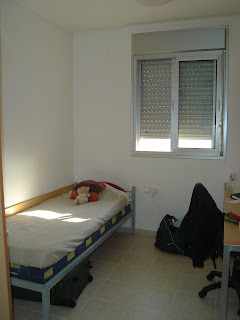
MY ROOM:
I’ve been in Israel now for about 6 hours and, predictably, I’ve experienced a month’s worth of excitement. Most of the things I expected to be difficult logistically were, but I’ve been able to bear the lines and red tape by smiling at just how typical Israeli it all is.
More remarkable than the expected yelling and curt responses that Israelis are infamous for, however, has been the serendipitous sequence of events that have unfurled one after the other in the past 24 hours. Jerusalem is magical - and after only a few hours I remember why its so hard not to believe in a higher power at work here. Despite the honking cars, the barbed wire, the constant signs of stress and tension, people here seem t possess a certain amount of spiritual awareness. Perhaps it comes from an acceptance, even among the most secular people, that life is not all in our control – so people freak out about small things where they feel they can exercise their control, and when wild coincidences occur, no one is surprised. Admittedly I am still in the naïve stage. So be it. I’ll enjoy this while it’s here!
**************
Finally … at 2:30, I arrived at the brand new graduate dorms ready to move in… I wrote my name on a list and settled in to wait for the 10 or so people in front of me to get their room assignments. Three hours later, I actually saw my room. In the meantime, I enjoyed chatting with some other students. I met people from Argentina, Mexico, and of course Israelis and Americans. It’s so nice to be in the brand new dorms and to know that everyone around is a graduate student. The graduate students here are a bit more serious about their studies, although going to class here is apparently not quite as required as in the states.
My apartment is beautiful! I walked in to a sparkling white room, with billowing peacock feathers on our coffee table to greet me. My roommate, Elad, has incredible taste in décor and wines from what I can tell so far. He is very keen on cleanliness and he set the some house rules straight away. I appreciate his directness and he and I had an awesome evening together.
He is studying law and accounting and comes across as extremely intelligent. He speaks German and English fluently but soon I will have to crack down and make him speak to me only in Hebrew. He grew up on a moshav in central Israel that is known for its honey. He is the eldest of 5 kids. When we talked about his time in the army, he said he couldn’t really discuss it. I guess he did some intelligence work, but whatever it was, it was specialized enough that he is forbidden from visiting several countries (Jordan, Egypt, Russia) for quite a few years.
He gave me a great tour of the student village and the nearby shops. We enjoyed a dinner of hummous, pita and cucumbers with some Israeli jelly donuts and rugelach for dessert. (and of course some good wine!) I’ve mostly unpacked and plan to spend today taking care of logistics at school and with the bank, cell phone etc… Then I need to study Hebrew for several hours. Tonight, I am meeting a friend in the city. I am ridiculously happy!

I’ve been in Israel now for about 6 hours and, predictably, I’ve experienced a month’s worth of excitement. Most of the things I expected to be difficult logistically were, but I’ve been able to bear the lines and red tape by smiling at just how typical Israeli it all is.
More remarkable than the expected yelling and curt responses that Israelis are infamous for, however, has been the serendipitous sequence of events that have unfurled one after the other in the past 24 hours. Jerusalem is magical - and after only a few hours I remember why its so hard not to believe in a higher power at work here. Despite the honking cars, the barbed wire, the constant signs of stress and tension, people here seem t possess a certain amount of spiritual awareness. Perhaps it comes from an acceptance, even among the most secular people, that life is not all in our control – so people freak out about small things where they feel they can exercise their control, and when wild coincidences occur, no one is surprised. Admittedly I am still in the naïve stage. So be it. I’ll enjoy this while it’s here!
**************
Finally … at 2:30, I arrived at the brand new graduate dorms ready to move in… I wrote my name on a list and settled in to wait for the 10 or so people in front of me to get their room assignments. Three hours later, I actually saw my room. In the meantime, I enjoyed chatting with some other students. I met people from Argentina, Mexico, and of course Israelis and Americans. It’s so nice to be in the brand new dorms and to know that everyone around is a graduate student. The graduate students here are a bit more serious about their studies, although going to class here is apparently not quite as required as in the states.
My apartment is beautiful! I walked in to a sparkling white room, with billowing peacock feathers on our coffee table to greet me. My roommate, Elad, has incredible taste in décor and wines from what I can tell so far. He is very keen on cleanliness and he set the some house rules straight away. I appreciate his directness and he and I had an awesome evening together.
He is studying law and accounting and comes across as extremely intelligent. He speaks German and English fluently but soon I will have to crack down and make him speak to me only in Hebrew. He grew up on a moshav in central Israel that is known for its honey. He is the eldest of 5 kids. When we talked about his time in the army, he said he couldn’t really discuss it. I guess he did some intelligence work, but whatever it was, it was specialized enough that he is forbidden from visiting several countries (Jordan, Egypt, Russia) for quite a few years.
He gave me a great tour of the student village and the nearby shops. We enjoyed a dinner of hummous, pita and cucumbers with some Israeli jelly donuts and rugelach for dessert. (and of course some good wine!) I’ve mostly unpacked and plan to spend today taking care of logistics at school and with the bank, cell phone etc… Then I need to study Hebrew for several hours. Tonight, I am meeting a friend in the city. I am ridiculously happy!
Monday, September 10, 2007
Has San Francisco changed at all in the 35 years since my parents - then a newlywed couple - walked its streets?
Surely it has, but there's something of its freewheeling roots that is style alive and in action.
I spent 3 days out there this week and had the best of my 3 visits there since my brother moved to the city 2 years ago. It ended at a festival in Golden Gate Park - the Saturday "Power to the Peaceful" concert featuring Hot Buttered Rum, the Indigo Girls and Michael Franti. The lawn was packed with dancing hippies of all ages, with children, with dancing pregnant women and shirtless seniors. There were Iraq Veterans Against the War, organic doggie treats, massage booths, community art work, and yuppie targeted energy bars. We ran into a friend of Dans from work - who we bearly recognized (pun intended, since the guy was dressed in a big brown bear costume.) What seemed to loom over much of the crowd, more than in any other venue I've been to (including many Phish show) was the ubiquitous smell, smoke and presence of a certain green herb. I steered clear (not the least because I had an airplane to catch), but was struck by the lack of police presence or security of any kind. It felt like a peaceful, happy and very free gathering of 10s of thousands of people united by a desire for a better global situation, a belief in the power of peaceful demonstrations and a serious distaste for the current administration. Even the professional sign language translator was rocking out on stage, and the bands joined the crowd after their performances.
Other evidence of the freedom of this western city? At synagogue on Friday night I got to chatting with a 75 year old congregant. We reminisced about his hometown in the Boston area and he told me he'd fled to San Francisco to escape some gambling troubles. He went on to describe some of his intimate adventures in San Francisco, reminding me that this was "during the time of free love." After a quick shabbat shalom, I ducked out of the congregation. Remember, this conversation took place at the local conservative synagogue where a dedicated minyan of 10-15 people come regularly on Friday night. Dan and I were honored guests, as the only new people in the crowd. I sure felt honored! Honestly though, personal stories aside, we had a great time. I'm glad to know some of the people who will be spending the new year with Dan.
More highlights:
When I first arrived, Dan and I spend Thursday out on one of the properties he manages. With the forest fires burning only 5 to 10 miles away, the air was gray, thick and pungent with smoke. It was hot, and after a dry summer the ranch reminded me a bit of Joshua Tree. We measured the pastures for grass content (very little) and met with the very friendly rancher who keeps tabs on the property. Being the first rancher I'd ever met, I was shocked at how much he fit my image. Tight blue jeans, fringed and healed cowboy boots, button down shirt, thumbs tucked comfortably in his belt loops, I had to control myself from bringing up Brokeback Mountain. Very mature, I know. As my stomach growled with surprise at the turkey sandwich I had shocked it with at lunch time, the rancher and I skittered politely around issues of vegetarianism and meat consumption.
As Dan and I drove around the property, we took our 4 wheel drive rental car up the steep hills that lead down toward the central valley. We saw ground squirrels, red tail hawks, and tons of deer. I also spotted a beautiful coyote down by one of the sparse springs.
The final noteworthy incident happened on our drive up hill through downtown. Wearing an expensive looking suit and a crisp pink tie, a 30-something commuter grabbed hold of the bumper of our car. Riding on his classic white roller skates, he hitched a ride with us through the streets of the city. I turned to say hello at a red light, joking that we would charge him. In spite of the fact that we were riding the middle lane - during rush hour - he encouraged us not to slow down. "You can go fast. I've been doing this for 20 years." As we neared the top of a hill, he rolled off on to a side street with a wave.
Surely it has, but there's something of its freewheeling roots that is style alive and in action.
I spent 3 days out there this week and had the best of my 3 visits there since my brother moved to the city 2 years ago. It ended at a festival in Golden Gate Park - the Saturday "Power to the Peaceful" concert featuring Hot Buttered Rum, the Indigo Girls and Michael Franti. The lawn was packed with dancing hippies of all ages, with children, with dancing pregnant women and shirtless seniors. There were Iraq Veterans Against the War, organic doggie treats, massage booths, community art work, and yuppie targeted energy bars. We ran into a friend of Dans from work - who we bearly recognized (pun intended, since the guy was dressed in a big brown bear costume.) What seemed to loom over much of the crowd, more than in any other venue I've been to (including many Phish show) was the ubiquitous smell, smoke and presence of a certain green herb. I steered clear (not the least because I had an airplane to catch), but was struck by the lack of police presence or security of any kind. It felt like a peaceful, happy and very free gathering of 10s of thousands of people united by a desire for a better global situation, a belief in the power of peaceful demonstrations and a serious distaste for the current administration. Even the professional sign language translator was rocking out on stage, and the bands joined the crowd after their performances.
Other evidence of the freedom of this western city? At synagogue on Friday night I got to chatting with a 75 year old congregant. We reminisced about his hometown in the Boston area and he told me he'd fled to San Francisco to escape some gambling troubles. He went on to describe some of his intimate adventures in San Francisco, reminding me that this was "during the time of free love." After a quick shabbat shalom, I ducked out of the congregation. Remember, this conversation took place at the local conservative synagogue where a dedicated minyan of 10-15 people come regularly on Friday night. Dan and I were honored guests, as the only new people in the crowd. I sure felt honored! Honestly though, personal stories aside, we had a great time. I'm glad to know some of the people who will be spending the new year with Dan.
More highlights:
When I first arrived, Dan and I spend Thursday out on one of the properties he manages. With the forest fires burning only 5 to 10 miles away, the air was gray, thick and pungent with smoke. It was hot, and after a dry summer the ranch reminded me a bit of Joshua Tree. We measured the pastures for grass content (very little) and met with the very friendly rancher who keeps tabs on the property. Being the first rancher I'd ever met, I was shocked at how much he fit my image. Tight blue jeans, fringed and healed cowboy boots, button down shirt, thumbs tucked comfortably in his belt loops, I had to control myself from bringing up Brokeback Mountain. Very mature, I know. As my stomach growled with surprise at the turkey sandwich I had shocked it with at lunch time, the rancher and I skittered politely around issues of vegetarianism and meat consumption.
As Dan and I drove around the property, we took our 4 wheel drive rental car up the steep hills that lead down toward the central valley. We saw ground squirrels, red tail hawks, and tons of deer. I also spotted a beautiful coyote down by one of the sparse springs.
The final noteworthy incident happened on our drive up hill through downtown. Wearing an expensive looking suit and a crisp pink tie, a 30-something commuter grabbed hold of the bumper of our car. Riding on his classic white roller skates, he hitched a ride with us through the streets of the city. I turned to say hello at a red light, joking that we would charge him. In spite of the fact that we were riding the middle lane - during rush hour - he encouraged us not to slow down. "You can go fast. I've been doing this for 20 years." As we neared the top of a hill, he rolled off on to a side street with a wave.
Wednesday, August 22, 2007
With the Azores nearly a week in my past, I've had little time to reflect on the experience. Already, I've been sucked into the urban frenzy of Brooklyn. Did I really miss driving with all its inclusive joys of red lights, honking and looking for parking? Did I really miss a bed, even though it lacks the fresh breeze of a tent and the stars above? Walking along Glenwood Avenue today, in spite of the pouring rain, I was still ecstatic to be outdoors, breathing the fresh air. This year has done its job of fully converting me into an outdoors(wo)man. I'm not complaining - but am hopeful I will be able to make space for the great outdoors even while studying and living in a dorm this fall and beyond. But enough about the future, and even the present.
The Azores:
Part of me wants to tell every one (there are 5 of you, right?) reading this to get on a plane asap and fly on over. But encouraging tourism to the Azores might go against everything that makes it so special. The islands work hard to stay mellow - prohibiting the construction of multi-story buildings and discouraging large tour group. Even the best diving and fishing companies on the islands don't have much advertisement/business sense, and I think they want to keep it that way. In brief, the Azores are unspoiled. (with the possible exception of Sao Miguel, an island I didn't visit.)
I led the trip with Kyle, an incredible, laid back and hilarious Idaho-an who has immigrated more or less to Bolivia. Or is it Mexico? He and I had a blast playing mom and pop to the chillest group of teenagers I've ever met. There were 6 of them, and they were ever content with books, hearty meals, early nights in bed and lots of naps. Nutella and a jungle gym always brought these guys more joy then snorkeling and whale-watching did. It made our job pretty easy, and they were a lot of fun to laugh and play with. As we spent our days sailing, hiking and more - many of our guides commented on the extraordinary tranquility of our crew.
Two of the best days of the trip were during the last week. On the small island of Sao Jorge, we did a hike along the Fajas of Santo Cristo. The hike is the most famous on the islands. Starting far above the sea, we (along with several cows) snaked down toward the abandoned downs that lie in the seaside pastures. One town is still alive, getting its supplies from 4 x 4s and boat. There were a handful of stone homes, one church, and blossiming gardens. We even stopped for sodas at the one bar/restaurant in town.
Later in the week, we set sail! Robin, a German sailor, took us out on his 47 foot catamaran and we laid out on the deck reading, playing with his two dogs (who were trained to use the bathroom over the boat's net!) and chatting with his crew. He and Andre, his buddy from Norway, had been all over the Carribean, to Cape Verde and the Canaries. We merely blew lazily among Pico and Faial , anchoring for lunch and snorkeling. On our final Saturday, we surprised the kids with an overnight at Noberto's on the island of Pico.
Noberto is a local character, known and loved by everyone on the islands. He runs diving, fishing and research boats. He has a small stone house on the smaller island of Pico. He cooked us 2 incredible meals during our trip. Over an outdoor stone oven, he boiled potatoes, grilled that day's catch of tuna, grilled squash and served salad from the garden and cheese and bread from the island. Yum! After the meal, he declared that he did not do dishes. We were happy to do them for him. He then headed off for his afternoon siesta and offered up the many available mattresses and a hammock for our own use.
We also did some environmental service work on the island. Working with Chris, who runs an eco-lodge in Horta, we built a solar oven out of a discarded refrigerator. We painted it dark blue, dragged it up to his roof and set a pot of curry chick and vegetables to cook in the sun. We also put together a solar water heater to use for all of the inn's laundry. We used an old pickling barrel and insulated it with life jackets. It was great to see the kids problem solving about how to use all of the recycled materials to construct something so useful. It inspired some good conversation on environmentalism and the kids pledged to make some different environmental choices back in the States.
While we were in the Azores, Horta celebrated la Semana Del mar, the biggest local festival of the year. To kick off the festival, a Madonna is carried from a church above the port down to a boat, with a procession singing ave maria following behind. We joined in on this annual event, and although the kids felt a bit awkward, it was cool to see. The Madonna is then taken by boat around the island and followed by a fleet of vessels carrying bright flags. All week long, there is live music, food and merchandise sold along the streets and a ton of visitors on island to celebrate until the wee hours. Our children were not particularly interested in the late night reverie, but we did surprise them on the last night with a 1am excursion into town. There was a great fireworks show to mark the close of the festival!
The Azores:
Part of me wants to tell every one (there are 5 of you, right?) reading this to get on a plane asap and fly on over. But encouraging tourism to the Azores might go against everything that makes it so special. The islands work hard to stay mellow - prohibiting the construction of multi-story buildings and discouraging large tour group. Even the best diving and fishing companies on the islands don't have much advertisement/business sense, and I think they want to keep it that way. In brief, the Azores are unspoiled. (with the possible exception of Sao Miguel, an island I didn't visit.)
I led the trip with Kyle, an incredible, laid back and hilarious Idaho-an who has immigrated more or less to Bolivia. Or is it Mexico? He and I had a blast playing mom and pop to the chillest group of teenagers I've ever met. There were 6 of them, and they were ever content with books, hearty meals, early nights in bed and lots of naps. Nutella and a jungle gym always brought these guys more joy then snorkeling and whale-watching did. It made our job pretty easy, and they were a lot of fun to laugh and play with. As we spent our days sailing, hiking and more - many of our guides commented on the extraordinary tranquility of our crew.
Two of the best days of the trip were during the last week. On the small island of Sao Jorge, we did a hike along the Fajas of Santo Cristo. The hike is the most famous on the islands. Starting far above the sea, we (along with several cows) snaked down toward the abandoned downs that lie in the seaside pastures. One town is still alive, getting its supplies from 4 x 4s and boat. There were a handful of stone homes, one church, and blossiming gardens. We even stopped for sodas at the one bar/restaurant in town.
Later in the week, we set sail! Robin, a German sailor, took us out on his 47 foot catamaran and we laid out on the deck reading, playing with his two dogs (who were trained to use the bathroom over the boat's net!) and chatting with his crew. He and Andre, his buddy from Norway, had been all over the Carribean, to Cape Verde and the Canaries. We merely blew lazily among Pico and Faial , anchoring for lunch and snorkeling. On our final Saturday, we surprised the kids with an overnight at Noberto's on the island of Pico.
Noberto is a local character, known and loved by everyone on the islands. He runs diving, fishing and research boats. He has a small stone house on the smaller island of Pico. He cooked us 2 incredible meals during our trip. Over an outdoor stone oven, he boiled potatoes, grilled that day's catch of tuna, grilled squash and served salad from the garden and cheese and bread from the island. Yum! After the meal, he declared that he did not do dishes. We were happy to do them for him. He then headed off for his afternoon siesta and offered up the many available mattresses and a hammock for our own use.
We also did some environmental service work on the island. Working with Chris, who runs an eco-lodge in Horta, we built a solar oven out of a discarded refrigerator. We painted it dark blue, dragged it up to his roof and set a pot of curry chick and vegetables to cook in the sun. We also put together a solar water heater to use for all of the inn's laundry. We used an old pickling barrel and insulated it with life jackets. It was great to see the kids problem solving about how to use all of the recycled materials to construct something so useful. It inspired some good conversation on environmentalism and the kids pledged to make some different environmental choices back in the States.
While we were in the Azores, Horta celebrated la Semana Del mar, the biggest local festival of the year. To kick off the festival, a Madonna is carried from a church above the port down to a boat, with a procession singing ave maria following behind. We joined in on this annual event, and although the kids felt a bit awkward, it was cool to see. The Madonna is then taken by boat around the island and followed by a fleet of vessels carrying bright flags. All week long, there is live music, food and merchandise sold along the streets and a ton of visitors on island to celebrate until the wee hours. Our children were not particularly interested in the late night reverie, but we did surprise them on the last night with a 1am excursion into town. There was a great fireworks show to mark the close of the festival!
Thursday, August 02, 2007


Thursday, July 26, 2007
Hello from the beautiful azores. Its 75 degrees and sunny. We spent our whole first day out on a catamaran tracking whales, bottle-nosed, striped and spotted dolphins with a marine biologist. We got a bit seasick, but it was beautiful and we got a good look at Pico Island and the island of Faial where we are staying. The islands are sparsely populated, dotted with small red roofs and green fields that are divided with natural barriers of hedges. All of the dairy and meat is local here, as is the fish of course.
Our campsite is alongside the water and we slept last night to the thunderous waves that crashed on the shore. The only hazards here are mosquitoes, one of which attacked my eye!
We're taking plans one or two days at a time here, but tomorrow we'll be out on the catamaran again and on the following day doing a hike.
Our campsite is alongside the water and we slept last night to the thunderous waves that crashed on the shore. The only hazards here are mosquitoes, one of which attacked my eye!
We're taking plans one or two days at a time here, but tomorrow we'll be out on the catamaran again and on the following day doing a hike.
Monday, July 23, 2007
Lisboa, Portugal...
I'll be totally honest here. After one month in India, and the last week filled with long bus rides, stomach aches and coughing children, not to mention 10 hours on the plane and a 3+ hour layover in Milano, arriving here in Lisbon I feel more like Iºve just come to the holy land. I am grinning ear to ear, reveling in europe at its best --- cafe machiatos, small restuarants that poor out into cobblestone plazas, blue skies that touch the bluer atlantic, monuments to dead white men, friendly travelers, sketchy european men hitting on me... all the familiarity is welcome, and Lisbon sort of feels like a friendlier version of france(with almost as many people speaking french!
I arrived around noon, I think, and went straight to my hotel. God bless Adam Lindsley at the Road Less Traveled who found me hostel smack in the center of the old city. Im 3 blocks from the central square and three blocks from the ocean. There are cafes everywhere, postcards, tourists, coffeeshops and trolley cars. Im feeling a bit run down and caught the cough from my trip, so I am greatful for the two day break I have between trips.
I ate lunch at an Italian restaurant where my waiter was, believe it or not, from Punjab, India. He has only been here two years and will return to India next year to marry. Coincidentally, he is Sikh, and yesterday our group visited a main Sikh temple in Delhi. That temple offers a daily soup kitchen'like service that feeds tens of thousands. It was incredible! We walked inside amidst the throngs of people who kissed the marble stairs before striding barefoot through the mantra filled sanctuary. At the exit, a sweet dish was offered to all of the worshipers.
India ended well. The children had a fantastic time, and I learned a lot that I will take with me on this next trip. It will be a huge transition --- from the service and luxury of India to the self'reliance and 3 weeks of cmaping will be doing on the Azores, but it will be nice to be free from worries of malaria pills, altitude and sketchy water. Plus, eating fresh fruits and vegetables is way way underrated!
I'll be totally honest here. After one month in India, and the last week filled with long bus rides, stomach aches and coughing children, not to mention 10 hours on the plane and a 3+ hour layover in Milano, arriving here in Lisbon I feel more like Iºve just come to the holy land. I am grinning ear to ear, reveling in europe at its best --- cafe machiatos, small restuarants that poor out into cobblestone plazas, blue skies that touch the bluer atlantic, monuments to dead white men, friendly travelers, sketchy european men hitting on me... all the familiarity is welcome, and Lisbon sort of feels like a friendlier version of france(with almost as many people speaking french!
I arrived around noon, I think, and went straight to my hotel. God bless Adam Lindsley at the Road Less Traveled who found me hostel smack in the center of the old city. Im 3 blocks from the central square and three blocks from the ocean. There are cafes everywhere, postcards, tourists, coffeeshops and trolley cars. Im feeling a bit run down and caught the cough from my trip, so I am greatful for the two day break I have between trips.
I ate lunch at an Italian restaurant where my waiter was, believe it or not, from Punjab, India. He has only been here two years and will return to India next year to marry. Coincidentally, he is Sikh, and yesterday our group visited a main Sikh temple in Delhi. That temple offers a daily soup kitchen'like service that feeds tens of thousands. It was incredible! We walked inside amidst the throngs of people who kissed the marble stairs before striding barefoot through the mantra filled sanctuary. At the exit, a sweet dish was offered to all of the worshipers.
India ended well. The children had a fantastic time, and I learned a lot that I will take with me on this next trip. It will be a huge transition --- from the service and luxury of India to the self'reliance and 3 weeks of cmaping will be doing on the Azores, but it will be nice to be free from worries of malaria pills, altitude and sketchy water. Plus, eating fresh fruits and vegetables is way way underrated!
Being in the Ladakh region felt like a very different country from the rest of India. Indeed, it is mostly Buddhist, largely Tibetan and had been cut off from the rest of India until the mid 1970s. Roads, cars, electricity and even cities are all recent additions to the region and it is still struggling on the cusp of modernity and millenia of traditional lifestyles. In spite of the technological advances, there is a mysterious and serene feeling to the city of Leh and its environs.
Arriving by plane, we headed up to our cruising altitude and then barely came down... As we landed, the plane weaved between 16,000 foot peaks, before landing easily among the clouds at 12,000 feet. In every direction were clouds and mountains, snow capped young peaks stretching starkly toward the sky. The main town of Leh sits just below the tree llne, at a height far greater than any American city. We spent the first 2 days fighting off the fatigue and neausea of altitude sickness. We drove long distances on narrow roads to visit one monastary after another. Each monastary is secluded among the mountains, up a windy road and overlooking a nearby village. The monastaries and their symbols and statues became familiar to us, but each one had a unique character and feel. The monks wore only red, mostly a deep red robe although some sported red Tommy HIlfiger or polo shirts, acquired throught trades with tourists. One of 9 people in the region are monks and boys as young as 6 will begin to train in monastaries.
Within the monastaries, there was a musty smell. Aged stone mixed with incense, spices and hundreds of years of chanting. The monastaries boasted rooms of statues, similar to what each Buddhist has in their home.Some of them, however, also had enormous Buddha statues that extended 3 or 4 stories tall. We were greeted by one lama, the head of a monastary, with the auspicious offering of a white scarf. At another monstary, we were offered rice while we sat in on lunchtime prayers. The monastaries were characterized by brightly colored flags in yellow, red, blue and green. Poles reached toward the clouds and Tibetan prayer flags could be seen in all directions, each string of flag showing varied levels of wear and tear.
The main city, a small town of winding streets, green fields, wandering cows and stray dogs, was a tourist mecca. Filled with dreadlocked travelers and countless Israelis, there were more guest houses than restaurants and the street vendors and small shops spilled out onto the sidewalk. Here at last was the focal point of every hippie trend, the epicenter of singing bowls, prayer flags, drums, Buddhist phrases, copious hashish dealers, flowing skirts, patchwork bags and yoga classes that dot college campuses and music festivals around the world. Free Tibet signs had a whole new meaning here, and Tibetan refugee centers were located in every small town. I especially enjoyed a trip to a womenºs center that supports local artisan and encourages ecologically responsible tourism. We spent a few hours shopping in the old city and stopped for our first cup of masala chai tea.
After three days, we headed to the small village of Stok, about half an hour away. There, prepared for back country living, we were met by a staff of 5 and entered our tents, which can be better described as canvas hotel rooms. For the next 10 days as we volunteered at the Stok Governemnt High SChool, we were treated like royalty by our cooking and cleaning crew. In the afternoons we were greeted with fresh juice, hot tea and snacks. The campsite even had plumbing and electricity, amenities that, ironically, the school lacked.
Arriving by plane, we headed up to our cruising altitude and then barely came down... As we landed, the plane weaved between 16,000 foot peaks, before landing easily among the clouds at 12,000 feet. In every direction were clouds and mountains, snow capped young peaks stretching starkly toward the sky. The main town of Leh sits just below the tree llne, at a height far greater than any American city. We spent the first 2 days fighting off the fatigue and neausea of altitude sickness. We drove long distances on narrow roads to visit one monastary after another. Each monastary is secluded among the mountains, up a windy road and overlooking a nearby village. The monastaries and their symbols and statues became familiar to us, but each one had a unique character and feel. The monks wore only red, mostly a deep red robe although some sported red Tommy HIlfiger or polo shirts, acquired throught trades with tourists. One of 9 people in the region are monks and boys as young as 6 will begin to train in monastaries.
Within the monastaries, there was a musty smell. Aged stone mixed with incense, spices and hundreds of years of chanting. The monastaries boasted rooms of statues, similar to what each Buddhist has in their home.Some of them, however, also had enormous Buddha statues that extended 3 or 4 stories tall. We were greeted by one lama, the head of a monastary, with the auspicious offering of a white scarf. At another monstary, we were offered rice while we sat in on lunchtime prayers. The monastaries were characterized by brightly colored flags in yellow, red, blue and green. Poles reached toward the clouds and Tibetan prayer flags could be seen in all directions, each string of flag showing varied levels of wear and tear.
The main city, a small town of winding streets, green fields, wandering cows and stray dogs, was a tourist mecca. Filled with dreadlocked travelers and countless Israelis, there were more guest houses than restaurants and the street vendors and small shops spilled out onto the sidewalk. Here at last was the focal point of every hippie trend, the epicenter of singing bowls, prayer flags, drums, Buddhist phrases, copious hashish dealers, flowing skirts, patchwork bags and yoga classes that dot college campuses and music festivals around the world. Free Tibet signs had a whole new meaning here, and Tibetan refugee centers were located in every small town. I especially enjoyed a trip to a womenºs center that supports local artisan and encourages ecologically responsible tourism. We spent a few hours shopping in the old city and stopped for our first cup of masala chai tea.
After three days, we headed to the small village of Stok, about half an hour away. There, prepared for back country living, we were met by a staff of 5 and entered our tents, which can be better described as canvas hotel rooms. For the next 10 days as we volunteered at the Stok Governemnt High SChool, we were treated like royalty by our cooking and cleaning crew. In the afternoons we were greeted with fresh juice, hot tea and snacks. The campsite even had plumbing and electricity, amenities that, ironically, the school lacked.
Thursday, June 28, 2007
India - the maze of cars and rickshaws only intensifies the confusion of my internal clock - but today the experiences I had remind me again of why I travel, and why I love it. In spite of countless experiences in India that I have heard, delving into the midst of Delhi today was nothing I could have imagined...
But let me back track...
When did this long day-week begin? I left Colorado at 3:30 am, headed for the airport. I had a 9 am flight to St Paul. There I caught a flight to Amsterdam. With 4 hours of layover in the Netherlands, I headed into the nearby city center for breakfast. I met a young journalist on her way to Uganda who was doing the same thing. Rejuvenated by the fresh air, we toured Amsterdam quickly, grins on our faces, cameras snapping - we felt as though this glimpse of Europe was a stolen delicacy, a forbidden treat. But I made it back to the airport with plenty of time to spare, and boarded my flight for India.
On the plane, I watched my first Bollywood movie - "Guru" - and was entertained by the cheesy love story coupled with the occasional music-video interlude that is so typical (apparently) of Indian film.
I arrived and was greeted by a man with a "Rachel Olstein" sign (My life is complete!) and we headed out into the late night Delhi traffic. He whisked us past the cab drivers and to an awaiting car.
At our hotel, which is incredible, I met up with Paul, my co--leader. 13 of our kids were safely asleep in their beds. But one had missed his connection in Chicago. My boss decided that I would stay in Delhi by myself for the day so that I Could greet Adam. The rest of our group took an early morning flight to Leh - in the Ladakh region of India.
Faced with the possibility of a day full of rest, I was and still am enormously grateful. Inexplicably, however, I couldn't sleep. I woke up, had a delicious breakfast around 8am and proceeded to explore the gardens at my hotel. I even got to do some laps in their new swimming pool. A note about the hotel - it's stunning, and has the outer appearance of any western 4 star hotel. On closer inspection, however, some things aren't quite streamlined yet. My TV and phone don't work, and the wake up call here is the knocking of the concierge at my door. It's great - so personal, but not always right on time. Also, when i tried to turn on my shower, the faucet fell off in my hands. I relate these trifles as observations more than complaints. They amuse me more than annoy me although a few fellow guests I met here far less humored.
On to the highlights of my day. Lilid, a tour guide, offered to show me around the city today. How could I refuse. The tour company in very reputable and my company has worked with them for three years. I was being offered a private tour for free! At noon, I took a car to the Grand Hotel - a 5 star palace that reeks of ostentation in comparison to the shanties, dirty streets and maze of cars that surround its walled and gardened acres on all sides. The (mis)adventures of my day began immediately. My driver, a 54 year old employee of the hotel, proceeded to interrogate me about my married life. (Seems to be a common first question here.) In spite of the details I provided to him about my husband and his very important job, this man had the nerve to ask me my room number! I chastised him and Lilid ended up complaining to this guy's boss. Hitting on the 20=something trip leaders isn't good for Lilid's business or the hotel. It's not particularly good for my peace of mind either.
In spite of the creepy driver, the ride to the Grand Hotel was unforgettable. Cars here drive on the left = in theory. But really, they go anywhere. Any side of the road, any lane, any tiny space that is small enough for them to squeeze between. There are buses, rickshaws, trucks, bikes, motorcycles (which the women ride side saddle with children in their arms.) At any traffic jam, there are children selling magazines or coconuts, standing in the middle of highway intersections barefoot, they appeal for a few small rupees (worth fractions of a penny.) Along the road are tents and make shift huts, whole villages set up beneath highway underpasses. I wonder if the tarps will survive the monsoon rains.
Hence, the shock of arriving at the Grand, a spot that Lilid had offered only because it is safe and well known. He pulled up in a motorcycle and realized how the tour would work. I was terrified, as he quickly saw, but he drove very slowly, very carefully and all the way on the right side. The scariest part was the constant honking. Cars here are encouraged to honk (the backs of buses say "Honke Please") so that drivers will know all the vehicles around them. You can only imagine the cacophony this creates. My heart lept each time a horn blared behind me. Shortly after lunch, we decided that I would feel safer in another form of transportation. Lilid is a kind and generous guide. He was always professional and appropriate - protective but not patronizing.
We rode off through Delhi toward a delicious lunch spot where Lilid and I discussed the differences between marriage and couplehood in our respective countries. He has been married 2 years to a 21-year-old woman that he never met before his wedding. His primary criteria in a wife was that she be able to life well with his mother. He spoke glowingly of his mother (even more so than of his wife.) His mother still cooks for him, cleans his clothes and wakes him up for work each day, in spite of his marriage and fatherhood. (He has a 1 year old) He told me of all the things his wife does to try and keep him happy. I asked what he does for her... "I protect her, and provide for her. I take her places and translate because she does not speak Hindi." he replied. I encouraged him to give his wife some more chances to visit her family; at 21, she must miss them terribly - he did say he wanted to do so, but that the 12 horu drive makes it difficult.
We also spoke a bit about Israelis (he is leading a group of 60 Israelis next month.) I told him about the sabra-fruit analogy and when I described the spiny sweet fruit, he knew it from his home village. He then asked me what religion Israelis are. It was a nice change to talk about Israel with someone so free of bias, so unaffected by news accounts, by family ties, by emotions or creed.
Monsoon season kicked in right after lunch. India has months of rare rains, and then, usually not until July, the monsoons arrives with little warning. The thick humidity of the air (so foggy that my camera lens needed constant wiping off) was the only hint. As I rode through Delhi on the bike, the rain began to fall in large painful droplets. We pulled over and Lilid led the way while I scrambled into a rickshaw and followed behind him.
We headed to the Lotus Temple, a Bahai prayer hall that gleams in marble and is designed to look exactly like the lotus flower. I only spotted one other non=Indian there. The place is more of a national attraction than a big tourist spot. As we approached the temple on countless stairs, we had to remove our shoes before entering the silent sanctuary - a round, smooth womb of white where music played barely audibly in the background. Feeling the cool stones beneath my feet, I felt grounded, calm and undistracted as I circled the temple's main hall.
As we left the temple, I was overcome (finally) with total exhaustion. Suddenly, in spite of the fact that at 4pm, I should have felt ready for breakfast back in the states, I could barely keep my eyes open. We hopped into another rickshaw and I feel asleep, completely oblivious to the cars, bikes and trucks that weaved around me, inches from my right leg.
Back at the hotel, I fell asleep instantly and woke up at 7, just in time for a quick breakfast before my flight. I dressed quickly, still feeling tired in spite of the 14 hours of rest. I checked in with Lilid went up to the dining room and ordered a coffee. The food offerings were oddly different from the previous day's fare. In place of cereal was soup; instead of fruit there were various salads. I inquired about omelets - or muffins - until I finally understood.
"What day is it?!" I asked. It was, of course, still Thursday - and it was 7PM - dinner time. (A good thing too - had it been Friday morning, I would not have been there to get Adam at the airport!)
I laughed for a long while at my utter confusion and then had dinner anyway. Now, back at the hotel with Adam, I have about 3 hours to rest before we head to Leh, the 11,000 feet, to the doorstep of Tibet...
But let me back track...
When did this long day-week begin? I left Colorado at 3:30 am, headed for the airport. I had a 9 am flight to St Paul. There I caught a flight to Amsterdam. With 4 hours of layover in the Netherlands, I headed into the nearby city center for breakfast. I met a young journalist on her way to Uganda who was doing the same thing. Rejuvenated by the fresh air, we toured Amsterdam quickly, grins on our faces, cameras snapping - we felt as though this glimpse of Europe was a stolen delicacy, a forbidden treat. But I made it back to the airport with plenty of time to spare, and boarded my flight for India.
On the plane, I watched my first Bollywood movie - "Guru" - and was entertained by the cheesy love story coupled with the occasional music-video interlude that is so typical (apparently) of Indian film.
I arrived and was greeted by a man with a "Rachel Olstein" sign (My life is complete!) and we headed out into the late night Delhi traffic. He whisked us past the cab drivers and to an awaiting car.
At our hotel, which is incredible, I met up with Paul, my co--leader. 13 of our kids were safely asleep in their beds. But one had missed his connection in Chicago. My boss decided that I would stay in Delhi by myself for the day so that I Could greet Adam. The rest of our group took an early morning flight to Leh - in the Ladakh region of India.
Faced with the possibility of a day full of rest, I was and still am enormously grateful. Inexplicably, however, I couldn't sleep. I woke up, had a delicious breakfast around 8am and proceeded to explore the gardens at my hotel. I even got to do some laps in their new swimming pool. A note about the hotel - it's stunning, and has the outer appearance of any western 4 star hotel. On closer inspection, however, some things aren't quite streamlined yet. My TV and phone don't work, and the wake up call here is the knocking of the concierge at my door. It's great - so personal, but not always right on time. Also, when i tried to turn on my shower, the faucet fell off in my hands. I relate these trifles as observations more than complaints. They amuse me more than annoy me although a few fellow guests I met here far less humored.
On to the highlights of my day. Lilid, a tour guide, offered to show me around the city today. How could I refuse. The tour company in very reputable and my company has worked with them for three years. I was being offered a private tour for free! At noon, I took a car to the Grand Hotel - a 5 star palace that reeks of ostentation in comparison to the shanties, dirty streets and maze of cars that surround its walled and gardened acres on all sides. The (mis)adventures of my day began immediately. My driver, a 54 year old employee of the hotel, proceeded to interrogate me about my married life. (Seems to be a common first question here.) In spite of the details I provided to him about my husband and his very important job, this man had the nerve to ask me my room number! I chastised him and Lilid ended up complaining to this guy's boss. Hitting on the 20=something trip leaders isn't good for Lilid's business or the hotel. It's not particularly good for my peace of mind either.
In spite of the creepy driver, the ride to the Grand Hotel was unforgettable. Cars here drive on the left = in theory. But really, they go anywhere. Any side of the road, any lane, any tiny space that is small enough for them to squeeze between. There are buses, rickshaws, trucks, bikes, motorcycles (which the women ride side saddle with children in their arms.) At any traffic jam, there are children selling magazines or coconuts, standing in the middle of highway intersections barefoot, they appeal for a few small rupees (worth fractions of a penny.) Along the road are tents and make shift huts, whole villages set up beneath highway underpasses. I wonder if the tarps will survive the monsoon rains.
Hence, the shock of arriving at the Grand, a spot that Lilid had offered only because it is safe and well known. He pulled up in a motorcycle and realized how the tour would work. I was terrified, as he quickly saw, but he drove very slowly, very carefully and all the way on the right side. The scariest part was the constant honking. Cars here are encouraged to honk (the backs of buses say "Honke Please") so that drivers will know all the vehicles around them. You can only imagine the cacophony this creates. My heart lept each time a horn blared behind me. Shortly after lunch, we decided that I would feel safer in another form of transportation. Lilid is a kind and generous guide. He was always professional and appropriate - protective but not patronizing.
We rode off through Delhi toward a delicious lunch spot where Lilid and I discussed the differences between marriage and couplehood in our respective countries. He has been married 2 years to a 21-year-old woman that he never met before his wedding. His primary criteria in a wife was that she be able to life well with his mother. He spoke glowingly of his mother (even more so than of his wife.) His mother still cooks for him, cleans his clothes and wakes him up for work each day, in spite of his marriage and fatherhood. (He has a 1 year old) He told me of all the things his wife does to try and keep him happy. I asked what he does for her... "I protect her, and provide for her. I take her places and translate because she does not speak Hindi." he replied. I encouraged him to give his wife some more chances to visit her family; at 21, she must miss them terribly - he did say he wanted to do so, but that the 12 horu drive makes it difficult.
We also spoke a bit about Israelis (he is leading a group of 60 Israelis next month.) I told him about the sabra-fruit analogy and when I described the spiny sweet fruit, he knew it from his home village. He then asked me what religion Israelis are. It was a nice change to talk about Israel with someone so free of bias, so unaffected by news accounts, by family ties, by emotions or creed.
Monsoon season kicked in right after lunch. India has months of rare rains, and then, usually not until July, the monsoons arrives with little warning. The thick humidity of the air (so foggy that my camera lens needed constant wiping off) was the only hint. As I rode through Delhi on the bike, the rain began to fall in large painful droplets. We pulled over and Lilid led the way while I scrambled into a rickshaw and followed behind him.
We headed to the Lotus Temple, a Bahai prayer hall that gleams in marble and is designed to look exactly like the lotus flower. I only spotted one other non=Indian there. The place is more of a national attraction than a big tourist spot. As we approached the temple on countless stairs, we had to remove our shoes before entering the silent sanctuary - a round, smooth womb of white where music played barely audibly in the background. Feeling the cool stones beneath my feet, I felt grounded, calm and undistracted as I circled the temple's main hall.
As we left the temple, I was overcome (finally) with total exhaustion. Suddenly, in spite of the fact that at 4pm, I should have felt ready for breakfast back in the states, I could barely keep my eyes open. We hopped into another rickshaw and I feel asleep, completely oblivious to the cars, bikes and trucks that weaved around me, inches from my right leg.
Back at the hotel, I fell asleep instantly and woke up at 7, just in time for a quick breakfast before my flight. I dressed quickly, still feeling tired in spite of the 14 hours of rest. I checked in with Lilid went up to the dining room and ordered a coffee. The food offerings were oddly different from the previous day's fare. In place of cereal was soup; instead of fruit there were various salads. I inquired about omelets - or muffins - until I finally understood.
"What day is it?!" I asked. It was, of course, still Thursday - and it was 7PM - dinner time. (A good thing too - had it been Friday morning, I would not have been there to get Adam at the airport!)
I laughed for a long while at my utter confusion and then had dinner anyway. Now, back at the hotel with Adam, I have about 3 hours to rest before we head to Leh, the 11,000 feet, to the doorstep of Tibet...
Tuesday, June 12, 2007
I am headed off to Colorado on Friday for a training with The Road Less Traveled. I've got my vaccines and a seemingly enhaustive supply of pills and backcountry gear. Just have to squeeze it all into my pack and I'm ready. I leave for India in 2 weeks and will be mostly in the Himalayas - backpacking and volunteering at a school there. We'll also be in Leh and Delhi. At the end of August, I head to the Azores for my second trip. Using this link, you can get the updates about the trips I am leading. We call in these updates via satelite phone and the company posts them for the parents of our kids.
Here is the link. My trips are Global Service trips and they are called "Namaste 1" and Baleia Bonita 2.
http://www.theroadlesstraveled.com/trip_news.html
I can also get mail, although only once a month or so. Letters, as always, are welcome and loved. I'll do my best to write too.
When you write, please put my name on the bottom of the letter. The addressee should be The Road Less Traveled.
July:
THE ROAD LESS TRAVELED
c/o Far Horizons Tours
66, LGF Charmwood Plaza
Eros Garden, Near Suraj Kund
Faridabad - 121009
August:
THE ROAD LESS TRAVELED
CASA DO LADO
Rua D. Pedro IV 23
Horta 9900-111
Faial, Azores
Portugal
Here is the link. My trips are Global Service trips and they are called "Namaste 1" and Baleia Bonita 2.
http://www.theroadlesstraveled.com/trip_news.html
I can also get mail, although only once a month or so. Letters, as always, are welcome and loved. I'll do my best to write too.
When you write, please put my name on the bottom of the letter. The addressee should be The Road Less Traveled.
July:
THE ROAD LESS TRAVELED
c/o Far Horizons Tours
66, LGF Charmwood Plaza
Eros Garden, Near Suraj Kund
Faridabad - 121009
August:
THE ROAD LESS TRAVELED
CASA DO LADO
Rua D. Pedro IV 23
Horta 9900-111
Faial, Azores
Portugal
Sunday, June 10, 2007
ACHDOOT (Unity)
12 days.
3 backpacking trips - (that's 3 pack outs, 3 pack ins)
50 children
2 1/2 thunder storms
1 raccoon family
I'll
keep this list short. . . because lists have been far too present in
the past 12 days. I'm just finding the time now to reflect, to think,
the breathe, after an intense but incredible, jam packed,exhilarating, and busy 12 days. The Achdoot season!
I worked this spring leading the Achdoot program at Teva. Working with the amazing Mati
Cooper and our fearless intern David Blank(man!), I was responsible for
organizing, planning and prepping 3-day back packing trips for 3
schools and 1 synagogue. From food orders, gear lists, cleaning peanut
butter containers, hanging tarps and schlepping tents - not to mention
the many car rides, it was a daunting task...
But worth every drop of sweat - because out in the backcountry, surrounded by 7th graders, we got to camp! We hiked, built fires, ate smores and had the privilege
of taking nearly 50 children on their first ever camping trip. We had
the honor of introducing these kids to something they had never done
before - and thus got to take part in creating anexperience that most of them will always remember.
Our first trip was with the Reconstructionist
Synagogue of the North Shore. I hadn't known much about this branch of
Judaism before the Memorial Day trip, but they taught us a lot and I
was very impressed. The first trip had some extra challenges.Teva
usually does car camping trips, but our site for this one was about 1/4
mile up beyond the van. When the children arrived (late on a Saturday
afternoon,
of all times), we did a "duffel shuffle." - -teaching them how to pack
their backpacks, and checking their gear for excess clothing and
toiletries.
Only a year after my first Outward Bound trip, I loved the chance to
pass on some of the tricks that I was taught in North Carolina and
California. For me, there was a powerful message in knowing that I can
now teach and facilitate backpacking with confidence - when a bit over
a year ago I was truly a novice.
Once we had reached our
site, it was time to send out scouts! We structure our trips as a model
for the Exodus from Egypt and the time the Jews spent wandering in the
desert. When we arrive at a new site, we send out scouts. We encourage
them to bring back positive feedback like Caleb and Joshua so that we
can all enter the Land of Milk and Honey. As a community, they choose a
kitchen location, a sanctuary and tent sites. Later, we divide intoshvatim - tribes. These 3 groups will rotate responsibility
for cooking, cleaning and fire/water. Each tribe is given a student
leader, just as Moses gave each of the Israelite tribes a leader.
Our first night out was eventful! As Blankman
was cleaning up dishes, he was visited by a very bold raccoon. Despite
his attempts to scare off our company, the raccoon (who the kids named
Caveman Joe) called upon his friends who started inching towards our
stronghold from all directions. We cleaned up impeccably and huddled
around the fire, hoping that the raccoons were feeling more curious
than carnivorous. The next day, I humbly threw away a piece of gum that
I had left in my backpack - turns out it had been the bait that was
luring Caveman Joe and his family.
Mati was a reliable
alarm clock throughout the trips. We take away watches from the
children in order to encourage them to be in tune with the natural
rhythms of their bodies and the world. Some of them are frustrated at
first, but by the end they appreciate the break from time - being on
time, knowing what time it is, having enough time, etc... We wake up
the children with a Jewish prayer "modeh ani" that talks of gratitude for another day of life. We sing as we walk through the tents, gently shaking the rainflys
above the children's heads. Before heading to our chosen prayer spot,
we drink hot chocolate and do some morning stretches, accompanied by
their corresponding prayers in Jewish Liturgy. (akabirchot hashachar)
With the Reconstructionist group, prayer was amazing! They have a beautiful book with drawings and readings about Kavanah - intention. We had them break up into groups to talk about each of the blessings of the Amidah
(a central Jewish prayer.) They came back to share their insight. We
sang and played drums and although services lasted an hour, no one
seemed bored or antsy. After praying, we head down to our kitchen for
morning chores and breakfast prep.
During the day, we do
group building activities and go for a hike. With lighting threatening
in the distance, we had to keep the hike short. We did get a chance to
go to the overlook and the kids were dazzled by the turkey vultures
that circled about the mountaintop. We had a view of Surprise Lake Camp
and the lake from our lookout. Back at camp, the rest of the evening
progressed uneventfully . . . until around 2am.
I woke up at
1:30 with the feeling that something was about to happen. Rain was
pounding on my tent and thunder rumbled from a not so distant place
nearby. I woke up Sara who was sleeping beside me. As the lighting
began to flash, we debated our options. Waking the kids would scare
them, but we could put them into a safe position. We decided thatoutting
them outside of their tents was too risky - most of them lacked decent
rain gear and we didn't want to compound our situation with the added
risk of hypothermia. Once the lighting was about miles away, we woke up
the kids, sternly but lovingly. We told them to sit in their tents in
the lightning position = on their sleeping pads, knees up, not touching
their tent mates. The lighting drill - which ended up lasting several
hours - was a highlight for many of the students. David, Sara and I set
up our own mats encircling their tents and as the thunder crashed ever
closer, we sang songs to stay awake and keep busy. Everyone came
together, no one was scared. One girl told me the next day that she was
sad when it was over.
Exhausted the next morning, the kids asked for breakfast smores.
Of course! We spend the third day packing up - the kids were thorough
and tireless. They helped us pack out and clean the gear for the 2nd trip, which was leaving only about 18 hours after the close of this one. We were bleary
eyed but ecstatic when the group drove off. It was a hot Memorial Day
and I finished with a dip in the lake. Without hot water, I showered
anyway, and then got to work packing for trip 2.
TRIP 2 - Solomon Schechter from South Boston
For trip two, we recruited our favorite Teva Superhero Intern David Blankman. Mati
and I were psyched to have the extra help and the kids enjoyed his
presence, especially those lucky enough to be in his tribe. (He taught
them some great cooking skills, and they excelled at craftsmanship when
they made dinner on the last night.)
But I'm jumping ahead:
The
week began in a bizarre manner. The group was due to arrive at 10. By
11, I was starting to worry because they still had not arrived. And
then my phone rang.
The group had managed to miss exit 50 in
Hartford Connecticut and was calling from Pennsylvania! I carefully
directed them through New York and back to our site on Route 44. 2
hours later, the phone rings again.
Excitedly, they declared their arrival - - -
at Surprise lake camp in New York.
But we were in Connecticut...
So
it wasn't until around 2 PM or so that the group arrived. We had a full
lunch plus added cookies and watermelon ready for them. They were
remarkably cheerful and excited to be there. I was especially impressed
with the staff's ability to maintain a positive attitude throughout the
ordeal.
The week went smoothly. I was proud of my backpacking
skills - we seemed to have the exact right amount of food. But the
school felt that a lack of leftovers meant too little food - so for the
third week we added in some more food. It felt good, nonetheless, to
know that I was developing my ability to assess the needs of groups in
terms of our pack out - gear, food, etc.
The highlight of the week happened on Thursday morning. One girl, Layla, was being Bat Mitzvahed
the following Saturday. The school had asked us to do something special
for morning services. during free time on Wednesday, we had some of the
children decorate our "makom kodesh" - the holy space reserved for prayer. Thursday morning, as we marched into our sanctuary, Layla led the way carrying
the Torah. (The school had brought with them a small Torah.) When we
walked up to the plateau for services, there were sticks and leaves
forming decorating the altar for the Torah. The sticks spelled out
Layla's name and there were patterns of Jewish stars. We carried over a
picnic table to use for the Torah. We prayed standing in a circle and
offered the children the opportunity to venture into the woods for
silent meditations.
But our surprise came during the Torah
service. While we knew that Layla would read from the Torah, I had no
idea that she would actually receive an ALIYAH - the moment and honor
that defines someone as a Bat Mitzvah. There, before my eyes, in the midst of the trees, the birds, and the morning sun, Achdoot had its first ever Bat Mitzvah! There were tears in my eyes as she finished the blessings and we all
sang loudly to her, then took turns hugging her. In her honor, there
was chocolate at breakfast, a too small token for the momentous
occasion.
Trip 3
The third Achdoot trip was an amazing end to the season. It was just Mati and I, so we delegated many of our duties to the staff from the 2 schools. One teacher had sent her two kids as chaperones. Veteran Camp Ramah staffers, they were always entertaining the kids with games and improv.
We
were worried about the weather all weekend. The kids arrived in the
pouring rain. The forecast was for continued rain and thundershowers.
We set up tarps all over the site and huddled under them for our
introductory meeting. The kids kept their spirits up, and the rain
cooperated with uncanny timeliness. It subsided during tent set up and
dinner preparations. WhileTuesday was full of rumbling thunder, the
lightning never came close, and we only had a brief rain drill in the
afternoon. As the thunder was building up on the second day during our
hike, we walked/ran back to camp to take cover. There, a few of us made
sandwiches while the kids stayed safe and dry in their tents. We
delivered their meals and waited for the storm to arrive.
It didn't.
After an hour or so, we gathered everyone together for group building challenges. We designed afternoon chuggim (choice periods) with the help, again, of Arielle and Noah, the Ramah kids. Mati taught the children to make dream catchers. Arielle and Noah did improv and acted out the Exodus story and its relevance to camping. I led a class on knots and tarping.
I
had been very nervous to teach this particular class. Knots are new to
me and in order to put up a decent tarp, I had to teach the children
several principles oftarpibng and 4 different kinds of knots. They were
incredible! I ended up showing them about 8 to 10 different knots. They
each practiced on their whistle cords. A math teacher who was with us
taught them all to daisy chain, so for the next two days, they were constantly daisy chaining
our ropes - keeping them organized and untangled. For a final
challenge, the kids hung up a tarp without our help. They did it
perfectly! I was blown away - and flattered whenmany of them told me it
was the highlight of their week. When it came time to breakdown camp,
we had many willing volunteers to help with the ropes and tarps. I told
the children that they would be set to camp on their own in a few
years. Tarping can be one of the most technically challenging parts of camping to master. They excelled.
Beyond
the rain, the week offered some additional excitement. One girl, fell
badly on her wrist. Another boy got a tick engorged and had a strange
mark left behind. On the last night, I took these two tough kids to the
local clinic. The boy with the tick was fine. The girl needed to see an
orthopedic surgeon for follow up. I am hoping she is okay. She handled
the pain very well and kept her wrist in the splint I made for her.
They took several x-rays at the clinic, and we stayed busy and laughing
with my dramatic reading of children's books that we found in the
waiting area.
When this group of kids left, I was elated. Not
by their departure, of course, but by the knowledge that the season had
been such a success. We marched them down to the bus in song, as
always, and ran after thebuses as they pulled off on the gravel roads.
When I turned and walked back through the trees to our deserted camp, I
cried a few tears of joy.Mati and I pulled off a kickass Achdoot season, with happy kids who learned and had fun, and overcome obstacles ranging from 2am lighting to unabashed raccoons, from a lack of flushing toilets to relentless mosquitoes.
Modah ani- - - -I am so grateful.
12 days.
3 backpacking trips - (that's 3 pack outs, 3 pack ins)
50 children
2 1/2 thunder storms
1 raccoon family
I'll
keep this list short. . . because lists have been far too present in
the past 12 days. I'm just finding the time now to reflect, to think,
the breathe, after an intense but incredible, jam packed,exhilarating, and busy 12 days. The Achdoot season!
I worked this spring leading the Achdoot program at Teva. Working with the amazing Mati
Cooper and our fearless intern David Blank(man!), I was responsible for
organizing, planning and prepping 3-day back packing trips for 3
schools and 1 synagogue. From food orders, gear lists, cleaning peanut
butter containers, hanging tarps and schlepping tents - not to mention
the many car rides, it was a daunting task...
But worth every drop of sweat - because out in the backcountry, surrounded by 7th graders, we got to camp! We hiked, built fires, ate smores and had the privilege
of taking nearly 50 children on their first ever camping trip. We had
the honor of introducing these kids to something they had never done
before - and thus got to take part in creating anexperience that most of them will always remember.
Our first trip was with the Reconstructionist
Synagogue of the North Shore. I hadn't known much about this branch of
Judaism before the Memorial Day trip, but they taught us a lot and I
was very impressed. The first trip had some extra challenges.Teva
usually does car camping trips, but our site for this one was about 1/4
mile up beyond the van. When the children arrived (late on a Saturday
afternoon,
of all times), we did a "duffel shuffle." - -teaching them how to pack
their backpacks, and checking their gear for excess clothing and
toiletries.
Only a year after my first Outward Bound trip, I loved the chance to
pass on some of the tricks that I was taught in North Carolina and
California. For me, there was a powerful message in knowing that I can
now teach and facilitate backpacking with confidence - when a bit over
a year ago I was truly a novice.
Once we had reached our
site, it was time to send out scouts! We structure our trips as a model
for the Exodus from Egypt and the time the Jews spent wandering in the
desert. When we arrive at a new site, we send out scouts. We encourage
them to bring back positive feedback like Caleb and Joshua so that we
can all enter the Land of Milk and Honey. As a community, they choose a
kitchen location, a sanctuary and tent sites. Later, we divide intoshvatim - tribes. These 3 groups will rotate responsibility
for cooking, cleaning and fire/water. Each tribe is given a student
leader, just as Moses gave each of the Israelite tribes a leader.
Our first night out was eventful! As Blankman
was cleaning up dishes, he was visited by a very bold raccoon. Despite
his attempts to scare off our company, the raccoon (who the kids named
Caveman Joe) called upon his friends who started inching towards our
stronghold from all directions. We cleaned up impeccably and huddled
around the fire, hoping that the raccoons were feeling more curious
than carnivorous. The next day, I humbly threw away a piece of gum that
I had left in my backpack - turns out it had been the bait that was
luring Caveman Joe and his family.
Mati was a reliable
alarm clock throughout the trips. We take away watches from the
children in order to encourage them to be in tune with the natural
rhythms of their bodies and the world. Some of them are frustrated at
first, but by the end they appreciate the break from time - being on
time, knowing what time it is, having enough time, etc... We wake up
the children with a Jewish prayer "modeh ani" that talks of gratitude for another day of life. We sing as we walk through the tents, gently shaking the rainflys
above the children's heads. Before heading to our chosen prayer spot,
we drink hot chocolate and do some morning stretches, accompanied by
their corresponding prayers in Jewish Liturgy. (akabirchot hashachar)
With the Reconstructionist group, prayer was amazing! They have a beautiful book with drawings and readings about Kavanah - intention. We had them break up into groups to talk about each of the blessings of the Amidah
(a central Jewish prayer.) They came back to share their insight. We
sang and played drums and although services lasted an hour, no one
seemed bored or antsy. After praying, we head down to our kitchen for
morning chores and breakfast prep.
During the day, we do
group building activities and go for a hike. With lighting threatening
in the distance, we had to keep the hike short. We did get a chance to
go to the overlook and the kids were dazzled by the turkey vultures
that circled about the mountaintop. We had a view of Surprise Lake Camp
and the lake from our lookout. Back at camp, the rest of the evening
progressed uneventfully . . . until around 2am.
I woke up at
1:30 with the feeling that something was about to happen. Rain was
pounding on my tent and thunder rumbled from a not so distant place
nearby. I woke up Sara who was sleeping beside me. As the lighting
began to flash, we debated our options. Waking the kids would scare
them, but we could put them into a safe position. We decided thatoutting
them outside of their tents was too risky - most of them lacked decent
rain gear and we didn't want to compound our situation with the added
risk of hypothermia. Once the lighting was about miles away, we woke up
the kids, sternly but lovingly. We told them to sit in their tents in
the lightning position = on their sleeping pads, knees up, not touching
their tent mates. The lighting drill - which ended up lasting several
hours - was a highlight for many of the students. David, Sara and I set
up our own mats encircling their tents and as the thunder crashed ever
closer, we sang songs to stay awake and keep busy. Everyone came
together, no one was scared. One girl told me the next day that she was
sad when it was over.
Exhausted the next morning, the kids asked for breakfast smores.
Of course! We spend the third day packing up - the kids were thorough
and tireless. They helped us pack out and clean the gear for the 2nd trip, which was leaving only about 18 hours after the close of this one. We were bleary
eyed but ecstatic when the group drove off. It was a hot Memorial Day
and I finished with a dip in the lake. Without hot water, I showered
anyway, and then got to work packing for trip 2.
TRIP 2 - Solomon Schechter from South Boston
For trip two, we recruited our favorite Teva Superhero Intern David Blankman. Mati
and I were psyched to have the extra help and the kids enjoyed his
presence, especially those lucky enough to be in his tribe. (He taught
them some great cooking skills, and they excelled at craftsmanship when
they made dinner on the last night.)
But I'm jumping ahead:
The
week began in a bizarre manner. The group was due to arrive at 10. By
11, I was starting to worry because they still had not arrived. And
then my phone rang.
The group had managed to miss exit 50 in
Hartford Connecticut and was calling from Pennsylvania! I carefully
directed them through New York and back to our site on Route 44. 2
hours later, the phone rings again.
Excitedly, they declared their arrival - - -
at Surprise lake camp in New York.
But we were in Connecticut...
So
it wasn't until around 2 PM or so that the group arrived. We had a full
lunch plus added cookies and watermelon ready for them. They were
remarkably cheerful and excited to be there. I was especially impressed
with the staff's ability to maintain a positive attitude throughout the
ordeal.
The week went smoothly. I was proud of my backpacking
skills - we seemed to have the exact right amount of food. But the
school felt that a lack of leftovers meant too little food - so for the
third week we added in some more food. It felt good, nonetheless, to
know that I was developing my ability to assess the needs of groups in
terms of our pack out - gear, food, etc.
The highlight of the week happened on Thursday morning. One girl, Layla, was being Bat Mitzvahed
the following Saturday. The school had asked us to do something special
for morning services. during free time on Wednesday, we had some of the
children decorate our "makom kodesh" - the holy space reserved for prayer. Thursday morning, as we marched into our sanctuary, Layla led the way carrying
the Torah. (The school had brought with them a small Torah.) When we
walked up to the plateau for services, there were sticks and leaves
forming decorating the altar for the Torah. The sticks spelled out
Layla's name and there were patterns of Jewish stars. We carried over a
picnic table to use for the Torah. We prayed standing in a circle and
offered the children the opportunity to venture into the woods for
silent meditations.
But our surprise came during the Torah
service. While we knew that Layla would read from the Torah, I had no
idea that she would actually receive an ALIYAH - the moment and honor
that defines someone as a Bat Mitzvah. There, before my eyes, in the midst of the trees, the birds, and the morning sun, Achdoot had its first ever Bat Mitzvah! There were tears in my eyes as she finished the blessings and we all
sang loudly to her, then took turns hugging her. In her honor, there
was chocolate at breakfast, a too small token for the momentous
occasion.
Trip 3
The third Achdoot trip was an amazing end to the season. It was just Mati and I, so we delegated many of our duties to the staff from the 2 schools. One teacher had sent her two kids as chaperones. Veteran Camp Ramah staffers, they were always entertaining the kids with games and improv.
We
were worried about the weather all weekend. The kids arrived in the
pouring rain. The forecast was for continued rain and thundershowers.
We set up tarps all over the site and huddled under them for our
introductory meeting. The kids kept their spirits up, and the rain
cooperated with uncanny timeliness. It subsided during tent set up and
dinner preparations. WhileTuesday was full of rumbling thunder, the
lightning never came close, and we only had a brief rain drill in the
afternoon. As the thunder was building up on the second day during our
hike, we walked/ran back to camp to take cover. There, a few of us made
sandwiches while the kids stayed safe and dry in their tents. We
delivered their meals and waited for the storm to arrive.
It didn't.
After an hour or so, we gathered everyone together for group building challenges. We designed afternoon chuggim (choice periods) with the help, again, of Arielle and Noah, the Ramah kids. Mati taught the children to make dream catchers. Arielle and Noah did improv and acted out the Exodus story and its relevance to camping. I led a class on knots and tarping.
I
had been very nervous to teach this particular class. Knots are new to
me and in order to put up a decent tarp, I had to teach the children
several principles oftarpibng and 4 different kinds of knots. They were
incredible! I ended up showing them about 8 to 10 different knots. They
each practiced on their whistle cords. A math teacher who was with us
taught them all to daisy chain, so for the next two days, they were constantly daisy chaining
our ropes - keeping them organized and untangled. For a final
challenge, the kids hung up a tarp without our help. They did it
perfectly! I was blown away - and flattered whenmany of them told me it
was the highlight of their week. When it came time to breakdown camp,
we had many willing volunteers to help with the ropes and tarps. I told
the children that they would be set to camp on their own in a few
years. Tarping can be one of the most technically challenging parts of camping to master. They excelled.
Beyond
the rain, the week offered some additional excitement. One girl, fell
badly on her wrist. Another boy got a tick engorged and had a strange
mark left behind. On the last night, I took these two tough kids to the
local clinic. The boy with the tick was fine. The girl needed to see an
orthopedic surgeon for follow up. I am hoping she is okay. She handled
the pain very well and kept her wrist in the splint I made for her.
They took several x-rays at the clinic, and we stayed busy and laughing
with my dramatic reading of children's books that we found in the
waiting area.
When this group of kids left, I was elated. Not
by their departure, of course, but by the knowledge that the season had
been such a success. We marched them down to the bus in song, as
always, and ran after thebuses as they pulled off on the gravel roads.
When I turned and walked back through the trees to our deserted camp, I
cried a few tears of joy.Mati and I pulled off a kickass Achdoot season, with happy kids who learned and had fun, and overcome obstacles ranging from 2am lighting to unabashed raccoons, from a lack of flushing toilets to relentless mosquitoes.
Modah ani- - - -I am so grateful.
Wednesday, May 23, 2007
The past few weeks have been full of travel - nonstop. Good preparation for my summer, I suppose. By the time my feet land in Israel and I am settled in a new apartment for two years, I will be ready to stay put for awhile.
Until then, I am enjoying the road.
After Pearlstone, we headed to Capital Camps in south central Pennsylvania. The camp just did a 15 million dollar renovation and it shows! It's beautiful - both as a facility and as a more remote basecamp for Teva. The grounds were huge and we didn't have nearly enough time to explore the woods, the creek, the ropes courses or the trails. We did, however, leave a lasting mark.
Jonathan, a fellow Tevanik, designed a sefirot orchard that we planted with the children. Each kvutzah group planted one tree to represent a part one of the 10 spheres in kabbalah. Each tree represents a different attribute, for example strength, beauty, or sovereignty - (at teva we break up in trail groups of 10-12 kids and one teacher). The type of tree we planted also related to the attribute it represented. Most of the trees were fruit bearing. This week, we had 7th graders who were a bit older and rowdier than our typical population. They met the challenge of tree planting and the orchard looked beautiful at the end of the week.
Last week I also had to use my Wilderness First Responder training for the first time. A boy was hit in the head with a rock and was bleeding pretty badly. He was scared, cold and wet. Along with the support of a few teachers and Tevaniks, we stopped the bleeding, calmed him down and kept him from becoming hypothermic. When the ambulance arrived, I briefed them on his condition. He received 7 stitches and a CAT scan, but was back at teva later in the day. Impressive! Go Michael!
A less serious event of the week relates to the discussions I had with my kvutzah about garbage. We try to teach the children the value of keeping resources in a cycle and that throwing things "away" is just misplacing resources and making them unrenewable. Nature, on the contrary, doesn;t throw away waste. Waste becomes food for another player in the cycle. My children, however, did not seem convinced that "away" is not a viable longterm option for garbage. We spent much of the week debating the merits and potential downfall of launching all of our trash into outerspace. In spite of the many counterpoints I offered, a few of them (including their college aged chaperone) remained married to the idea. On the other hand, the kids had great suggestions about how to provide water for everyone in a sustainable way. Creativity was on.
After a stop in New Brunswick, NJ, I headed to the city last weekend for Lauren's bday. Back at Surprise Lake Camp on Monday, we packed out our Achdoot backpacking trips. This weekend, we are taking 12 high schoolers on a 3-day trip. The following two weeks, we will be camping with 7th graders. Mati and I got to scope out cmapsites in northern connecticut. I can't wait! There are moose and bear in the area - and I am excited to be in relatively undisturbed parts of our woods. Getting all the gear packed and organized is a huge task, but it's worth it.
Now I am enjoying Shavuot in my mom's new house. It's beautiful and feels like home already. Having more space offers privacy and places to put oru things. The street is full of trees and I watched the sunrise this morning through the slants of my 3rd floor window.
Until then, I am enjoying the road.
After Pearlstone, we headed to Capital Camps in south central Pennsylvania. The camp just did a 15 million dollar renovation and it shows! It's beautiful - both as a facility and as a more remote basecamp for Teva. The grounds were huge and we didn't have nearly enough time to explore the woods, the creek, the ropes courses or the trails. We did, however, leave a lasting mark.
Jonathan, a fellow Tevanik, designed a sefirot orchard that we planted with the children. Each kvutzah group planted one tree to represent a part one of the 10 spheres in kabbalah. Each tree represents a different attribute, for example strength, beauty, or sovereignty - (at teva we break up in trail groups of 10-12 kids and one teacher). The type of tree we planted also related to the attribute it represented. Most of the trees were fruit bearing. This week, we had 7th graders who were a bit older and rowdier than our typical population. They met the challenge of tree planting and the orchard looked beautiful at the end of the week.
Last week I also had to use my Wilderness First Responder training for the first time. A boy was hit in the head with a rock and was bleeding pretty badly. He was scared, cold and wet. Along with the support of a few teachers and Tevaniks, we stopped the bleeding, calmed him down and kept him from becoming hypothermic. When the ambulance arrived, I briefed them on his condition. He received 7 stitches and a CAT scan, but was back at teva later in the day. Impressive! Go Michael!
A less serious event of the week relates to the discussions I had with my kvutzah about garbage. We try to teach the children the value of keeping resources in a cycle and that throwing things "away" is just misplacing resources and making them unrenewable. Nature, on the contrary, doesn;t throw away waste. Waste becomes food for another player in the cycle. My children, however, did not seem convinced that "away" is not a viable longterm option for garbage. We spent much of the week debating the merits and potential downfall of launching all of our trash into outerspace. In spite of the many counterpoints I offered, a few of them (including their college aged chaperone) remained married to the idea. On the other hand, the kids had great suggestions about how to provide water for everyone in a sustainable way. Creativity was on.
After a stop in New Brunswick, NJ, I headed to the city last weekend for Lauren's bday. Back at Surprise Lake Camp on Monday, we packed out our Achdoot backpacking trips. This weekend, we are taking 12 high schoolers on a 3-day trip. The following two weeks, we will be camping with 7th graders. Mati and I got to scope out cmapsites in northern connecticut. I can't wait! There are moose and bear in the area - and I am excited to be in relatively undisturbed parts of our woods. Getting all the gear packed and organized is a huge task, but it's worth it.
Now I am enjoying Shavuot in my mom's new house. It's beautiful and feels like home already. Having more space offers privacy and places to put oru things. The street is full of trees and I watched the sunrise this morning through the slants of my 3rd floor window.
Sunday, May 13, 2007

Back in the wilderness - with trees this time.
So I am now in Reisterstown, MD - about half an hour outside of of Baltimore at a beautiful Jewish retreat center called Pearlstone. We have been here for 3 weeks, running the Teva outdoor education program for 5th and 6th graders.
The Teva staff (9 of us) are houses in three beautiful log cabins. We have our own bedrooms, linens, bathrooms etc. Its incredible. I can look out my windows and see farmland and trees. Each cabin has a huge porch with rocking chairs and benches. Everything is made of a beautiful light wood. We eat in the dining room which is also really nice. all of our food is vegetarian and the staff seems to love us! This place feels more like a hotel than the camp atmosphere of ISabella Freedman, where I was in the fall.
Being back with children has been incredible. They energize me and I love teaching them, being outside with them and hearing their ideas. The children down here seem a lot more childlike (with a preciously guarded naivete that is lacking in NYC kids.) These children are also less materialistic. They handle all the ticks and poison ivy pretty well. I've gotten good at taking out ticks and handing out Benadryl. There's a creek here that runs all the way around the property - a two mile loop that circles the green fields of Pearlstone and Camp Milldale. We take the children on creek walks, following the current along rocks and under and around branches. We see fish, tadpoles and various fly larva. Then, we test the water quality and show them where herbacides running off from nearby farms are creating algae overgrowth in the stream.
One girl I had this week was incredibly homesick. From 9am, all she would talk about was how she wanted to go home that evening. She had never ever slept away from home. With a lot of effort from several Teva staff and her amazing teacher, we helped convince her mother that staying here would be positive experience. She did! We were so proud of her. She did have fun during the days, and by the third night she slept well, too. We have a lot of children who come here with ADD, Depression and anxiety. The line for meds is outrageously long. It's great to see those kids empowered here. The experiential learning style lets those kids thrive sometimes in a way that many of them have never known. That is perhaps one of the best things about this program.
Jakir, a former Tevanik, lives and works here. Along with his wife - Netzizah - and a woman named Rachel, they are starting an incredibly organic farm. Weekly, volunteers come to help till, hoe and plant. In the fall, they built greenhouse. The vision and planning behind every aspect of the farm is impressive. The design in a combination of permaculture and kabbalah. Environmental responsibility and Jewish farming laws are considered and weighed at every turn. there will be a vineyard and separate fields for barley and wheat. They are also designed a children's garden to use as a teaching tool and to make the earth and plants more accessible to kids. This summer, Jakir will be running a camp here for the farm. Its combination farming/Teva. I'm so inspired by his ambition, and his ability to realize this project.
What I've enjoyed most out here - in addition to simply being around children and teaching again! - is being outside and watching nature change week by week. When we first arrived, the ferns were mere fiddle heads, just peaking up their bent feathers form the ground. Today, looking at the woods, the forest floor is a mass of ferns reaching up above our ankles. From the porch of our cabins, the trees look like giant versions of the new broccoli that is growing in the greenhouse. The trees have turned darker green, the cherry blossoms have come and gone in our brief stint here. By the lake, there are three families of geese. One with 6 goslings, one with 5 and one with only 2. The parents always walk on either side of their children, protecting them on either side and hissing at anyone who comes too close. The dandelions (edible!) showed up a few days after we arrived here but by now they have turned to seed. In their place, are beautiful buttercups that turn the hillsides into seas of yellow.
Thursday, March 15, 2007
Transitions...
I returned from the wilderness on a Sunday and spent a bizarre celebratory evening in Palm Springs with many of the people frm my course. Monday, I happily boarded a plane to San Francisco where I relaxed to the best of my ability. I spent a good deal of quality time with Sitka, my brother's dog - and walked all around Golden Gate Park and the Richmond District. I also did research about summer programs that involve travel, community service, and the outdoors. We'll see.
Saturday, Dan meg and I went hiking up in Marin. We did about 6 miles through the redwoods. Sitka loves hiking and pulled us up with him along the trail. That night, we had pizza on Haight Street. Sunday, while Dan and Meg were off playing frisbee, I explored china town and the adjacent neighborhood that is lines with cafes, italian restaruants and remnants of the beatnik generation. I spent hours in Citylights bookstore and happily found my cousin's poetry on their shelves. I visited the Jewish Museum to see a photography exhibit on Jewish identity. One of the artists gave a talk about his work which featured the story of a woman, a family and a community of Jews from Latin American countries. Many of these recent converts could trace their routes back to Jewish ties from before the Spanish Inquisition in 1492. Now, they have a synagogue in the Bronx bursting with young community members. Another one of the works, by an artist named Nikki lee, depicted a Jewish wedding. Nikki Lee's approach is to set up scenes to illustrate a message.For this project, she dressed as an Asian bride at a Jewish wedding. The groom was cropped intenttionally fromn each photo. Bizarre, but powerful - and feminist. Im not sure how I feel about it!
I met up with Miriam, a friend from Teva. and Sunday night I had a delicious and peaceful evening with her roommies. We made margharitas and stirfry, relaxed overlooking their garden, and woke up to yoga. The next day, I fell in love with Berkeley (as I fully expected would happen...) I walked around the campus and the main streets there a bit. In the library, there was an unbelievably powerful art exhibits depicting scenes from the Abu Gharab prison.
Then, Dan and I headed up north to do some wine tasting. It was gorgeous - rolling hills covered with vines. I wished we were on bike! The first winery we went to was biodynamic - even better than organic, their enterprise was entirely sustainable complete with solar power, crop rotation, etc.
Tuesday night, I took a redeye back to NYC. I guess it's been too long since I lived in Seattle; I'd forgotten how rough red eyes can be! I landed in Atlanta in the middle of the night, without getting much sleep on the first flight. Then, after wandering blindly through the Atlanta airport for 2 and a half hours, I finally got on my flight to Newark. I landed back in this center of urban blight at 10 am, took 3 trains through concrete and metal mazes and arrived at noon in Penn Station. Even after a week in San Fran, the site of New York, and especially NJ, was shocking. I watched some ducks drinking on a puddle of muddy water - wished I could tell them of the beauty and clean water that lies elsewhere. What a humble home they have found!
I am excited to be in New York, near friends and family, and working for an organization that I believe in so strongly. But I miss the stars, the moon, the breeze. I miss being outside so much. I crave a camping trip, a climbing trip, a fire. For now, I must enjoy the merits that only a city can offer, relishing its own special organisms, while not forgetting the great outdoors that awaits me only a few miles away.
I returned from the wilderness on a Sunday and spent a bizarre celebratory evening in Palm Springs with many of the people frm my course. Monday, I happily boarded a plane to San Francisco where I relaxed to the best of my ability. I spent a good deal of quality time with Sitka, my brother's dog - and walked all around Golden Gate Park and the Richmond District. I also did research about summer programs that involve travel, community service, and the outdoors. We'll see.
Saturday, Dan meg and I went hiking up in Marin. We did about 6 miles through the redwoods. Sitka loves hiking and pulled us up with him along the trail. That night, we had pizza on Haight Street. Sunday, while Dan and Meg were off playing frisbee, I explored china town and the adjacent neighborhood that is lines with cafes, italian restaruants and remnants of the beatnik generation. I spent hours in Citylights bookstore and happily found my cousin's poetry on their shelves. I visited the Jewish Museum to see a photography exhibit on Jewish identity. One of the artists gave a talk about his work which featured the story of a woman, a family and a community of Jews from Latin American countries. Many of these recent converts could trace their routes back to Jewish ties from before the Spanish Inquisition in 1492. Now, they have a synagogue in the Bronx bursting with young community members. Another one of the works, by an artist named Nikki lee, depicted a Jewish wedding. Nikki Lee's approach is to set up scenes to illustrate a message.For this project, she dressed as an Asian bride at a Jewish wedding. The groom was cropped intenttionally fromn each photo. Bizarre, but powerful - and feminist. Im not sure how I feel about it!
I met up with Miriam, a friend from Teva. and Sunday night I had a delicious and peaceful evening with her roommies. We made margharitas and stirfry, relaxed overlooking their garden, and woke up to yoga. The next day, I fell in love with Berkeley (as I fully expected would happen...) I walked around the campus and the main streets there a bit. In the library, there was an unbelievably powerful art exhibits depicting scenes from the Abu Gharab prison.
Then, Dan and I headed up north to do some wine tasting. It was gorgeous - rolling hills covered with vines. I wished we were on bike! The first winery we went to was biodynamic - even better than organic, their enterprise was entirely sustainable complete with solar power, crop rotation, etc.
Tuesday night, I took a redeye back to NYC. I guess it's been too long since I lived in Seattle; I'd forgotten how rough red eyes can be! I landed in Atlanta in the middle of the night, without getting much sleep on the first flight. Then, after wandering blindly through the Atlanta airport for 2 and a half hours, I finally got on my flight to Newark. I landed back in this center of urban blight at 10 am, took 3 trains through concrete and metal mazes and arrived at noon in Penn Station. Even after a week in San Fran, the site of New York, and especially NJ, was shocking. I watched some ducks drinking on a puddle of muddy water - wished I could tell them of the beauty and clean water that lies elsewhere. What a humble home they have found!
I am excited to be in New York, near friends and family, and working for an organization that I believe in so strongly. But I miss the stars, the moon, the breeze. I miss being outside so much. I crave a camping trip, a climbing trip, a fire. For now, I must enjoy the merits that only a city can offer, relishing its own special organisms, while not forgetting the great outdoors that awaits me only a few miles away.
Subscribe to:
Posts (Atom)